
Preserving a collection for the nation
An important moment this week in my ‘career’ as a book collector, when the Imperial War Museum in London accepted the donation of my collection of UK Services Editions. Maybe just a tinge of sadness that something I’ve spent over 30 years building up has now gone, but also some pride that the collection is recognised as of national importance. Above all though I’m convinced that as an almost unique collection, it’s right for it to be preserved rather than broken up, and that the Imperial War Museum is the right place for it to be kept and made available to researchers.

In my view, the UK Services Editions have for a long time been too little known and too little researched, and that’s particularly striking in comparison with the much better known US Armed Services Editions, which have been the subject of at least three books, but which did not start as early as those in the UK. There have been almost no examples of the UK Services Editions at the British Library, or at the Bodleian, or at any other library that I’m aware of, and the Imperial War Museum has until now had only a handful. There may be other collections in private hands – I know of at least one that existed some time ago – but the collection I put together may well be the best / largest collection of them anywhere.
It is far from a complete collection. I reckon that there are probably just over 500 paperback Services Editions – no comprehensive list exists so far as I am aware – and I had copies of 427 of them, including a few that were reprints rather than first printings. But I doubt any more complete collection exists and there are quite a significant number of the books in it that so far as I know have never been recorded in any other collection. There are several for which even the existence had become unknown, or was known only by a series number that had no recorded title.

Extending the collection has become more and more difficult. The books are now around 80 years old (almost twice as old as when I started collecting them) and printed on poor quality wartime paper, so were never really expected to last this long and the vast majority of them haven’t. The early titles are known to have been printed in an edition of 50,000 copies, but in most cases only a handful survive and in some cases perhaps none. For the last few years, I’ve been able to add only one or two copies a year to the collection, so it feels now the right time to pass it on. I shan’t be able to resist keeping an eye open for them though and if I do manage to come across any more of the missing books, the Museum may be open to adding to the collection.

Along with the main Services Editions, I’ve included in the donation a smaller collection of the Penguin Forces Book Club and Prisoner of War Editions (59 FBC editions and 32 POW editions), which I can certainly not claim as being the largest known collection of these editions, but which were also lacking in the Museum’s collections.

And there is one other area where the Museum’s collection is still very deficient. I have only ever been able to find 5 copies of the Collins Services Editions printed in India specifically for the British Forces in India and South East Asia Command, although there is at least some evidence that 40 or more different titles existed. If any one knows of a better collection of these, the Museum might well be interested, and I certainly would be.


English literature in your pocket
A brief post to welcome a new book ‘The Tauchnitz Edition and Related Paperback Series. English literature in your pocket’, recently published by Palgrave Macmillan and edited by three academics at Leipzig University with a particular interest in Tauchnitz – Melanie Mienert, Stefan Welz and Dietmar Böhnke.

That they are all from Leipzig is of course no coincidence. Leipzig was the home of Bernhard Tauchnitz, and it was where the millions of Tauchnitz Editions were printed and published for more than a century. It was at the time the centre of the book trade in Germany and to some extent in Europe, with large numbers of publishers, printers and other associated trades based there. So it’s entirely appropriate and hugely welcome that there should be a group of researchers with an interest in Tauchnitz based in Leipzig and this is not the first fruit of their work. The three editors of this book have already, together with a colleague, Thomas Keiderling, published an earlier book on Tauchnitz, ‘Baron der Englischen Bücher’ (currently available only in German). That one, produced in a very attractive format, is a broad introduction to the publisher and in particular to his monumental series, the Collection of British Authors.

That first book led on to a small conference organised in Leipzig in November 2021 that brought together researchers from several different countries interested in Tauchnitz and, more generally, other related paperback series. The second book now published is based on the papers presented at that conference, so goes into more detail on a wide range of issues, some directly connected with Tauchnitz, others more tangentially relevant.
I should confess an interest here. I was responsible for one of the papers presented at the conference in 2021 and now included as a chapter in this book, so I’m not an independent reviewer of it. It’s certainly a specialist, relatively academic book and it’s priced for sale to academic libraries, not the general public, so it’s unlikely to be available yet in your local bookshop, but is available online, for example at https://link.springer.com/book/10.1007/978-3-031-69324-3. I guess free access is probably available somewhere for those who have an affiliation to a university or other academic institution, but may be a bit more difficult otherwise. I hope not too difficult, as it’s a varied and fascinating book that deserves more attention, and it’s great to see the Tauchnitz series being taken seriously as a subject of academic study. I’ve long felt that the Tauchnitz Collection of British Authors was not only an amazing achievement, but one that is completely unparalleled in its coverage of English literature for that key period from roughly 1840 to 1940 and deserves more study.
My own contribution to the book looks at the main rival publishers that attempted to challenge Tauchnitz over the long period in which it more or less dominated the market for English language novels in Continental Europe. I’ve rehearsed some of the themes of the paper in various posts on this blog over a period of years, for instance about key rivals such as Asher’s Collection, Heinemann and Balestier, then Nelson’s Continental and the Standard Collection. I’ll no doubt come back to the subject before long, perhaps to try to bring together some of the key points raised in those posts and then in the paper.

Tauchnitz and a Shakespeare feud
In the early 1840s John Payne Collier and the Rev. Alexander Dyce were two of the most respected Shakespeare scholars in Britain. They were also friends, although that friendship was not to endure.


In 1842 Collier’s eight volume edition of Shakespeare’s works started publication by Whittaker & Co. in London, an event that attracted the attention of the German publisher Bernhard Tauchnitz, who was at much the same time launching his Collection of British Authors – a series that would eventually run to over 5000 volumes over the next 100 years. Although the focus of the Tauchnitz series was contemporary English literature, he still found room for occasional classic works and there was no classic British author who sold like Shakespeare.
So it was perhaps not surprising that ‘The Plays and Poems of Shakespeare’ appeared in 1843 to 1844 as volumes 40 to 46 of the Tauchnitz Edition and that the text used was that of John Payne Collier. When publication started, Tauchnitz was a pirate publisher, so although Collier’s name appeared on the title page of each volume, he probably received no payment. Shortly afterwards though Tauchnitz started to offer payment to authors in return for being able to describe his publications as authorised or sanctioned, and from 1846 onwards, they became subject to the introduction of the first international copyright agreements.

By the time the last of the seven Shakespeare volumes appeared in 1844, Tauchnitz was offering payment to authors, but as far as I can tell, these particular volumes were never described as authorised, sanctioned or copyright editions. Shakespeare himself was of course way out of copyright, but given that Collier’s name was on each title page, some payment to him might reasonably have been due. The Tauchnitz Edition also included at the end of the final volume, a 35 page ‘Life of William Shakespeare’, which is uncredited, but was probably written by Collier. It is not the same as the text included in Collier’s own UK Shakespeare Edition, but there are some quite close textual similarities. It seems very unlikely that it was specially written for the Tauchnitz Edition and would surely have been credited if it had been, so I assume it was taken from elsewhere. I also assume, since it was never described as authorised or sanctioned, that no payment to Collier ever happened, although I’d be delighted to be proved wrong.

What did happen is that Collier’s work, together with that of another Shakespeare scholar, Charles Knight, quickly came under attack from his old friend Alexander Dyce. In 1844 Dyce published a long work ‘Remarks on Mr. J.P. Collier’s and Mr. C. Knight’s Editions of Shakespeare’. Most of its 300+pages were devoted to questioning very small changes, often just individual words, that had been made in these two editions. To give a flavour of it, in Act 1, Scene 2 of ‘The Tempest’, Prospero refers to “a rotten carcass of a boat, not rigged, nor tackle, sail nor mast” in which he and Miranda had been abandoned. Collier had substituted the word ‘butt’ for ‘boat’, arguing that this had been the word in the original texts, likening the vessel to a wine-butt or barrel, with ‘boat’ a more modern substitution. Dyce mocked this change, saying it couldn’t possibly have been meant to refer to a barrel, which of course nobody would expect to have masts or sails, and the word was clearly meant to be ‘boat’.

Dyce was well aware though that his views might raise controversy and might be seen as unfairly critical of both Collier and Knight. In the dedication at the front he says that the work ‘originated in pure love to Shakespeare, and not in the desire of decrying the labours of those who have thought themselves competent to become his editors’.
Whether this controversy was a matter of any concern to Tauchnitz is unknown. It seems unlikely that it would have had any effect on sales of the Tauchnitz Edition. It was though just the opening skirmish in what was to become a series of unfortunate events.

In 1852 Collier announced an unexpected find he had made three years earlier – a copy of Shakespeare’s Second Folio with a large number of handwritten corrections and notes, which he believed dated from the 17th Century. The following year he published ‘Notes and emendations to the texts of Shakespeare’s plays’ as a Supplement to his earlier edition of Shakespeare’s works, based on the the corrections in the copy he had found.
It created something of a stir, at least in academic circles amongst Shakespeare scholars, several of whom set to work checking Collier’s claims, including of course the Rev. Dyce. Initially they did not have access to Collier’s Folio and so they could only comment on whether the corrections made sense or not, but later a facsimile of the book showing the handwritten corrections was produced by photolithography. Then in 1859 arrangements were made for the book itself to be reviewed by the British Museum.
Sadly it did not stand up to scrutiny. Analysis of the ink and examination by microscope showed that the corrections were relatively modern and written over pencil writing that was also modern. The British Museum concluded that it was a forgery and it was hard to avoid the conclusion that the forger was Collier. A thorough investigation of Collier’s earlier work turned up other cases where he appeared to have made claims on the basis of forged evidence.

This was something Tauchnitz could not ignore. Their edition of Shakespeare’s plays was not only based on a text that was now suspect, but carried the name of a forger prominently on the title page. In the short term they chose the easy option, removing Collier’s name, without making any change to the text itself. But this was not going far enough and in 1868, very unusually for Tauchnitz, the firm published a Second Tauchnitz Edition, this time ‘from the text of the Rev. Alexander Dyce’s Second London Edition’. By 1868 Tauchnitz’s days as a pirate publisher were long behind him, so the new edition was produced in consultation with the Rev. Dyce and presumably with some payment to him, although Dyce died the following year. Excerpts from the correspondence between Tauchnitz and Dyce were published in the Tauchnitz Fiftieth Anniversary history in 1887.


Front wrapper and title page of the 1868 2nd Edition
The most peculiar thing though was that the new Dyce Edition still featured at the end of volume 7, the same ‘Life of William Shakespeare’ as before, assumed to have been written by Collier. If it was by Collier, how in the new age of copyright could they have avoided obtaining authorisation from him or his publishers for the right to publish it, giving appropriate credit and making appropriate payment? But on the other hand, how could either Collier or Dyce have been happy that Collier’s work should appear in the new Dyce edition, published expressly to avoid being associated with Collier? And if it was not by Collier, then it was certainly open to charges of plagiarism, and the question of who wrote it remains a puzzle.

Penguin’s other Prisoner of War Book Service
If the Penguin Prisoner of War Book Service was a total failure, as my recent post suggested, what other ways were there of providing books for POWs? Well, as it happens there is an alternative example that I referred to briefly in that post, that’s worth looking at in more detail. It’s not an entirely fair comparison, but the series produced for German Prisoners of War in the US, was certainly far more successful. And oddly it was in part arranged by none other than Penguin Books.

The series in question was called Bücherreihe Neue Welt (‘New World’ book series), a series of 24 volumes produced in 1945 and it worked in an entirely different way from the Penguin series in the UK. For one thing the books were produced and supplied locally in the US, so in and by the country running the prison camp, not the country where the prisoners came from. The practical difficulties in sending books from Germany to the US at the time probably ruled the other option out anyway. And because the initiative came from the US rather than from Germany the aims of the service were rather different.
It wouldn’t be fair to say that the books were just American propaganda – they did after all include novels by Thomas Mann and by Joseph Conrad – and feeding propaganda to POWs would have been against the terms of the Geneva Convention. But the motivation for the series certainly started with the desire for ‘re-education’ and ‘de-Nazification’ of German POWs – indeed it sprung from a wider programme concerned with the ‘re-education’ of the German people in general. That project led to other book series, but the Germans in Prisoner of War camps in the US, almost 400,000 of them, were an interesting test case for what could be achieved. Later on, the justification for the series was re-imagined as providing for the recreational, entertainment and intellectual needs of German POWs, a justification carefully crafted to fit the terms of the Geneva convention, but this was not where it started.
The project was co-ordinated by the Special Projects Division of the army’s Office of the Provost Marshal General, but the books were produced by the Infantry Journal, with at least some involvement from the American branch of Penguin Books, who had worked together with the Infantry Journal on other wartime projects. The involvement of Penguin is confirmed in Ron Robin’s book ‘The barbed-wire college’ (Princeton University Press, 1995) and more specifically the role of Kurt Enoch, a vice-president of Penguin’s US branch, is referred to in John B. Hench’s ‘Books as Weapons’ (Cornell University Press, 2010).

Enoch’s background made him particularly suitable. A German Jewish veteran of the First World War, he had experience in publishing, and particularly paperback publishing as a Director of Albatross Books, but had been forced out of first Germany and then France by the Nazis, before being recruited in the US by Allen Lane. He was multilingual, but a native German speaker, with an extensive knowledge of German literature and no doubt well motivated to assist with the task of de-Nazification. His involvement though and that of both Penguin Books and the Infantry Journal was kept quiet initially, as it was feared information on the origin of the books could be counter-productive. German prisoners might assume there was some hidden motive behind them (as indeed there was) and in the extreme the German authorities might take retaliatory action on similar lines with Allied prisoners in German camps.
Crucially though, there was also another party involved – the Bermann-Fischer Verlag, run by the exiled German publisher Gottfried Bermann-Fischer, whose firm was able to provide appropriate copyright access to books by prestigious German authors. This firm was the only one mentioned in the books themselves, or at least in those for which it provided the copyright. For German prisoners, most of whom would have had little idea of the background of Bermann-Fischer, the name might have given the impression that the books had been produced by a German firm.

Gottfried Bermann-Fischer (right) with Franz Werfel, one of the ‘Neue Welt’ authors (photo: Deutsches Exilarchiv)
Gottfried Bermann had married Brigitte Fischer, daughter of one of the most successful publishers in Germany, Samuel Fischer, owner of the Fischer Verlag. With that assistance and changing his name to Bermann-Fischer, he had risen to become the Managing Director/ owner of the business. Both he and Brigitte though were of Jewish origin and in 1936 they were forced to leave Germany, first moving to Austria, and then after the Anschluss to Sweden and onto the United States. Although ownership of the Fischer Verlag had to remain in Germany, Bermann-Fischer was allowed to take with him ownership of the copyright for books that had been banned in Germany by the Nazi regime, on the basis of which he was able to set up a new company, initially in Stockholm and later in the US.


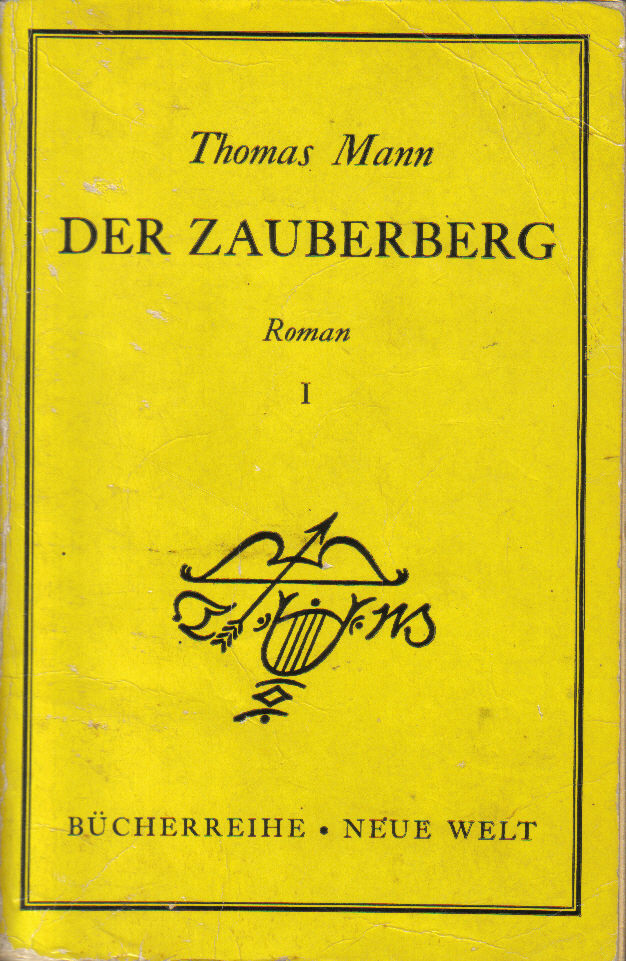
In this respect he was an ideal partner for the Neue Welt series, with access to a prestigious list of German language authors and titles, which were precisely those most attractive to the American authorities with re-education and de-Nazification in mind. The titles appearing in the series with copyright from Bermann-Fischer included the classic First World War novel Im Westen nichts Neues (All quiet on the Western Front) by Erich Maria Remarque, Der Zauberberg (The magic mountain) by Thomas Mann, and two other titles by Mann, who was living in exile as a result of his opposition to the Nazis. There was also a volume of the work of Heinrich Heine, one of the greatest German poets, but disowned by the Nazis as a result of his Jewish ancestry and works by Joseph Roth, Leonhard Frank, Carl Zuckmayer, Franz Werfel, Arnold Zweig and Vicki Baum, all disapproved of by the Nazis for one reason or another. Fiction volumes had a yellow cover and the few non-fiction volumes were in blue.


Works by German and Austrian authors were supplemented by a small number of English language books in translation, including works by Joseph Conrad, Ernest Hemingway and William Saroyan amongst others. These too were carefully selected for the ‘right’ political message. Volume 1 in the series, Amerika by Stephen Vincent Benét, was a specially written history designed to show the United States in the light that it wanted to be seen, and certainly came close to propaganda. Benét, an established writer who had died in 1943, had been working for the Council for Democracy and he himself referred to much of his work in this period as propaganda. Perhaps more oddly from a modern perspective, volume 23, Jenseits des Ural (Beyond the Urals) by John Scott, came close to propaganda for the Soviet Union, then America’s ally in the war.


Importantly the books were not given to German Prisoners of War, they were offered for sale in the camp canteens at a price of 25c. A relatively low price and perhaps subsidised, but the distinction that the books had to be bought was an important one for the American authorities, sensitive about the re-education aims of the series and its American connections. There was though a clue in the ‘New World’ title, that this was a series looking forward to a post-war world and by Spring 1945 when the books appeared in POW camps it was clear that that new world would have no place for the Nazi lists of banned books.
There is little doubt that the books found their target market. Unlike Penguin’s UK POW Editions, almost all the copies I have seen have censor stamps and other evidence of ownership by German prisoners. And indeed they seem to have been welcomed, with reports of camps requesting extra copies and of the books ‘being read widely and passed around’.


The initial printing was 10,000 copies of each volume, so 240,000 volumes overall. Not quite all were sold by the time the last prisoners departed in 1946 – at least 8,000 copies were distributed free to departing POWs and some surplus copies were sent to Europe for use by civilians. But to sell anything like 200,000 volumes to a POW population of under 400,000 must be seen as a success.
There was little credit for Penguin in the US, but Kurt Enoch must have been pleased with the results. Whether Allen Lane was pleased, or even knew anything about it is more doubtful. He was generally reluctant to give much credit to a business that he saw as not fully in line with Penguin’s brand and values. Perhaps on this occasion though, if he was aware of it, he may just have paused to reflect on his own earlier failure in the POW market.

The grim story behind a beautiful book
Many of the volumes in my collection of Tauchnitz Editions are frankly in poor condition. I always give priority in the collection to first printings in the original wrappers. A tatty paperback copy with the wrappers in the earliest possible state is preferred to a later copy in fine condition. Paperback first printings are given priority over copies that have been rebound in glorious leather bindings. Sadly time rarely does much to enhance the condition of paperbacks and once they are 100 or 150 years old, or even more in the case of some Tauchnitz Editions, there are few copies that can really be described as beautiful. So as I acquire more first printing paperbacks to ‘improve’ the collection, the condition and appearance of the books in it tends to get worse.

Rare paperbacks do not always improve the look of the collection
I have occasional pangs of regret about this. I may have acquired a rare 1st printing paperback, perhaps the only known 1st printing copy in the original wrappers, but it’s almost inevitably in less than perfect condition and to make room for it in the collection I have to displace a beautifully bound volume. Keeping both may be a temptation, but there are over 5000 volumes in the series and space is limited.
Just occasionally I give in and this is one such case. I have first printing paperback copies of volumes 3789 and 3790, the two volumes of ‘The prodigal son’ by Hall Caine, first published by Tauchnitz in January 1905. The bibliography records just two other known copies in first printing wrappers, so the copies I have are both rare and, for their age, in pretty good condition. But still I can’t let another hardbound copy go.

Partly because it’s physically a beautiful book. The bookbinder has taken the two paperback volumes, stripped the wrappers off and bound the two together in a luxurious full leather binding. He (almost certainly he) has had the decency to keep the half-title and title pages of each separate volume and bind them in. Many bookbinders stripped those as well and without them copies are almost impossible to date. All the edges have been neatly trimmed (again not always the case) and the top edges have been gilded. The spine has five raised bands with the author and title in gilt between two of them and small leaf decorations in gilt in each of the other sections of the spine. There are decorative borders in gilt on both front and rear boards and the owner’s crest and motto in the middle of the front board.


Remember these started off life as relatively cheap paperback volumes, costing 1.6 Marks each (equivalent in the British currency of the time to about three shillings for the two volumes). The binding must have cost much, much more than that. The owner must nevertheless have judged that it was worth the expense, perhaps not just to make the book more durable, but also to achieve a consistent look to the books in their library. And although sold as paperbacks, the paper used for Tauchnitz Editions was of reasonable quality, in the expectation that some owners would choose to have their copies bound.

So who was this owner who went to such expense? The crest on the front board is for the Forbes family and the Earls of Granard, from Ireland, featuring bears and the motto ‘bear and forbear’. The bookplate on the front pastedown identifies the owner though as May von Weinberg and for good measure ‘Madame von Weinberg’ has been handwritten on the first title page.

Bronze bust of May von Weinberg by Alexander Archipenko (1913)
May von Weinberg was born in Plymouth in 1867 as Ethel Mary Villiers Forbes. In 1894 she married Carl von Weinberg, a German businessman from a Jewish family in Frankfurt. Carl and his brother Arthur von Weinberg were partners in a chemical company that later became part of IG Farben. May herself became well-known as a patron of the arts and philanthropist in the Frankfurt area.

She converted to Catholicism in 1915 and her bookplate is based on religious imagery. A winged child looks at an open book with her name in it and the Latin phrase ‘dum vivam et ultra’ (during life and beyond). Buildings in the background are the dome of St. Peter’s and the Castel Sant’Angelo in Rome. Below are the coats of arms of her own family and her husband’s family beneath a crown. The von Weinberg shield features cornflowers and the decorative border on the front and back boards of the book includes flowers possibly intended to represent cornflowers.

And just to cap it all, each of the two volumes has been separately signed by the author, Hall Caine and dated 31st January 1909 in St. Moritz,. Presumably he signed them when they were still two separate paperback volumes, possibly newly bought on holiday in St Moritz, before Madame von Weinberg had them bound on returning home. Possibly even, she only had them bound so luxuriously because they had been signed by the author and in remembrance of their meeting there.

The library at Villa Waldfried, home of Carl and May von Weinberg
May von Weinberg died in 1937 and then in 1938, because of his Jewish descent, her husband Carl was forced to sell his house and art collection to the City of Frankfurt for a fraction of its value. That may have included this book, which contains a small cataloguing label dated 1941. There was a restitution of property to the family after the war.
Carl von Weinberg went into exile in Italy, where he died in 1943. IG Farben, of which he had been a Board member, was broken up after the war, having been used to produce the poison gas used to kill over 1 million people in the gas chambers.

Erste Lieder von Gabriele – an unusual Tauchnitz
The books published by Bernhard Tauchnitz were mostly cheap editions, nineteenth century paperbacks published at M1.60, a price equivalent to 1s 6d in the UK. So it’s unusual to see a book produced by the firm that is clearly an expensive production. ‘Erste Lieder von Gabriele’, a slim book of poetry, is bound in smart blue cloth with a very decorative border, blind-stamped on the rear and lavishly covered with gilt on the front. It has floral patterned endpapers and all edges finished in gilt. The paper is of high quality and the margins are very wide. It’s a beautiful book.

The title page of the book shows only the title ‘Erste Lieder’, with no author’s name, no date of publication and no publisher’s name. That it is produced by Bernhard Tauchnitz is evident only from the colophon ‘Offizin Bernhard Tauchnitz’ at the end. And that the author is a mysterious Gabriele is evident only from the front cover.
All is made clear though by the handwritten dedication in the copy I have, which is signed by Gaby von Minckwitz. She was the daughter of Christian Carl Bernhard Tauchnitz, the second Baron Tauchnitz, and the grand-daughter of Bernhard Tauchnitz, the founder of the firm. The book seems to have been produced in 1887, as it is dedicated to her grandparents on their 50th wedding anniversary in that year and starts with a poem to mark that occasion. Perhaps the book was produced on instructions from her father and kept secret from her grandfather until the day of the anniversary.
Gabriele was just 17 at that time in 1887 and the poems are dated from 1882 to 1887, so written between the ages of 12 and 17 (although in her dedication she suggests between 14 and 17). I guess not many 17 year olds in those days could get their teenage poems published, especially in such a beautiful little book, but it’s very convenient if your family owns a publishing firm. I’m not capable of judging whether the poems have any merit or not, but I guess that’s not really the point. I’m sure Bernhard and Henriette Tauchnitz were delighted with them.
I assume this was a privately produced book in a limited edition, never published or made available for sale, although there is no indication of how many copies may have been produced. As the dedication in my copy is signed Gaby von Minckwitz, a name she did not acquire until after her marriage in October 1892, presumably she had a small stock of these books that she gave out to friends for several years after 1887. It wouldn’t surprise me to find that almost all copies of the book have a personal dedication from her in them.

Incidentally, in a preface to a 2017 book on Tauchnitz (‘Baron der Englischen Bücher – Der Leipziger Verlag Bernhard Tauchnitz 1837 -1973’ – Melanie Mienert et al), Gabriele’s wedding to Hans von Minckwitz in 1892 is recalled. Their great-grandson, Jochen von Osterroth, writes that no expense was spared on the wedding breakfast and that over 60 years later when he was a child, Gabriele was still raving about the culinary experience of the meal. He also mentions the poetry book (although oddly under a different title) and notes that she did later have a second small book of poems produced, although this seems to have been not until 1925.

Penguin’s Prisoner of War Editions
Penguin‘s first venture into wartime publishing for the services, the Forces Book Club, was a pioneering move, but was nevertheless a major failure. Having aimed to sell 75,000 subscriptions, the firm ended up with fewer than 10,000 and with a lot of spare books on its hands. With paper rationing in force, books could not be wasted, so some other use had to be found for them. And so was born the Penguin Prisoners of War Books Service.

The basic idea was a variant of the Forces Book Club (FBC) subscription system. In return for an annual subscription payable in advance (or six monthly or quarterly subscriptions pro rata), Penguin would supply to an individual Prisoner of War, a monthly selection of ten books chosen by Penguin, providing a total of 120 books over the year, just as for the Forces Book Club. The subscription fee was slightly higher, three guineas rather than three pounds, with the difference possibly due to the fact that subscriptions could be sent through any bookseller. This is a guess, but three guineas would have allowed for the bookseller to be paid three shillings (basically a 5% commission), if Penguin retained three pounds as before.
That was the key difference here. For the Forces Book Club, subscriptions were only accepted from units of the services, with no individual subscriptions, whereas for the POW scheme it was individual subscriptions that were being sought, presumably from relatives of the prisoners.
But the scheme was no more successful than the Forces Book Club and may even have been less successful – in other words, an even bigger disaster. I don’t know how it was marketed, or even how you could market it, other than through the authorities who were in contact with the relatives of prisoners. The only Penguin advertising I have seen is inside the books themselves, where it would be seen only by the prisoners who were already receiving them. It might have been more useful to advertise them in books sold in the UK, where the potential customers for the scheme were (see comment added below for an example of this having been done).
I suppose some local booksellers might have known which of their customers had a relative imprisoned and could have pushed sales to earn that commission. But if the marketing was difficult, the even bigger flaw still seems to be the choice of titles. That choice was entirely up to Penguin and in practice the selection was much the same as for the Forces Book Club, because one of Penguin’s main aims was to use up that spare stock.
The mix seems unlikely to have been suitable for anyone, with books on history, poetry, science, maths, politics, design, music, biography and literature alongside crime stories and middlebrow fiction. Granted that prisoners would have had plenty of time for reading and for self-education or self-improvement, but still the list seems likely to have tested anyone’s patience.
Most of the books, perhaps 80 to 90% of them, are clearly from the FBC printing, as shown by the printing history and by the publisher’s imprint, which is usually ‘Published by Penguin Books for The Forces Book Club’. They have been rebound with a standard Penguin front cover, with standard Penguin numbering, but are identifiable by the back cover, headed ‘A Selection’ and by the inside front cover, which has a blurb on the Prisoners of War Book Service, as shown above. So to take one example, Profiles from ‘The New Yorker’ was first published by Penguin as part of the Forces Book Club selection for November 1942, the second month of that scheme. It was then published in the main Penguin series as volume 376 in January 1943, and at some point, probably later in 1943, spare copies of the FBC printing were rebound in POW format bindings with the series number 376. The book block was clearly printed in 1942, but the covers carry a series number that was not allocated until 1943.


Forces Book Club Edition (left) and Forces Book Club pages rebound in POW format binding
One of the clearest pieces of evidence though that the scheme was not a success is that almost none of the surviving books in the POW format have ever been inside a Prisoner of War camp. Lots of surviving Forces Book Club editions have stamps or stickers on them showing evidence of service use. Lots of surviving Services Editions from 1943 to 1945 have evidence of service use. Surely any book that ever made it into a Prisoner of War camp would have stamps, stickers or censor marks. And yet not a single one of the Penguin POW editions in my collection has any such evidence and I have never seen one that does. For comparison the gallery below shows evidence of POW use on similar books provided to German POWs in US camps.


There are POW Camp stamps on almost all books in the Neue Welt series, produced for German POWs in US Camps
On the other hand, several of them have contemporary evidence of having been owned by civilians. Others appear to have been sold in bookshops, possibly abroad. I have one with a small ’50c’ stamp to the front cover, another with a ‘Selling Price Frs. 10’ to the back. It seems likely that after the failure of both the Forces Book Club and POW schemes, Penguin had to find other ways to dispose of them.


Two POW editions showing evidence of having been sold abroad
I don’t doubt that Penguin did succeed in selling a few subscriptions to the scheme and that some books did make it through the censors and survive with evidence of having done so, but I feel pretty sure that it was a very small proportion of them. I’d be interested to see any such examples, and it feels as if there ought somewhere to be a complete series of them, all stamped from the same POW camp and having survived together on a shelf in a hut somewhere, until the camp was liberated. One of the oddest things though is that the series included at least two books – ‘The escaping club’ by A.J. Evans (vol. 202) and ‘The tunnellers of Holzminden’ by H.G. Durnford (vol. 286) that could never have made it past a POW camp censor. I would be utterly astonished if anyone could produce a copy of those two books with POW camp stamps on them.


Editions in POW format, but surely never allowed in to a POW camp
I am not aware of any definitive list of which books appeared in POW editions, or how they were grouped into monthly selections. As Penguin invited annual subscriptions, it seems likely that 120 books were produced in this format and the most complete list I have seen, has just short of this number of titles on it. As with the FBC editions, copies are now rare and given the number of Penguin collectors with an interest in them, most are also likely to be keenly sought after and potentially expensive to buy.

A finger in every pie – even some mouldy ones
Historian, traveller and travel writer, exhibition organiser, lawyer, editor, novelist and … white supremacist. William Hepworth Dixon (1821 – 1879) wore many hats in his lifetime and donned several of them for his relationships with the Leipzig firm of Tauchnitz.
He would probably not have been at the top of my list of authors to write about, if I had not recently acquired a letter to him from Baron Tauchnitz, of which more later. The letter was enough though to pique my interest in this rather odd Victorian literary celebrity, who spread his talents over a wide range of interests.

William Hepworth Dixon (courtesy of the National Portrait Gallery), seemingly aiming for the ‘grand old man of letters’ look that Dickens had pioneered
Dixon eventually became best known as a historian and travel writer, but one of his first claims to fame was as one of the organisers of the Great Exhibition of 1851, held at the Crystal Palace. He was then, for 16 years from 1853, Editor of the Athenaeum, a literary magazine, somehow also finding time to be called to the Bar in 1854, although never practising.
Various historical publications followed, in which he seemed to delight in criticising the work of other, perhaps more established, historians. Biographies of William Penn and of Admiral Robert Blake (neither published by Tauchnitz) were followed by a major study of Francis Bacon, for which he was granted permission to inspect the ‘State Papers’ that had previously been kept from public view. As a result and as a prelude to his own work being published, Dixon published four articles in the Athenaeum, criticising John Campbell’s ‘Life of Bacon’ that had appeared in 1853. Dixon’s own ‘Personal History of Lord Bacon’ came out in 1861 and was published in the Tauchnitz Edition shortly afterwards (vol. 549).

The Dictionary of National Biography notes however rather tersely that ‘Dixon’s books upon Bacon obtained wide popularity both at home and abroad, but have not been highly valued by subsequent investigators’.
His next involvement with Tauchnitz came rather indirectly through the publication of Lady Morgan’s Memoirs in 1863 (vols. 637 to 639). Sydney Owenson Morgan was an Irish writer, best known for her 1806 novel ‘The wild Irish girl’. She had died in 1859, leaving her memoirs incomplete and naming Dixon as her literary executor. In practice though, her friend Geraldine Jewsbury had been most closely involved in the preparation of the memoirs and continued with this work after Morgan’s death, with Dixon in his preface to their publication denying any significant involvement.
So his own next work to be published in Tauchnitz was a travel memoir of Palestine, published in 1865 as ‘The holy land’ (volumes 797/798), to be followed two years later by one on the United States as ‘New America’ (vols. 928/929)

‘Spiritual wives’ in 1868 (vols. 985/986) went off in a different direction, exploring, apparently seriously, the religious concept of wives with whom one had a spiritual rather than a physical connection, although the two could allegedly co-exist with several women simultaneously. In part it dealt with Mormonism and was accused of indecency, a charge which Dixon responded to by bringing a libel action against the Pall Mall Gazette. He won his case, but was awarded symbolic damages of one farthing.

Volumes 3 and 4 of ‘Her Majesty’s Tower’ in the original paperback form
Another historical work, ‘Her Majesty’s Tower’, a history of the Tower of London and some of its famous prisoners, came next, although spread out over four volumes in a two year period between 1869 and 1871 (vols. 1007, 1079, 1141 and 1142) and then another travel memoir, this time of his travels in Russia.
It was in connection with this publication that Baron Tauchnitz wrote to Dixon in August 1872, thanking him for passing ‘Free Russia’ to the firm for publication ‘at the usual terms’, which Tauchnitz interpreted as meaning for a payment of £60 (for a two volume work). He writes rather effusively, “It is a real pleasure to me to see our relations re-established by the publication of ‘Free Russia’ – for me personally and for my series, not to miss a name like yours!”

Tauchnitz had good reason though for being very pleased. The rival Asher’s Collection had been launched earlier that year and his business was in some quite serious competitive danger. His reaction was to redouble his efforts and publish a record 98 volumes in 1872, which must have taken some doing at a time when he was being deserted by many of his authors. A new two volume work from an established author that came with no request for higher payment, was exactly what he wanted. It appeared as volumes 1272/3 towards the end of the year. Even better, Dixon followed it up with his ‘History of Two Queens’ about Catherine of Aragon and Anne Boleyn, to be published in six volumes – three in 1873 and three in 1874 (vols. 1320-1322 and 1393-1395). If any medals were to be awarded in the Battle of Asher’s Collection, then WH Dixon surely deserved one.
Although there were still to be some later skirmishes, that battle was largely won by 1876 when Dixon’s next work appeared in the series. ‘White Conquest’ (vols. 1549/50) was another travel memoir of the USA, tied up with a white supremacist bow. After a penultimate chapter predicting an end to to the immigration that had fuelled America’s growth (‘Shoals of emigrants are going back to Europe, and still greater shoals would go back if they had the means’), the book concludes with an appeal to the solidarity of the white race. ‘If we desire to see our free institutions perish, it is right that we should take the part of Red men, Black men, and Yellow men against our White brethren. If we wish to see order and freedom, science and civilization preserved, we shall give our first thought to what improves the White man’s growth and increases the White man’s strength’.
Despite these rather nasty and brutish sentiments, presumably less exceptional at the time than they seem now, Tauchnitz wrote to Dixon in November 1875 – ‘Being desirous to include your new work “White Conquest” in my series, I shall feel obliged to hear from you whether you are disposed to agree with me and at what terms’. The letter, very similar in format to that above, is shown in the Todd & Bowden bibliography of Tauchnitz.

And that leaves just one more work and another slightly odd twist, this time to a work of fiction. ‘Diana, Lady Lyle’, published as volumes 1699/1700 in 1877, was Dixon’s first novel – a hardly genre-busting tale of a wealthy and beautiful young woman, married to an older husband but drawn to a young artist. It was not his last novel, although it was the last of his works of any type to be published in the Tauchnitz series.

As usual, Tauchnitz volumes come in a huge variety of bindings
Over a period of nearly 20 years, WH Dixon had nine works (not counting Lady Morgan) in a total of 23 volumes, published by Tauchnitz, a more than respectable number, even if some of them were of less than respectable quality. And in yet another example of the almost interminable relationships between Tauchnitz authors, his daughter Ella Hepworth Dixon also achieved that status, with two books published by Tauchnitz in 1895 and 1904.

Fight for Freedom
During the Second World War there was huge interest in international politics and the progress of the war and publishers of course reacted by providing books on these subjects. All the main paperback publishers in the UK launched series of non-fiction books on war-related subjects. Probably the best known series was the Penguin Specials, which sold in huge numbers during the run up to the war and its early stages.
Hutchinson also provided a series of ‘Pocket Specials’, with less obvious series branding than the Penguins, but eventually running to around 15 titles. Alongside these it also published a series of small booklets on behalf of the Fight for Freedom organisation. Between 1942 and 1945 this series included at least 18 pamphlets, mostly around 60 to 80 pages. The Editorial Board for the Fight for Freedom group is shown in each book, although there is no other explanation of who they were or what their aims were. A symbol of a broken swastika on the back cover suggests they were anti-nazi, but in early 1940s Britain that hardly marked them out.

In practice Fight for Freedom was a socialist group and the editorial board brought together prominent socialist expatriates from Germany, Poland, Czechoslovakia, Spain, Holland and Belgium with representatives of the British Labour Party and Trade Unions. Perhaps its most distinguished member was Camille Huysmans, who after the war became Prime Minister of Belgium, while its British members included Rennie Smith, a former MP, John Brown, a trade unionist and Mary Sutherland, a Labour Party administrator and Chief Women’s Officer.

Later on Curt Geyer was replaced by Walter Loeb, and Rennie Smith by W.W. Henderson, another former Labour MP and son of the former Labour leader, Arthur Henderson.
Britain was at the time host to quite significant numbers of exiles, both from the countries occupied by Germany and from Germany itself. Most of these exiles were of course strongly anti-Nazi, although many were nonetheless for a period interned by Britain as ‘enemy aliens’. But there was still room for a lot of very different views about what should happen in the future in respect of Germany and other European countries. And there was still the small matter of a war to win first as well.
On the left, a lot of socialists and communist sympathisers felt that the Nazis were capitalist oppressors of the working people of Germany, who should rise up in revolution once the war was over. Their argument was with the German Government, but not the German people. But others, more in the social democratic tradition, considered that not just Germany, but Germans, had made bad choices that had taken the country in a direction that was not consistent with the true German spirit. They effectively accepted that the Nazis had become a mass movement and not simply an oppressive elite. After the war, re-education of the German people, not revolution, was the answer. This seems to have been the guiding spirit of the Fight for Freedom group. It may have been a popular view amongst non-German exiles in the UK, but it was probably not the majority view amongst German Socialist exiles, including even figures such as Willy Brandt, later Mayor of West Berlin and German Chancellor. Many German socialists and communists kept their distance from this group.


The position is laid out in the first book, issued in April 1942, ‘Hitler’s new order, Kaiser’s old order’ by Curt Geyer. The book aimed to show parallels between the foreign policy of the Kaiser leading up to World War 1 and that of Hitler leading up to World War 2. In his preface Geyer says ‘It is most important to realise that these were not only the ambitions and ideas of German Governments, but also the ambitions and ideas of the German people’.
It became even clearer, and also more personalised, in the third book of the series, ‘Gollancz in German Wonderland’ by Curt Geyer and Walter Loeb. Victor Gollancz was a British publisher from a German / Polish Jewish background, the publisher of the Left Book Club, and had been closely allied to the Communist Party. In late 1941 he had published a pamphlet ‘Shall our children live or die?’, as a response to another book, ‘Black Record’ by Lord Vansittart that had been seen as anti-German rather than anti-Nazi. Geyer and Loeb’s book attempted in turn to respond to Gollancz’s response.


It also led to the group being labelled Vansittartist, which was shorthand for a set of views they may have generally shared, but the description was probably too simplistic. Vansittart was best known for his strong opposition to appeasement and to German militarism, but his anti-German views were at times extreme and unlikely to have been representative of the views of German exiles.
Quite what the publisher, Walter Hutchinson, made of all this is unclear. He was not a socialist himself, far from it, and in publishing their booklets, he was not endorsing the views of the Fight for Freedom group. But he may have been amused by the way that it put him in direct opposition to the rival publisher, Gollancz.


By the end of 1942 the group had published six booklets and was announcing an ambitious programme of future publications. Perhaps not surprisingly, several of the books announced never materialised, and others changed titles and authors. As one example an early announcement publicised a book to be called ‘Judges in arms’ by Wilhelm Danziger. Later announcements, showed the same title with the author as ‘Prosecutor’, and later still it was shown as by Kurt R. Grossmann. So far as I can tell, the book never appeared.


The series continued to expand and prosper though, increasing to about twelve titles by the end of 1943, looking at various aspects of German politics, and mostly written by German socialist authors. Gradually authors of other nationalities were added, particularly to look at the position of their countries in relation to Germany, including Norway, Poland, Belgium and Czechoslovakia. Planned books on France and the Netherlands seem not to have appeared. Throughout, the editorial direction remained very clearly socialist and anti-communist.


The price of the books had increased from sixpence to one shilling in mid 1942 and increased further to 1s 6d in 1944. The front covers continued to show a wide diversity of styles and the relatively consistent typography of the early covers disappeared, so that other than a strapline at the bottom of the front cover, the rear cover with its broken swastika logo is really the only consistent series branding.


Some of the later books exist in simple hardback editions, which appear to have been produced directly by the publisher rather than constructed afterwards by bookbinders or libraries, and at least one of them ‘About Belgium’ was issued in a full hardback edition, with dustwrapper, selling for 3s 6d. The final books appeared in 1945 and with the ending of the war, the series too came to an end. I can find evidence of eighteen titles, all pictured here, but I have never seen a comprehensive list elsewhere and it’s possible that there are others.


Women authors in Tauchnitz 1865 – 1890
I ended my previous post by posing three questions: Why was the overall proportion of fiction written by female authors so high between about 1865 and 1890? Why was it even higher in Tauchnitz? And why, in both cases, did it decline so clearly and so durably after 1890, at a time when prejudice against women was, at least in most fields, thought to be reducing? The data underlying these questions is shown in charts in that previous post.
In Chapter 1 of ‘The Cambridge Companion to Victorian Women’s writing‘ Alexis Easley writes ‘Throughout the century, it was challenging for women to find success in a male-dominated literary marketplace. Women who chose the literary life often faced social censure, received substandard pay, and fell subject to a critical double standard‘. On the face of it that seems little more than a statement of conventional wisdom. But the data in my previous post suggests that between about 1865 and 1890 works by female authors were actually in the majority. Is that consistent with a male-dominated literary marketplace? Was there really prejudice against women writers?

George Eliot
George Eliot certainly thought so. But in her essay, ‘Silly novels by Lady Novelists’ written in 1856, her complaint was not that it was too hard for women authors to be published, more that it was too easy. Many novels by women were too frivolous, too pious or too ridiculous to be taken seriously and a prejudice therefore existed, which made it hard for any female novelist to be taken seriously. For herself she chose a male pseudonym in order to counter this prejudice, as the Bronte sisters had chosen names of indeterminate gender. For George Eliot, prejudice against women authors was entirely consistent with large numbers of works by women being published. It was a matter of quality, not quantity.
So who were the female authors being published and what type of literature were they writing? The leading female authors in the Tauchnitz series between 1865 and 1890 are as shown in the table below, together with the number of volumes in that period (sometimes more than one volume for a single novel).

All of these women writers were in their day popular and widely read, in Britain as well as in the Tauchnitz series. Most of them still have their admirers today and many of their books have been brought back into print. Nevertheless it is probably fair to say that they are not the names that most people would think of first if asked to name Victorian female authors. Better known names such as George Eliot, Mrs. Gaskell, Louisa M. Alcott and Frances Hodgson Burnett are much lower down in the list, each with fewer than 10 volumes.


Mary Elizabeth Braddon, Florence Marryat (courtesy of National Portrait Gallery) and Margaret Oliphant (also courtesy of NPG)
But even if some of the authors above were not of the highest literary quality, they were not the ones that George Eliot was taking aim at. Several of them were writing what was known as ‘sensation’ fiction – stories that hinged on hidden secrets, often involving bigamy, secret illegitimate children, crimes or other ‘shameful’ episodes in a hidden past. Mary Braddon and Ellen Wood were two of the leading authors in this genre, but alongside male authors such as Wilkie Collins, James Payn and Charles Reade.
Florence Marryat and Ouida also wrote sensation novels, which were at the peak of their popularity in the 1860s and 1870s, but Margaret Oliphant was very much a critic of this type of literature and a particularly stern critic of some of her fellow female authors. Her own works were better described as ‘domestic realism’ and like the novels of Charlotte Yonge, were concerned to carry the right moral and religious message, that heroes or heroines should be virtuous, that good deeds should in the end be rewarded and wickedness punished. There was room in the popular literature of the 1860s, 70s and 80s for that type of writing as well as sensation novels. There was room too for Margaret Hungerford’s sentimental romances and also for supernatural fiction, a genre which brought Margaret Oliphant together with Florence Marryat and Mary Elizabeth Braddon.

Sensation novels were by no means the only area in which women novelists excelled. But it is probably still true in broad terms that sensation novels were an area where female authors were particularly prominent and perhaps an area where they could escape the prejudice that they might face in attempting to have more literary work published. And the same is probably also true of stories carrying a strong moral or religious message, such as those of Charlotte Yonge. So the popularity of these genres does in part explain the prominence of female authors in this period. But why was the proportion even higher in Tauchnitz?

The Tauchnitz market was rather different from the general UK fiction market. In fact Tauchnitz sold to two quite distinct markets. One was British and American travellers and expatriates in continental Europe, accessed through station bookstalls and specialist English language bookshops. The other was local nationals in European countries who could read English or were learning to do so. Customers in each of these markets would have been relatively well off and may have had different tastes from the wider public who borrowed from circulating libraries or bought cheap reprints in the UK. Sensation novels certainly sold well on the Continent and may have been one reason for the high proportion of female authors in Tauchnitz.
A direct comparison is available though with one of the principal competitors of Tauchnitz – Asher’s Collection of English Authors. This series ran from 1872 to 1892, right in the period we’re talking about here. It published far fewer volumes than Tauchnitz, but was choosing from exactly the same pool of works published in the UK and the US as Tauchnitz was and there was a lot of overlap in their authors. Of the 276 volumes in the Asher series, just 104, or 38%, were by female authors. This rather suggests that there was something specific about Tauchnitz, rather than about its market.

Could that have been the personality of Bernhard Tauchnitz, founder of the firm? Certainly he maintained cordial relationships with all his authors and seems to have been equally attentive to both male and female writers. He kept files of correspondence with authors and selections from them, quoted in various anniversary histories, show a mutual regard. As one example, I have in my own collection a letter that Tauchnitz wrote to Charlotte Yonge, one of the authors referred to above, in which he is at pains to assure her that “It will give us always a great satisfaction to include your forthcoming books in our Collection, always at terms quite convenient to you”.

My dear Miss Yonge …
He was also generous with his hospitality, frequently inviting authors to Schloss Kleinzschocher, his estate on the edge of Leipzig. One such visit was recalled later in life by Matilda Betham-Edwards. She had first visited as a young writer, even before becoming a Tauchnitz author, with a letter of introduction from George Henry Lewes, better known as the partner of George Eliot. Tauchnitz had then entertained her and accompanied her to see ‘Lohengrin’ at the Leipzig Opera. Whilst travelling on the Continent ten years later, she was invited again and was clearly charmed by him.

Schloss Kleinzschocher
No doubt many other publishers enjoyed cordial relations with their authors. Tauchnitz may not have been exceptional, but he was very good at it and this seems to have been the case equally for male and female authors. So his personal attitudes and relationships may explain in part the high proportion of female authors in Tauchnitz and it is notable that it was lower after his death in 1895.
It seems possible then to get some explanation of why there were so many female authors in the period from 1865 to 1890 and perhaps even why the proportion was higher in the Tauchnitz series. The prevailing literary fashions were in areas where women authors were particularly strong. Both publishers and readers may have had prejudices about the type of fiction they expected from women and even what was appropriate for women to be writing. But when those prejudices coincided with what was in fashion, there was no bar to women authors being published and being very widely read – far from it. If the type of fiction that was being read, was being written by women authors and readers were happy to read novels by women authors, as they undoubtedly were in this period, then publishers were more than happy to publish them.

And it seems, none more so than Bernhard Tauchnitz. It seems unlikely that he was any feminist in the modern sense of the term, but he was very alert to what would sell in the market he was serving and to who was writing it. He had no prejudice that would favour male authors, just a prejudice in favour of publishing the books that would sell best in his market and best maintain the critical standards that he set for the series.
What then happened after 1890? The charts in the previous post showed a clear decline in the proportion of books by women authors, both in the overall fiction market and specifically in the Tauchnitz series. By some measures it continued from about 1890 until 1970 before turning round, and it took almost 150 years to return to the parity that women first achieved around 1865.
I have already noted one change for Tauchnitz, that Bernhard Tauchnitz died in 1895. There was also a major change in the UK fiction market in 1894 with the abandonment of the three-decker system that amongst other effects, led generally to shorter novels. Fiction magazines, that had provided many opportunities for female authors, both new and established, were starting to decline around this time. Could these changes go some way to explaining the new trend?
There were of course developments in literary fashions too. Sensation novels were gradually being replaced by a new fashion for the kind of adventure novels being written by Arthur Conan Doyle, E.W. Hornung, Anthony Hope, Rider Haggard, Robert Louis Stevenson and other, mostly male authors. Were readers less willing to accept this type of novel from female authors, or women less interested in writing them? Crime novels were also becoming more popular, mostly by male authors to start with, but a host of female crime writers were about to burst onto the scene. In any case, the decline was to last longer than any literary fashion. Perhaps many other opportunities were starting to open up for women that were more attractive than the relatively solitary, and often poorly remunerated, life of a novelist. Or perhaps simply the generation of Mary Elizabeth Braddon and Ellen Wood was exceptional and was not replaced by younger authors.
None of these explanations seem entirely satisfactory. I have been unable to find any very convincing explanation, and to some extent without this, there must be some doubt about whether the explanations put forward for the earlier period have much merit. But regardless of the underlying explanation, I am still happy, as an enthusiast for the Tauchnitz Editions, that in this respect as in so many others, Bernhard Tauchnitz seems to have been well ahead of his time.
Note: This post and the preceding one have been based on a longer paper entitled ‘A highpoint for female equality in the Victorian period? Women Authors in the Tauchnitz series 1865 -1890’. The paper is unpublished, but a copy can be obtained by contacting me through the ‘About Al’ page.
 paperbackrevolution