<?xml version="1.0" encoding="utf-8"?>
<feed xmlns="http://www.w3.org/2005/Atom">
  <title>Notes</title>
  <subtitle>Notes from the desktop</subtitle>
  <link href="https://notes.autiomaa.org/feed.xml" rel="self"/>
  <link href="https://notes.autiomaa.org/"/>
  <updated>2022-02-01T21:00:10Z</updated>
  <id>https://notes.autiomaa.org</id>
  <author>
    <name>Daniel Schildt</name>
  </author>
    
    <entry>
      <title>Lack of privacy</title>
      <link href="https://notes.autiomaa.org/blog/2022-02-02-lack-of-privacy/"/>
      <updated>2022-02-01T21:00:10Z</updated>
      <id>https://notes.autiomaa.org/blog/2022-02-02-lack-of-privacy/</id>
      <content type="html">
        <![CDATA[
          <p>Happened to see a tweet from a lawyer and business law researcher:</p>
<blockquote>
<p>“Presently and for thousands of years, individuals are/have been able to transact with cash anonymously, and do not need/have not needed to sign-up or provide their identity in order to make transactions with public money. Eliminating that capacity in the digital age is extreme.”</p>
<p>— Grey, Rohan. <a href="https://twitter.com/rohangrey/status/1484251954167500802">@rohangrey</a>. Message thread. Twitter. 2022-01-20 at 21:50.</p>
</blockquote>
<p>I wrote a personal <a href="https://twitter.com/autiomaa/status/1488557398876999683">Twitter thread</a> about the problem of thinking cash would be anonymous.</p>
<ul>
<li>Problem with payments is that almost everything can (and will) be tracked, regardless of the original intentions. <strong>Paper money is not anonymous either</strong>, because every piece of paper has a serial number that is used to track who takes it from ATM, and where it ends up to. <a href="https://twitter.com/autiomaa/status/1488557398876999683">Tweet</a></li>
<li>It would be naive to think that banks wouldn't keep track of who pours out pieces of paper from ATMs. Similarly, most bigger <strong>cash payments at grocery stores are validated by sending the serial number</strong> of a paper money to the banking systems. There is always tracking of usage flow. <a href="https://twitter.com/autiomaa/status/1488558322546524164">Tweet</a></li>
<li><strong>Cash is a contract between institutions.</strong> Organizational stability requires some level of tracking to maintain a stability of systems. Same applies to digital payment systems, regardless of what people call them. Question is mainly about who controls what, not about if it's done. <a href="https://twitter.com/autiomaa/status/1488559401199935494">Tweet</a></li>
</ul>
<p><a href="https://rohangrey.net/about/">Rohan Grey</a> reacted strongly:</p>
<blockquote>
<ol>
<li>not true of coins</li>
<li>only trackable once they return to banks</li>
</ol>
<p>— Grey, Rohan. <a href="https://twitter.com/rohangrey/status/1488563535294570496">@rohangrey</a>. Message thread. Twitter. 2022-02-01 at 19:22.</p>
</blockquote>
<p>I tried to expand on the problems.</p>
<ul>
<li><strong>Coins have very limited value.</strong> It costs tons of money to transport &amp; count them. That cost is essentially limiting the risk of financial fraud. If same principle would be applied to digital (&quot;distributed&quot;) systems, the cost of payment would be much bigger for small transactions. <a href="https://twitter.com/autiomaa/status/1488571386541006850">Tweet</a></li>
<li>Serial numbers are validated with cash verification devices before shops accept cash bills (above certain amounts). Risk management allows small payments because it doesn't cause large volume losses. That doesn't apply to automated transactions because digital fraud is easier. <a href="https://twitter.com/autiomaa/status/1488572159106691074">Tweet</a></li>
</ul>
<p>Rohan replied:</p>
<blockquote>
<p>“Historically they were used for all sorts of denominations not just small denominations, and again, paper currency is only trackable at either end. Capacity for anonymous payments have historically been the norm not the exception”</p>
<p>— Grey, Rohan. <a href="https://twitter.com/rohangrey/status/1488573434737004548">@rohangrey</a>. Message thread. Twitter. 2022-02-01 at 20:02.</p>
</blockquote>
<p>I replied to him:</p>
<ul>
<li>Agreed, it was different historically. World changed. I do value the goal of keeping it possible for people to transfer value with certain amount of safety. Problem is in assumptions that tracking would be possible to avoid on digital systems. <strong>All network traffic is recorded.</strong> <a href="https://twitter.com/autiomaa/status/1488574351083507712">Tweet</a></li>
</ul>
<p>Rohan had a (final?) word:</p>
<blockquote>
<p>“Well paper money filled that role and while I agree there's definitely more trackability w notes v coins the former still has the capacity for anonymous tx's because banks cannot monitor it between ATM and when it comes back to them (if it does at all)”</p>
<p>— Grey, Rohan. <a href="https://twitter.com/rohangrey/status/1488575852463865856">@rohangrey</a>. Message thread. Twitter. 2022-02-01 at 20:11.</p>
</blockquote>
<p>…and:</p>
<blockquote>
<p>“And as for the latter point, that's not true at a technical level just a policy one.”</p>
<p>— Grey, Rohan. <a href="https://twitter.com/rohangrey/status/1488575927051165696">@rohangrey</a>. Message thread. Twitter. 2022-02-01 at 20:11.</p>
</blockquote>
<p><em>I was too tired to argue.</em></p>
<p>On one level, he is right about historical status of cash privacy. On another, he is trying to preserve some level of ability for people to do value transactions without strict state control. But at the deeper level, there is a problem of being too optimistic about the current status of the money transfer systems, as essentially all digital transactions can be traced in one way or another.</p>
<p>There are various ways of following the path of transactions, and possibility of governments and banks allowing a true anonymity for regular people is really limited. Someone is always watching, whether we like it or not.</p>
<p><strong>Monitoring is built-in to the core network technologies.</strong> All the way from the very business and legal processes underneath, to physical hardware, to data transfer stack, to network protocols, application protocols, user interfaces, and beyond. What is happening now on the consumer finance of digital assets companies is that people buy the hype &amp; grey propaganda, while missing the obvious lack of legal &amp; journalistic validation towards what are the true motivations behind the growth of new service providers.</p>
<p>We can hope for a different future, but it would be bad to expect that things would go the way we want things to go. Increased amount of conflicts between countries (on business, power, natural resources, technology, area control) are causing ripple effects on the amount of monitoring. Everyone is increasingly building more data-driven and data-informed systems for automating systems of control.</p>
<p>As world moves beyond the past, amount of data about human behaviours grow faster than ever before. Even when application-level traffic is encrypted, it is (almost) always possible to track at least part of the conversation by tapping the core network infrastructure, hardware, and end-user devices. We might expect some level of privacy from individual services, but larger question is whether the very hardware devices we use are trustworthy enough for anything serious?</p>
<p>There have been a lot of serious conversation about risks of hardware-level tracking and factory-installed hardware implants. Lot of hardware includes built-in software components, and there are always bugs (both as misfeatures, and monitoring). Regular people have little control over the devices they use, as there really aren’t that much of cost-effective options available.</p>
<p>Especially when talking about mobile devices, market is essentially run by a few large multi-national gigantic corporations, who essentially have control over most of the planet. Even while Android market is splintered to hundreds of brands, essentially most are connected to same types of core infrastructure services, even when people running them are different. Replacing one service with another isn’t going to fix the core issues when end-user devices are largely tracked and monitored already. Add to that mess a variety of ads-related badware and malware issues, and you have a world where mobile devices can’t ever be trusted completely. There is always a supply chain issue somewhere.</p>
<p>Anyway, lets hope for a better future, but not be fooled by the apparent misunderstandings on the rivers of digital world. Hope for the best, prepare for the worst.</p>

        ]]>
      </content>
    </entry>
    
    <entry>
      <title>Forgotten history</title>
      <link href="https://notes.autiomaa.org/blog/2022-01-21-forgotten-history/"/>
      <updated>2022-01-21T15:32:10Z</updated>
      <id>https://notes.autiomaa.org/blog/2022-01-21-forgotten-history/</id>
      <content type="html">
        <![CDATA[
          <p>Early history of new inventions is often full of mystery when looked decades later. <a href="http://lindaliukas.com/">Linda Liukas</a> writes in her newsletter:</p>
<blockquote>
<p>“My prediction: there is going to be a Netflix-series on the life of <em>Klára Dán von Neumann</em>. <strong>Her life was an exclamation mark that lacked neither drama nor historic events.</strong>”</p>
<p>— Liukas, Linda. <a href="https://helloruby.substack.com/p/no-34-next-up-klari-the-case-of-the">No. 34 — Next up: Klári</a>. Blog post. Substack. 2022-01-18.</p>
</blockquote>
<p>She tells a quote from the old times:</p>
<blockquote>
<p>“The older machines could only play one tune … like a music box. In contrast, the <strong>‘all purpose’ machine is like a musical instrument</strong>.”</p>
<p>— Klára Dán von Neumann</p>
</blockquote>
<p><em>Klára Dán</em>’s life was full of change. While she was one of the pioneers of computer programming, her work was hidden by strict NDA’s (non-disclosure agreements), and mostly forgotten until over a half century later. It is an example of how skilled people are often left in shadows, while someone else take the credit for their inventions. Even while her work was instrumental to many of the core technologies of modern world, almost all of the credit was given to other people.</p>
<blockquote>
<p>“She was a <strong>key figure in the experiment that launched modern weather prediction</strong>, despite having no formal mathematical training”</p>
<p>“The team's results proved that computer-based forecasting, the cornerstone of modern weather prediction, was possible.” “For this difficult, highly technical work … resulted in a merely a small “thanks” at the bottom of the team’s paper.”</p>
<p>— Witman, Sarah. <a href="https://www.smithsonianmag.com/science-nature/meet-computer-scientist-you-should-thank-your-phone-weather-app-180963716/">Meet the Computer Scientist You Should Thank For Your Smartphone’s Weather App</a>. Article. Smithsonian Magazine. 2017-06-16.</p>
</blockquote>
<p>Twitter thread about the history:</p>
<blockquote>
<p>“… Klári Dan von Neumann, <strong>writer of the first truly useful, complex programs</strong> ever to have been executed on a modern computer and to my mind, the most overlooked person in the history of computing …”</p>
<p>— Bhattachary, Ananyo. <a href="https://twitter.com/Ananyo/status/1447859405232431105">@Ananyo</a>. Message thread. Twitter. 2021-10-12.</p>
</blockquote>
<p>There is an upcoming book written by <a href="https://www.crystalbennes.com/">Crystal Bennes</a> (to be published via <a href="https://www.eriskayconnection.com/">The Eriskay Connection</a> during 2022) about the early history of computers. <strong>Technology industry was made for war</strong>, and out of war, repurposed to the needs of large corporations.</p>
<blockquote>
<p>“Klara’s story highlights the extent to which women were involved both computing and nuclear weapons development.”</p>
<p>— Bennes, Crystal. <a href="https://www.kickstarter.com/projects/632375787/klara-and-the-bomb">Klara and the Bomb</a>. Crowdfunding campaing. Kickstarter. 2021.</p>
</blockquote>
<p>Wikipedia has a short introduction about her, but lacks most details:</p>
<blockquote>
<p>“Klára … was a Hungarian-American self-taught computer scientist, noted as <strong>one of the first computer programmers</strong>.”</p>
<p>— Wikipedia. <a href="https://en.wikipedia.org/wiki/Kl%C3%A1ra_D%C3%A1n_von_Neumann">Klára Dán von Neumann</a>. Wiki article. The Wikimedia Foundation, Inc. 2021-10-29.</p>
</blockquote>
<p>Geni archive has additional details about her life &amp; work:</p>
<blockquote>
<p>“Unfortunately, she features significantly mainly as von Neumann's wife, even though she also was &quot;a pioneer computer programmer,&quot; […] She was also one of the primary programmers working on the ENIAC, and <strong>Dyson's book names her as one of the first three programmers</strong>, along with her husband, <strong>programming ENIAC</strong>. (p. 104). Her work, however, is described as &quot;help,&quot; one of the ways that women's activities are diminished in importance (men &quot;do&quot;, women &quot;help&quot;): &quot;'With the help of Klari von Neumann,' says Metropolis, 'plans were revised and completed and we undertook to implement them on the ENIAC...'&quot; p. 194 Yet she obviously provided more than &quot;help.&quot; <strong>In fact, she invented.</strong>”</p>
<p>— Feldmájer, Sándor. <a href="https://www.geni.com/people/Kl%C3%A1ra-D%C3%A1n/6000000002591466617">Klára Dán</a>. Genealogy profile. Geni. 2020-04-26.</p>
</blockquote>
<p>May there be more documented history about future of computing, as a lot of people are still getting forgotten. Often people are disallowed (by work contracts) to write about how world’s technology is planned, built, maintained, and used. As much as history has to tell, <strong>there are lot more to learn</strong> from people who are now making future more interesting.</p>
<hr />

        ]]>
      </content>
    </entry>
    
    <entry>
      <title>Uptimed</title>
      <link href="https://notes.autiomaa.org/blog/2021-10-31-uptimed/"/>
      <updated>2021-10-30T22:00:10Z</updated>
      <id>https://notes.autiomaa.org/blog/2021-10-31-uptimed/</id>
      <content type="html">
        <![CDATA[
          <p>Started tracking macOS laptop uptime with <em>Uptimed</em>, a small background process that keeps track of amount of computer usage. While it was originally made for Linux &amp; *nix-based systems, there is also a macOS version available via <a href="https://brew.sh/">Homebrew</a> package management system.</p>
<blockquote>
<p>“Uptimed is an uptime record daemon keeping track of the highest uptimes a computer system ever had. It uses the system boot time to keep sessions apart from each other. Uptimed comes with a console front-end to parse the records, which can also easily be used to show your records on a web page.”</p>
<p>— Podgorny, Radek. <a href="https://github.com/rpodgorny/uptimed">rpodgorny/uptimed</a>. Git repository. GitHub. 2017-07-17.</p>
</blockquote>
<p>Before you install anything, remember to update package listings to the latest version:</p>
<pre class="language-bash"><code class="language-bash">brew update</code></pre>
<p>Before installing any new package from Homebrew, it is recommended that you check details about package first to understand what is being installed. To do so on the command line for this specific application, run the following to see dependencies etc. that get installed:</p>
<pre class="language-bash"><code class="language-bash">brew info uptimed</code></pre>
<p>This allows you to see details such as the URL to the Ruby-based <a href="https://github.com/Homebrew/homebrew-core/blob/HEAD/Formula/uptimed.rb">Formula</a> that Homebrew uses behind the scene for package version verification and installation. After looking at what the package description says, installation happens with the following command:</p>
<pre class="language-bash"><code class="language-bash">brew <span class="token function">install</span> uptimed</code></pre>
<p>After package has been installed, it is not yet running before you manually enable it with Homebrew background services management system:</p>
<pre class="language-bash"><code class="language-bash">brew services start uptimed</code></pre>
<p>If everything went well, application should be running on the background now. It might take few minutes before uptimed creates the first database snapshot of the uptime records, so you might initially see error message (“<em>uptimed: no useable database found.</em>”) when running the <em>uprecords</em> command (that will be used for checking the collected statistics).</p>
<p>To check the statistics, run:</p>
<pre class="language-bash"><code class="language-bash">uprecords</code></pre>
<p>For more details about the tool, check the official <a href="https://github.com/rpodgorny/uptimed">Git repository</a>. Software is also available for various Linux distributions via other package managers, so it can be used in different types of computers. While there are other more network-centric tools for uptime tracking, this one works nicely for more casual &amp; non-critical use cases.</p>

        ]]>
      </content>
    </entry>
    
    <entry>
      <title>Oikoluku</title>
      <link href="https://notes.autiomaa.org/blog/2021-06-07-oikoluku/"/>
      <updated>2021-06-06T21:23:10Z</updated>
      <id>https://notes.autiomaa.org/blog/2021-06-07-oikoluku/</id>
      <content type="html">
        <![CDATA[
          <h2>Oikoluku VS Code editoriin</h2>
<p>Käytän <a href="https://code.visualstudio.com/">Visual Studio Code</a> kehitysympäristöä lähes päivittäin tavallisen tekstin kirjoittamiseen. Yksi toistuvista haasteista ohjelmistokehitykseen tehdyn editorin käyttämisessä muuhun tekstinkäsittelyyn on ollut toimivan oikoluvun puuttuminen.</p>
<p>Olin aikaisemmin käyttänyt <code>cspell</code> kirjaston päälle rakennettua <a href="https://marketplace.visualstudio.com/items?itemName=streetsidesoftware.code-spell-checker" title="Spelling Checker for Visual Studio Code">Code Spell Checker</a> laajennusta tekstien oikolukuun, mutta sen ongelmana on koko ajan ollut se että kun kirjoitan sekä suomeksi että englanniksi, laajennus ei osaa kunnolla tunnistaa asioita. Se on yhden ihmisen kehittämä, eikä ainakaan vielä pysty samaan kattavuuteen mitä järjestelmätason oikolukijat mahdollistavat.</p>
<p>Löysin <a href="https://foambubble.github.io/foam/" title="A personal knowledge management and sharing system for VSCode">Foam</a> laajennuksen tekijöiden <a href="https://github.com/foambubble/foam-template/blob/e64b0d99610fe6bce66f920c15e281b1c5ade4cb/.vscode/extensions.json#L14-L15">templatessa</a> suositteleman <strong><a href="https://marketplace.visualstudio.com/items?itemName=ban.spellright" title="Multilingual, Offline and Lightweight Spellchecker for Visual Studio Code">Spell Right</a></strong> laajennuksen, joka käyttää suoraan käyttöjärjestelmästä löytyviä oikoluku-ominaisuuksia. Laajennus mahdollistaa useamman kielen tuen ilman että tarvitsisi jatkuvasti turhautua kun yleisiä sanoja ei tunnisteta.</p>
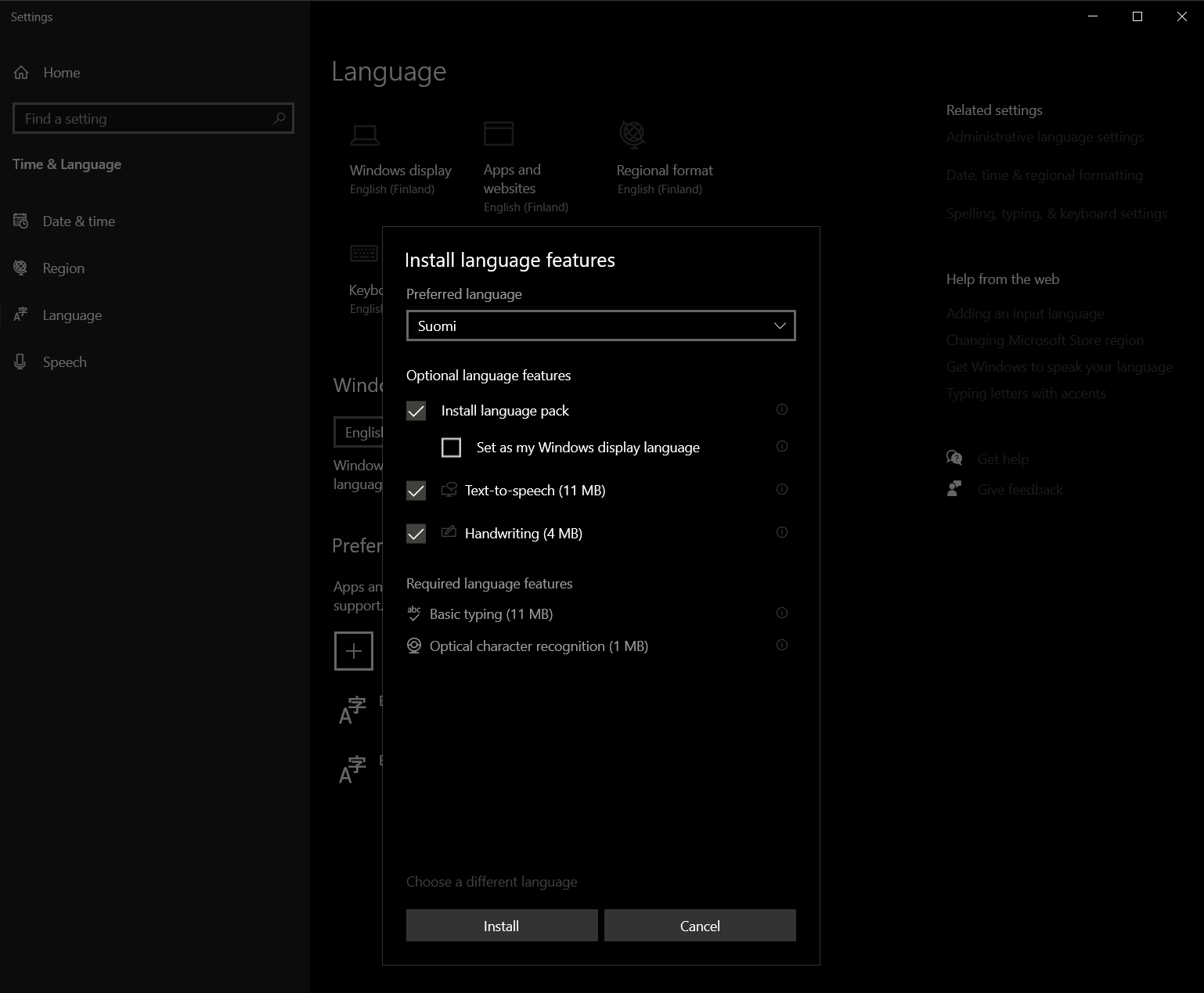
<p>Lisäsin Windowsiin Suomen kielen tuen oikolukua varten:</p>
<ul>
<li><code>Windows Settings</code> &gt; <code>Time &amp; Language</code> &gt; <code>Language</code>.</li>
<li><code>Preferred languages</code> otsikon alta löytyy <code>Add a language</code> nappi.</li>
<li>Avautuvasta dialogista voi joko valita haluamansa kielet tai hakea suoraan tiettyä kieltä.</li>
<li>Hae kieltä: <code>Finnish</code>.</li>
<li>Lisää kieli hyväksymällä kielen asennus koneeseen.
<ul>
<li>En halunnut muuttaa Windowsin oletuskieltä, joten jätin oletuskielen vaihtamisen valitsematta.</li>
</ul>
</li>
</ul>
<p><img src="https://notes.autiomaa.org/assets/img/2021-06-06-202910-windows-settings-add-language.png" alt="Windows Settings ikkuna jossa on auki &quot;Install language features&quot; toiminto." title="Windows Settings ikkuna jossa on auki &quot;Install language features&quot; toiminto." /></p>
<p>Tarkemmat ohjeet IT-ylläpitäjille löytyvät <a href="https://docs.microsoft.com/en-us/windows-hardware/manufacture/desktop/add-language-packs-to-windows" title="Add languages to Windows images | Microsoft Docs">Microsoft Docs</a> sivustolta.</p>
<p>Järjestelmätason oikoluvun käyttö auttaa yleisellä tasolla paljon, mutta sen ongelmana on ettei uusia sanoja pysty lisäämään paikalliseen sanakirjaan (ainakaan tämänhetkisellä laajennuksella). <em>Code Spell Checker</em> mahdollistaa workspace-kohtaisen sanaston luomisen jotta halutut sanat pystyy lisäämään projektikohtaisesti osaksi kokonaisuutta. Samantapainen <em>quick fix</em> mahdollisuus olisi näppärä apu jos järjestelmätason sanakirjaa pystyisi <em>VS Code</em> softan tasolla laajentaa. Ongelmana tosin on se että koska laajennus ulkoistaa tekstin tarkastuksen olemassa oleville järjestelmän työkaluille, ei niiden toimintaan pysty suoraan vaikuttamaan. Jonkinlaiset rajapinnat on olemassa ainakin osaan työkaluista, mutta se miten hyvin ne toimisivat eri käyttöjärjestelmien välillä on hyvä kysymys.</p>
<p>Kokonaisuudessaan kumpikin laajennus on hyödyllinen, mutta päädyin laittamaan aikaisemmin käyttämäni pois päältä. Vaikka <em>VS Code</em> mahdollistaa useamman oikoluku-laajennuksen käytön yhtä aikaa, ongelmana on että ne eivät tässä tapauksessa toimineet kunnolla keskenään (suomenkielinen teksti tuli virhemerkinnällä alleviivatuksi, vaikka toinen laajennuksista ymmärsi sen suomena).</p>
<p>Ehkä jossain vaiheessa editoriin tulee paremmat integroidu rajapinnat joilla spell checker laajennukset pystyvät toimimaan paremmin toistensa kanssa. Sellainen helpottaisi monen ihmisen elämää, sillä samaa editoria käytetään suurelta osin myös moneen muuhun käyttötarkoitukseen kuin perinteisen ohjelmien lähdekoodin kirjoittamiseen.</p>
<p>Lisätietoja edellä mainituista työkaluista:</p>
<ul>
<li>Antosik, Bartosz. <a href="https://marketplace.visualstudio.com/items?itemName=ban.spellright" title="Multilingual, Offline and Lightweight Spellchecker for Visual Studio Code">Spell Right</a>. Software. Visual Studio Marketplace. Microsoft. 2021-05-08.</li>
<li>Antosik, Bartosz. <a href="https://github.com/bartosz-antosik/vscode-spellright" title="Multilingual, Offline and Lightweight Spellchecker for Visual Studio Code">bartosz-antosik/vscode-spellright</a>. Git repository. 2021-05-07.</li>
<li>Dent, Jason. <a href="https://marketplace.visualstudio.com/items?itemName=streetsidesoftware.code-spell-checker" title="Spelling Checker for Visual Studio Code">Code Spell Checker</a>. Software. Visual Studio Marketplace. Microsoft. 2021.</li>
<li>Dent, Jason. <a href="https://github.com/streetsidesoftware/vscode-spell-checker" title="A simple source code spell checker for code">streetsidesoftware/vscode-spell-checker</a>. Git repository. Street Side Software. 2021-06-06.</li>
<li>Dent, Jason. <a href="https://github.com/streetsidesoftware/cspell" title="A Spell Checker for Code">streetsidesoftware/cspell</a>. Git repository. Street Side Software. 2021.</li>
</ul>
<!-- Lähdeviitteiden pitkät URL-osoitteet -->

        ]]>
      </content>
    </entry>
    
    <entry>
      <title>Write for yourself</title>
      <link href="https://notes.autiomaa.org/blog/2020-08-15-write/"/>
      <updated>2020-08-15T19:51:10Z</updated>
      <id>https://notes.autiomaa.org/blog/2020-08-15-write/</id>
      <content type="html">
        <![CDATA[
          <h2>How we learn</h2>
<p>While there are a lot of pressure from employers and society to learn new skills, we often learn alone. Learning is about combining &amp; replacing existing knowledge and assumptions. All too often the process of learning gets forgotten in the long run. We lose track of why our ideas about world are what they are.</p>
<h2>Write for yourself</h2>
<p>By writing about learning, we create a trail of knowledge for the future. It can help to clarify thinking. Future ourselves can see better how we ended up to the conclusions. How small those notes might be, depends on the topic and situation. Sometimes even a few words be enough. Context for the future, allowing travel back to the source of understanding. Other times it might be a good idea to bring ideas together with more long form note taking.</p>
<p>Focusing on personal learning path is a good idea in the long run. Turning the focus from external temporary motivators to internal. Focus on a longer term understanding.</p>
<blockquote>
<p>“Whatever your thing is, make the thing you wish you had found when you were learning. Don't judge your results by &quot;claps&quot; or retweets or stars or upvotes - just talk to yourself from 3 months ago. I keep an almost-daily dev blog written for no one else but me.”</p>
<p><cite>— Wang, Shawn. <a href="https://www.swyx.io/learn-in-public/">Learn In Public</a>. swyx Writing (blog). 2020-03-20.</cite></p>
</blockquote>
<h2>Visual learning</h2>
<p>Not only text. Many ways to take notes. Many ways to learn.</p>
<ul>
<li>Draw, paint, make stick figures.</li>
<li>Use sticker notes for temporary bookmarks while reading books.</li>
<li>Figure out what works for you.</li>
</ul>
<h3>Blocks to blogs</h3>
<p>Another possibility is to move learning from text to physical world. For example, you might get a better idea about scale of concepts by piling up small LEGO blocks next to each other. Each block can be one unit of a scale. Those can be then compared to each other more than one could with pixels on a screen.</p>
<p>Whatever ways of learning you end up, it can help to give yourself something to come back to. Collection of knowledge and ideas, even when the imminent memory loss happens. We forget a lot. Because brain optimizes for the short term needs. Less immediate knowledge gets away to the background. By having a collection of notes to look later, we can make it easier to recall memories.</p>
<h2>Enough, not more</h2>
<p>Time. Our understanding. Amount of energy. Everything is limited.</p>
<p>We spend energy on trying to remember. Trying to figure out later how we did what we did. Documenting our learning gives a starting points for the rediscovery of knowledge.</p>
<p>There are many methods to think about, but what matters most is that we make learning possible. Small steps to a better future. No need to do everything at once, no need to be perfect. Good enough is a good enough.</p>

        ]]>
      </content>
    </entry>
    
    <entry>
      <title>Day in JavaScript</title>
      <link href="https://notes.autiomaa.org/blog/2020-07-19-javascript/"/>
      <updated>2020-07-19T00:00:00Z</updated>
      <id>https://notes.autiomaa.org/blog/2020-07-19-javascript/</id>
      <content type="html">
        <![CDATA[
          <h2>Yarn</h2>
<h3>Migrating from npm to Yarn</h3>
<p><a href="https://classic.yarnpkg.com/en/docs/migrating-from-npm" title="Migrating from npm | Yarn">Comparison of commands</a> between the <code>npm</code> CLI and Yarn is an overview of what commands work for similar tasks in the tools. There are more differences in the <a href="https://yarnpkg.com/getting-started/install/" title="2 - Installation | Yarn - Package Manager">Yarn 2</a> version, but have not yet migrated my own projects to it.</p>
<h3>Get latest dependencies</h3>
<h4><code>yarn upgrade</code></h4>
<blockquote>
<p>This command updates dependencies to their latest version based on the version range specified in the <code>package.json</code> file. The <code>yarn.lock</code> file will be recreated as well.</p>
<p><cite>— <a href="https://classic.yarnpkg.com/en/docs/cli/upgrade" title="yarn upgrade">Yarn documentation</a>. 2020.</cite></p>
</blockquote>
<p>Figured out a faster way to update the package dependencies. I have been using Yarn for a long time, but somehow had forgotten about some of the built in features. I had used more &quot;traditional&quot; way of updating packages. One by one, by editing the latest version number to <code>package.json</code> file, and running <code>yarn install</code> after it.</p>
<h2>Babel core bug fixes</h2>
<p>Latest Babel release <a href="https://github.com/babel/babel/releases/tag/v7.10.5">v7.10.5</a> reduces amount of <a href="https://lodash.com/">Lodash</a> usage. It replaces parts of old code with native JavaScript features. This is a positive change to better. Less potential issues caused by 3rd party dependencies.</p>

        ]]>
      </content>
    </entry>
    
    <entry>
      <title>Static sites</title>
      <link href="https://notes.autiomaa.org/blog/2020-07-17-static-sites/"/>
      <updated>2020-07-17T00:00:00Z</updated>
      <id>https://notes.autiomaa.org/blog/2020-07-17-static-sites/</id>
      <content type="html">
        <![CDATA[
          <p>Good history lessons on why pre-generated static sites matter a lot.</p>
<p>Fundraising website of the Obama 2012 campaign run on top of a static HTML pages. It was pre-generated using Jekyll static site generator. Site gathered ~81 million pageviews, with ~17,8 million unique visitors. ~4,2 million donations amounted to a $250 million USD, a large part of the campaign funding.</p>
<p>Previous SaaS fundraising platform had the features bundled together. Centralized system architecture was a too big risk for a national campaign.</p>
<p>New site used JavaScript to do REST API calls to a payment system to handle the campaign donations. Site had ~4,000 lines of JavaScript. This allowed the team to split UI design &amp; optimization away from the payment backend.</p>
<p>Compared to the previous platform, site had 60% faster time to paint. (Time it takes for a page content to get displayed on a web browser of a visitor.) Speed increase resulted a 14% increase in donation conversions. Improvement came partly from the static content served served by Akamai CDN infrastructure. Amazon S3 storage buckets hosted the origin content.</p>
<p>240 A/B tests helped to create a 49% increase in donation conversion rate, according to the case study. Project had a 6 month life span with 1,101 frontend deployments.</p>
<p>More details on the original case study:</p>
<ul>
<li>Rush, Kyle. <a href="https://web.archive.org/web/20130111080801/http://kylerush.net/blog/meet-the-obama-campaigns-250-million-fundraising-platform/">Meet the Obama campaign’s $250 million fundraising platform</a>.<br />
Blog post (Internet Archive copy). Kyle Rush (personal website). 2012-11-27.</li>
<li>Wikipedia. <a href="https://en.wikipedia.org/wiki/Barack_Obama_2012_presidential_campaign">Barack Obama 2012 presidential campaign</a>. Wiki article. Wikipedia. 2020-06-27 at 15:56.</li>
<li><a href="https://jekyllrb.com/">Jekyll</a>. Software documentation. 2020.</li>
</ul>

        ]]>
      </content>
    </entry>
    
    <entry>
      <title>Design</title>
      <link href="https://notes.autiomaa.org/blog/2020-07-16-design/"/>
      <updated>2020-07-16T00:00:00Z</updated>
      <id>https://notes.autiomaa.org/blog/2020-07-16-design/</id>
      <content type="html">
        <![CDATA[
          <h2>Grid layout makes sense for list items</h2>
<p>Was doing a redesign of how lists on my CV looked.
Realized that a switch to a block grid layout from a vertical list
made the page structure much more readable and faster to scan.</p>
<p>From the point of data structures, it is still an <code>&lt;ul&gt;</code> unordered list
with a <code>&lt;li&gt;</code> list items. From the viewpoint of a person with eye vision,
it looks like a grid layout. That allows getting a lot better visual structure,
while still keeping the content readable for people who use accessibility tools.</p>
<p><img src="https://notes.autiomaa.org/assets/img/2020-07-16-2341-cv-education-grid-layout.png" alt="Grid layout example" title="Grid layout example" /></p>

        ]]>
      </content>
    </entry>
    
    <entry>
      <title>Ideas vs. reality</title>
      <link href="https://notes.autiomaa.org/blog/2020-07-13-ideas-vs-reality/"/>
      <updated>2020-07-13T00:00:00Z</updated>
      <id>https://notes.autiomaa.org/blog/2020-07-13-ideas-vs-reality/</id>
      <content type="html">
        <![CDATA[
          <p><a href="https://sive.rs/local" title="You don’t have to be local | Derek Sivers">Local versus global?</a> Both needed.
My focus has been global over the years, at least for learning.
A lot of my conversations during the past decade(s) have been on Twitter.
But somehow at the same time, have felt a need for being part of a local community.
For many years, attended a lot of meetup events (few hundred, in total), besides of a few other events .</p>
<p>But as communities grow, they also disappear.
People's priorities in life change, as the world around changes.
People grow, and learn. And some of the past sticks, while other ideas get forgotten.</p>
<p>During the past few years I have been thinking. And being alone.
Lack of work has pushed me aside from office conversations (regardless if those are good or not).
Lack of energy has limited the amount of time spent on other places.
I have been at home, trying to figure out what to make of this life.</p>
<p>For reasons unintended, a lot of life has been difficult, as it is for many. Can't always choose what happens around.</p>
<p>One of the goals of the past year has been to try to focus more on creating a personal publishing platform. Kind of.
Not a new piece of software. Collection of personal workflows and processes, to make creation process more easy.
This blog is a small part of writing I have been writing, but haven't been publishing much.
Most of the notes on the corners of my hard drive I have forgotten about. Trying to review few years of daily notes, collecting some of the best ideas together.</p>
<p>Have been thinking a lot about meaning of work.
And also, frustrated about the state of technology industry.
A lot of what is happening in the world is outside of the circle of influence, and out of circle of control.
Same goes for work: a little bit that we can influence is often limited to what people work with.
Economic reality is often rather dark, regardless of an industry. People work because they they have to pay rent and buy food, not because they would enjoy the work itself. There are a lot of upsides of a work related communities. Output we create is at times useful to other people.</p>
<p>But everything in the world has limits, as our life does.
We need to make good use of the time we have, as years disappear to the history, a moment at time.
What we use our time matters in the long run. What is now a current moment, is a past few minutes later.
What is a good use of our time is another, <em>a lot longer</em>, conversation. But lets leave it for an another day.</p>

        ]]>
      </content>
    </entry>
    
    <entry>
      <title>GitHub contributions</title>
      <link href="https://notes.autiomaa.org/blog/2020-07-13-github-contributions/"/>
      <updated>2020-07-13T00:00:00Z</updated>
      <id>https://notes.autiomaa.org/blog/2020-07-13-github-contributions/</id>
      <content type="html">
        <![CDATA[
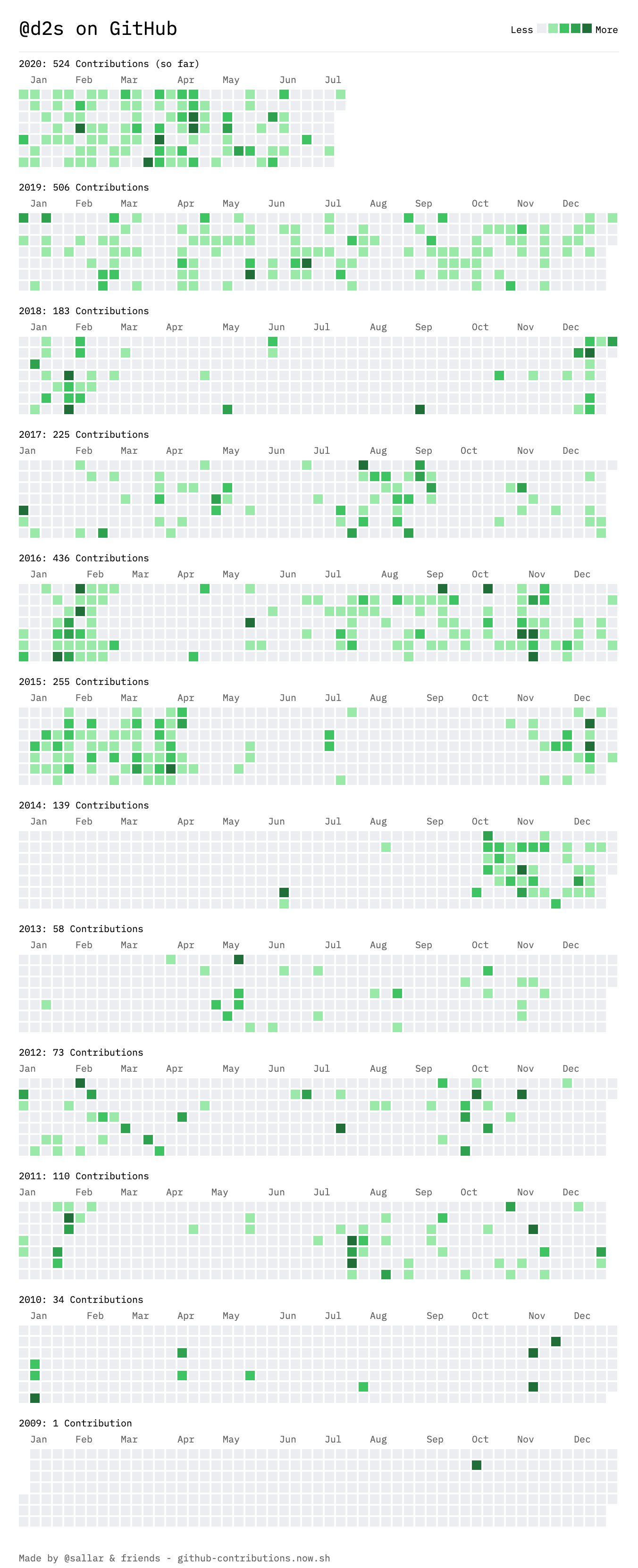
          <p>Created my <a href="https://github.com/d2s" title="Personal GitHub account">GitHub account</a> in October 2009, but made my first contributions on GitHub in 2010.
Focus has been on learning. Over the years usage has shifted from consuming to creating.
Spent years reading what others had been creating, and that is not visible on the charts.
Still, contributions are what the chart is about, and this is what it is.</p>
<p><img src="https://notes.autiomaa.org/assets/img/external/2020-07-13-1828-GitHub-contributions-d2s-light.png" alt="GitHub contributions" title="Diagram of GitHub contributions as of 2020-07-13" /></p>
<p>Generated with the <a href="https://github-contributions.now.sh/">GitHub Contributions Chart Generator</a>, a visualization tool created by <a href="https://github.com/sallar">Sallar</a>.
If you want to run it locally, <a href="https://github.com/sallar/github-contributions-chart" title="sallar/github-contributions-chart: Generate an image of all your GitHub contributions">source code</a> is available.</p>

        ]]>
      </content>
    </entry>
    
    <entry>
      <title>Together</title>
      <link href="https://notes.autiomaa.org/blog/2020-06-07-together/"/>
      <updated>2020-06-07T00:00:00Z</updated>
      <id>https://notes.autiomaa.org/blog/2020-06-07-together/</id>
      <content type="html">
        <![CDATA[
          <p>There is a lot of sun outside. But it still feels cold inside.</p>
<p>Reading news gives a bit of idea what is happening. Looking at the videos of the protests around the planet shows much more painful reality.</p>
<p>A lot of sadness.</p>
<p>People want to be equal, and have a right to be equal. It's been decades and centuries. The structure of inequality still shows its heavy hand. What people now see, has been happening before. How to fix the structural problems of societies? All the way from a street to a regulation, and leadership.</p>
<p>People can change the rules, together. Often small steps matter. When many people take steps together, it has a much bigger impact. Steps to change systems to a better direction.</p>
<p>It is also about money, and power. Structural issues in society are visible on how others have an ability to survive. Understanding that people matter. Making sure that all people are part of society.</p>
<p>Life is not perfect, but there are many ways to improve the world. Ways to show that people care about each other. Ways to take a stand. Allowing the future that has more hope. There is much to improve in this world, around the planet.</p>
<p>All the best to a better future.
Together.</p>

        ]]>
      </content>
    </entry>
    
    <entry>
      <title>Website redesigned</title>
      <link href="https://notes.autiomaa.org/blog/2020-04-22-autiomaa/"/>
      <updated>2020-04-22T00:00:00Z</updated>
      <id>https://notes.autiomaa.org/blog/2020-04-22-autiomaa/</id>
      <content type="html">
        <![CDATA[
          <p>Replaced old <a href="https://autiomaa.org/">autiomaa.org</a> website last month with a small mini-site.
Previous site structure was originally from the late 2016, and was way overdue to replace.</p>
<p>As part of the structure changes, I <a href="https://notes.autiomaa.org/blog/2020-03-07-website/">moved</a> an
old <a href="https://notes.autiomaa.org/blog/2016-09-22-learning/" title="How to learn better">blog post</a>
from the previous location to be part of this blog.
To make sure old URL keeps working, adjusted redirects
to tell direct visitors and search engines of the new address.</p>
<p>At the same time, refocusing the main site to work more as a landing &amp; navigation page
to different sub-domains &amp; other related websites.
Goal is to make it easier to make structure changes to individual personal sites in the future,
while keeping the flexibility to improve and adjust tools based on the current needs.</p>
<p>There is always more to improve, but hopefully this is a step to a good direction.</p>

        ]]>
      </content>
    </entry>
    
    <entry>
      <title>Website</title>
      <link href="https://notes.autiomaa.org/blog/2020-03-07-website/"/>
      <updated>2020-03-07T00:00:00Z</updated>
      <id>https://notes.autiomaa.org/blog/2020-03-07-website/</id>
      <content type="html">
        <![CDATA[
          <p>Initially the idea was to have my own personal “link blog”, but the initial site layout turned out more flexible, even for a bit longer content. Started to migrate older content from various older personal blogs. Atom formatted <a href="https://notes.autiomaa.org/feed.xml" title="Atom feed">XML feed</a> is available for the RSS feed readers. Site is built with <a href="https://www.11ty.dev/docs/" title="Overview | Eleventy, a simpler static site generator.">Eleventy</a> &amp; <a href="https://parceljs.org/" title="Parcel">Parcel</a>, and hosted on the wonderful <a href="https://www.netlify.com/" title="Netlify: All-in-one platform for automating modern web projects">Netlify</a> service.</p>
<p>Basically restarted my previous website project from scratch after getting stuck with the over-engineered site structure. Now this is more focused, with just the blog part on a sub-domain. Ideally each of the new larger &quot;features&quot; of my personal website(s) would live under different sub-domains, with a separate CI pipeline for building and publishing the contents.</p>
<p>Understandably it takes a bit more effort to have seperate DNS entries for each of the projects, but eventually that makes a lot more sense, as I don't have to worry about accidentally increasing complexity of new prototypes etc. (as everything is in a seperate Git repository). Planning to write more about how I build these projects later, but this is a short entry about current state of the personal website.</p>
<p>Also did setup a <code>_redirects</code> file from the main <a href="https://autiomaa.org/" title="autiomaa.org">autiomaa.org</a> website to point old blog post to the current blog. Will keep the main site there, while moving it more towards of an introduction &amp; project list page, with links to the sub-domains.</p>

        ]]>
      </content>
    </entry>
    
    <entry>
      <title>Android 11</title>
      <link href="https://notes.autiomaa.org/blog/2020-03-06-android/"/>
      <updated>2020-03-06T00:00:00Z</updated>
      <id>https://notes.autiomaa.org/blog/2020-03-06-android/</id>
      <content type="html">
        <![CDATA[
          <h3>Android 11</h3>
<p>Improved storage access rights limitations for the Android platform.</p>
<blockquote>
<p>“At the top of that list for Android apps is probably “scoped storage,” which limits apps’ ability to look at storage outside of their own silo (similar to how the iPhone works). It was introduced last year with Android 10 but Google is implementing it more aggressively in 11. Users will apparently be able to opt apps in to broader access if they choose, however. Google is aware this could be disruptive for a bunch of apps, so it will be publishing a separate blog post about it.”</p>
<p><cite>— <a href="https://www.theverge.com/2020/2/19/21143789/google-android-11-developer-preview-release-5g-security-early">Google releases Android 11 developer preview earlier than expected</a>. Blog post. The Verge. 2020-02-19.</cite></p>
</blockquote>
<p>Changes coming to Android 11 that will improve privacy and security of a regular people. Android has been a lot more ‘open’ compared to iOS. Partly because there have not been much of access rights limits between mobile apps. That might have increased ideas for improving people’s productivity, but with a cost. It has still been a problem from the system security viewpoint.  Other applications that might not always behave as well as expected. When there are good limits to what apps can access, people’s personal data will stay better guarded.</p>

        ]]>
      </content>
    </entry>
    
    <entry>
      <title>Healthcare</title>
      <link href="https://notes.autiomaa.org/blog/2020-03-03-notes/"/>
      <updated>2020-03-03T00:00:00Z</updated>
      <id>https://notes.autiomaa.org/blog/2020-03-03-notes/</id>
      <content type="html">
        <![CDATA[
          <h2>Economic effects</h2>
<blockquote>
<p>“Finance ministers from the G7 and central bankers said they were “ready to act” to cushion economic fallout.”</p>
<h3>Fear management</h3>
<p>[At the same time, U.S. administration focused on] <em>“efforts to manage public fears over the disease, even as it continues to spread around the world.”</em></p>
<h3>Attempts to reduce health risks</h3>
<p>“With the threat of a full-scale pandemic growing by the day, governments around the world shifted their focus on Tuesday to devising plans to contain the spread of the new coronavirus rather than to stamp it out, and to do so without causing widespread social disruption and economic upheaval.”</p>
<h3>More population quarantines</h3>
<p>“Beijing and Shanghai will now require people who have recently visited countries where infections are on the rise to undergo quarantine.”</p>
<p><cite>— The New York Times. <a href="https://www.nytimes.com/2020/03/03/world/coronavirus-live-news-updates.html">Coronavirus Updates: Governments Shift Focus to Containment, as Virus Spreads Globally</a>. News article. The New York Times. 2020-03-03.</cite></p>
</blockquote>
<h2>3,000 deaths worldwide</h2>
<blockquote>
<p>“The epidemic continues to expand rapidly worldwide, topping 90,000 cases and 3,000 deaths. U.S. officials say virus testing kits will soon become widely available.”</p>
<p><cite>— The New York Times. <a href="https://www.nytimes.com/2020/03/02/world/coronavirus-updates-news-covid-19.html">Outbreak Strikes Seattle Area as Testing Is Scrutinized</a>. News article. The New York Times. 2020-03-03.</cite></p>
</blockquote>
<h2>Manhattan Woman</h2>
<blockquote>
<p>“[…] she <strong>had not</strong> ridden public transportation since returning to New York.”</p>
<p><em>People rush to buy sanitary supplies</em></p>
<p>“By this weekend, many stores in the city had run out of sanitary supplies such as hand sanitizer, masks and antibacterial wipes.”</p>
<p><cite>— Goldstein, Joseph; McKinley, Jesse. <a href="https://www.nytimes.com/2020/03/01/nyregion/new-york-coronvirus-confirmed.html">Manhattan Woman Is First Confirmed Coronavirus Case in State</a>. News article. The New York Times. 2020-03-01.</cite></p>
</blockquote>
<h2>Privacy impact of coronavirus outbreak</h2>
<blockquote>
<p>“As China encourages people to return to work despite the coronavirus outbreak, it has begun a bold mass experiment in using data to regulate citizens’ lives — by requiring them to use software on their smartphones that dictates whether they should be quarantined or allowed into subways, malls and other public spaces.</p>
<p>But a New York Times analysis of the software’s code found that the system does more than decide in real time whether someone poses a contagion risk. It also appears to share information with the police, setting a template for new forms of automated social control that could persist long after the epidemic subsides.”</p>
<p><cite>— Mozur, Paul; Zhong, Raymond; Krolik, Aaron. <a href="https://www.nytimes.com/2020/03/01/business/china-coronavirus-surveillance.html">In Coronavirus Fight, China Gives Citizens a Color Code, With Red Flags</a>. News article. The New York Times. 2020-03-01.</cite></p>
</blockquote>
<h2>Effects on the oil production</h2>
<blockquote>
<p>“Commodity exporters are especially exposed to trade with China, where the coronavirus outbreak has crippled production and consumption, as factories remain below capacity and transport is curtailed.</p>
<p>“While many firms remained upbeat for the year ahead, business expectations were hit by fears that the virus outbreak could damage an already struggling domestic economy” in the U.A.E., [David Owen, Economist at IHS Markit, said in a report].”</p>
<p><cite>— Mathew, Shaji. <a href="https://www.bloomberg.com/news/articles/2020-03-03/u-a-e-business-conditions-worsen-again-on-coronavirus-fears">Gulf’s Top Two Economies Dealt Setback After Virus Disruption</a>. News article. Bloomberg. 2020-03-03.</cite></p>
</blockquote>
<h2>Airports</h2>
<blockquote>
<p>“This is the emptiest I’ve ever seen the airport.”</p>
<p><cite>— Quinn, Corey. <a href="https://twitter.com/QuinnyPig/status/1234823844088578049">Corey Quinn on Twitter</a>. Message thread. Twitter. 2020-03-03 at 14:52.</cite></p>
</blockquote>
<p>Airports are getting less crowded because people are reducing amount of travel.</p>

        ]]>
      </content>
    </entry>
    
    <entry>
      <title>Healthcare</title>
      <link href="https://notes.autiomaa.org/blog/2020-02-29-notes/"/>
      <updated>2020-02-29T00:00:00Z</updated>
      <id>https://notes.autiomaa.org/blog/2020-02-29-notes/</id>
      <content type="html">
        <![CDATA[
          <h2>Masks can't stop the coronavirus</h2>
<blockquote>
<p>“To be clear once again, Americans don't need masks. The CDC says that <em>healthy people in the US shouldn't wear them</em> because they won't protect them from the novel coronavirus.”</p>
<p>“But medical workers who treat patients with novel coronavirus do need them. And, the CDC says, it's crucial that those supplies don't run out.”</p>
<p>“When it comes to hysteria and panic, though, reason takes a backseat.”</p>
<p><cite>— CNN. <a href="http://lite.cnn.com/en/article/h_cd175447b3f892d7adcb7c196b0b7316">Masks can't stop the coronavirus in the US, but hysteria has led to bulk-buying, price-gouging and serious fear for the future</a>. News article. CNN. 2020-02-29 at 6:14 AM ET.</cite></p>
</blockquote>
<h2>Stock market losses</h2>
<blockquote>
<p>“Stock markets in the US have posted some of their worst ever losses as the novel coronavirus sparked mass sell-offs.</p>
<p>The Dow dropped 1,191 points on Thursday, in its worst one-day point drop in history, while the S&amp;P 500 posted its worst day since 2011. Stocks are on track for their worst week since the 2008 financial crisis.”</p>
<p>“In Japan, the ongoing outbreak has raised questions over the viability of the 2020 Tokyo Olympics.”</p>
<p>“In the Middle East, numerous countries have cut off travel…”</p>
<p><cite>— CNN. <a href="http://lite.cnn.com/en/article/h_ecfcc89eac8d6f960b37f5c083c3726d">Novel coronavirus sparks massive US stock market losses as cases spread worldwide</a>. News article. Hong Kong. CNN. 2020-02-28 at 7:05 AM ET.</cite></p>
</blockquote>
<h2>Fear management</h2>
<blockquote>
<p>“<em>Rep. John Garamendi</em> (D-Calif.) on Friday said the director of the National Institute of Allergy and Infectious Diseases was told to <em>“stand down”</em> and not appear on five Sunday morning talk shows to discuss the coronavirus.”</p>
<p>“Garamendi told MSNBC's Hallie Jackson that <em>Anthony Fauci</em> was scheduled to do all five major Sunday talk shows, but says Fauci canceled the appearances after <em>Vice President Pence</em> took over the administration's response to the disease.”</p>
<p><cite>— Concha, Joe. <a href="https://thehill.com/homenews/media/485147-rep-garamendi-nih-director-fauci-cancelled-on-five-sunday-talk-shows-after">Rep. Garamendi: NIH official canceled on five Sunday talk shows after Pence's office 'took over'</a>. News article. TheHill. 2020-02-28 at 11:51 AM EST.</cite></p>
</blockquote>
<h2>Preparing is a good idea</h2>
<blockquote>
<p>“Getting ready for the possibility of major disruptions is not only smart; it’s also our civic duty”</p>
<p>“[…] the real crisis scenarios we’re likely to encounter require cooperation and, crucially, <em>“flattening the curve”</em> of the crisis exactly so the more vulnerable can fare better, so that our infrastructure will be less stressed at any one time.”</p>
<p>“The infectiousness of a virus, for example, depends on how much we encounter one another; how well we quarantine individuals who are ill; how often we wash our hands; whether those treating the ill have proper protective equipment; how healthy we are to begin with—and such factors are all under our control.”</p>
<p><cite>— Tufekci, Zeynep. <a href="https://blogs.scientificamerican.com/observations/preparing-for-coronavirus-to-strike-the-u-s/">Preparing for Coronavirus to Strike the U.S.</a>. Blog post. Scientific American Blog Network. Scientific American, a Division of Nature America, Inc. 2020-02-27.</cite></p>
</blockquote>
<h2>Habits changed by the health crisis</h2>
<p>People are learning to cook again, because there isn't much else to do.</p>
<blockquote>
<p>“In China, millions of people living under lockdown are using the Internet to re-create the conviviality of sharing a meal.”</p>
<p><cite>— Raghav, Krish. <a href="https://www.newyorker.com/culture/cultural-comment/quarantine-cooking-finding-relief-from-coronavirus-anxiety-in-the-kitchen">Quarantine Cooking: Finding Relief from Coronavirus Anxiety in the Kitchen</a>. Cultural Comment. The New Yorker. 2020-02-27.</cite></p>
</blockquote>
<p>Good visual storytelling.</p>

        ]]>
      </content>
    </entry>
    
    <entry>
      <title>Writing the web</title>
      <link href="https://notes.autiomaa.org/blog/2019-02-07-notes/"/>
      <updated>2019-02-07T00:00:00Z</updated>
      <id>https://notes.autiomaa.org/blog/2019-02-07-notes/</id>
      <content type="html">
        <![CDATA[
          <h2>Notes for the future</h2>
<p>This is the first <em>daily note</em> post to the freshly updated personal website.</p>
<p>Definition for the word <strong><em>note</em></strong> is described by <a href="https://www.wordnik.com/words/note" title="note - definition and meaning">Wordnik</a> as:</p>
<blockquote>
<p><em>n.</em>  A brief record, especially one written down to aid the memory.
<em>n.</em>  A brief informal letter.
<em>n.</em>  A comment or an explanation, as on a passage in a text.</p>
</blockquote>
<p>There are a lot of other meanings to the word, but these might be the most relevant in this context. I plan to start publishing these daily notes more frequently, to share what I have discovered.</p>
<h2>Eleventy</h2>
<p>This site is generated with the <a href="https://www.11ty.dev/docs/" title="Overview | Eleventy, a simpler static site generator.">Eleventy</a> static site generator. I have tried a wide variety of different document generators over the years, but everyone has different types of issues. While Eleventy is clearly not perfect (as I realized after spending hours trying to understand how the templates system works), it still provides a well written set of tools for making a long lasting web projects.</p>
<h3>Data visualizations</h3>
<p>One potential future use case for Eleventy would be to generate a data visualizations about my event attendance history. There are various good tools for charting and drawing various kinds of graphs, so this would provide me a good practice for the future. Having an overview of what I have been doing in my life might help me to better communicate my skills and experiences. While writing is a very important way to clarify what one thinks, making data visible helps to understand it from more viewpoints.</p>

        ]]>
      </content>
    </entry>
    
    <entry>
      <title>How to learn better</title>
      <link href="https://notes.autiomaa.org/blog/2016-09-22-learning/"/>
      <updated>2016-09-22T07:10:10Z</updated>
      <id>https://notes.autiomaa.org/blog/2016-09-22-learning/</id>
      <content type="html">
        <![CDATA[
          <h2>Information overflow</h2>
<blockquote>
<p>“Time is more precious than money. Money is a renewable resource. Everyone always has the potential to make more money. Time, on the other hand, is finite. There are only so many hours in a day. By definition, you only have so much time to give.”</p>
<p>— <a href="https://medium.com/@hairyelefante/instagram-and-the-cult-of-the-attention-web-how-the-free-internet-is-eating-itself-909b5713055e" title="Instagram and the Cult of the Attention Web: How the Free Internet is Eating Itself">Jesse Weaver</a></p>
</blockquote>
<h2>Choose your sources</h2>
<p>Focus on relevant topics and find what are reliable sources of information. Filter out things that don’t matter at the moment. Learn more details later, when needed.</p>
<h2>Cognitive bias</h2>
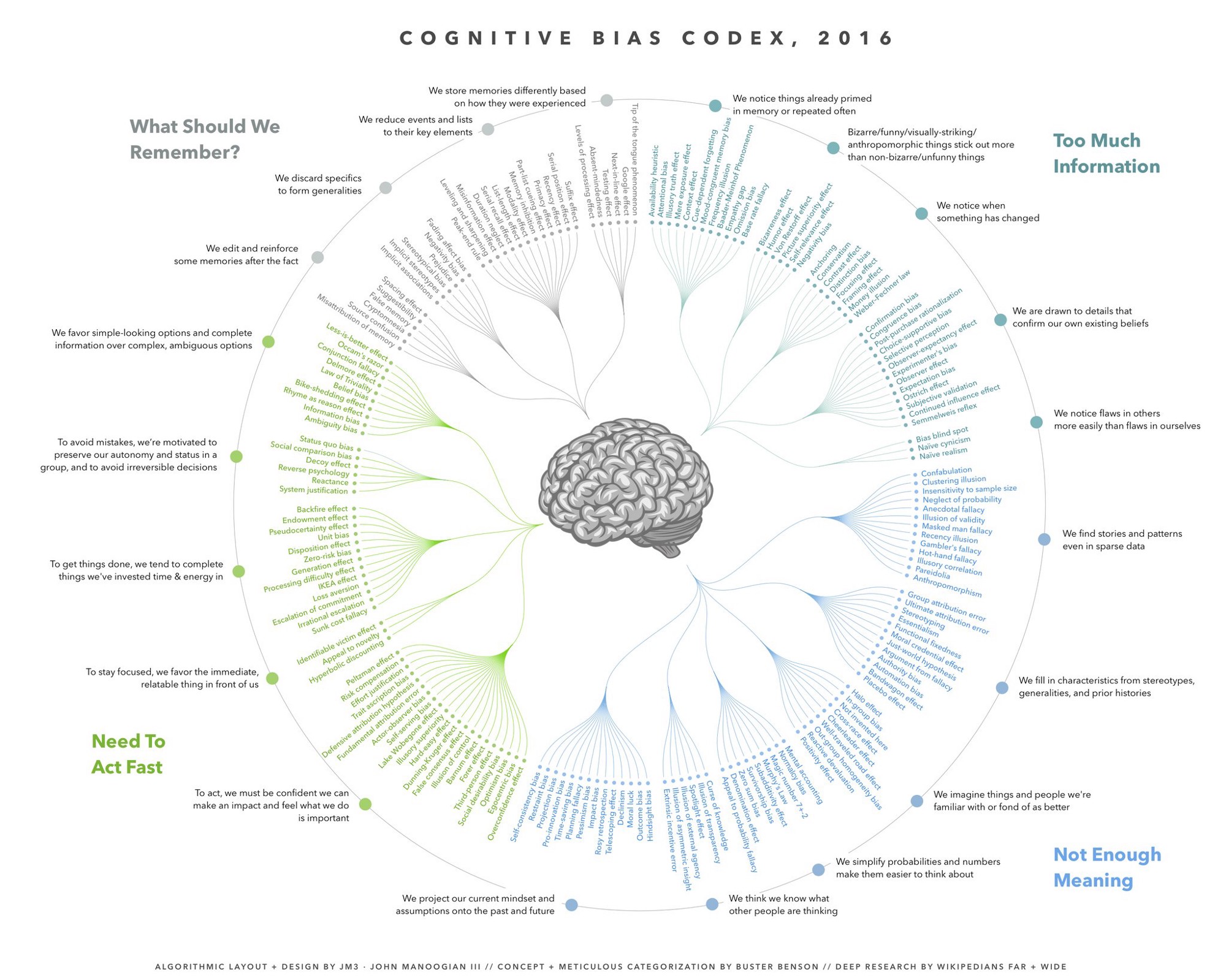
<p><em>Cognitive Bias Codex</em> (created by <a href="https://www.jm3.net/" title="John Manoogian III">John Manoogian III</a>) shows overview of different biases that humans have. Most are caused by lack of information or lack of time to process it. <a href="https://medium.com/better-humans/cognitive-bias-cheat-sheet-55a472476b18" title="Cognitive bias cheat sheet – Better Humans">Cognitive bias cheat sheet</a> shows overview about each of them.</p>
<p><img src="https://notes.autiomaa.org/assets/img/external/Cognitive-Bias-Codex-2016-Medium-jm3.jpg" alt="Cognitive Bias Codex, 2016" title="John Manoogian III. Cognitive Bias Codex. 2016." /></p>
<h2>Future of work is to learn</h2>
<blockquote>
<p><em>“Post-industrial work is learning”</em> says Esko Kilpi in the article <a href="https://medium.com/@EskoKilpi/the-design-patterns-of-work-72f8b4299b10" title="The design patterns of work – Esko Kilpi">The design patterns of work</a>. <strong>Learning starts from questions</strong>. What you ask matters. When you take time to understand context first, you don’t waste time from others.</p>
</blockquote>
<h2>Share what you learn</h2>
<blockquote>
<p>“The collective intelligence of our societies
depends on the tools that augment human intelligence.”</p>
</blockquote>
<p>Writing and drawing are just some of the ways to share that knowledge. It is also known that people learn more when they take notes. Still it does not make that much of sense to write down everything.</p>
<p>An <a href="https://www.scientificamerican.com/article/a-learning-secret-don-t-take-notes-with-a-laptop/" title="A Learning Secret: Don’t Take Notes with a Laptop">article</a> tells that <em>“students who write out their notes on paper learn more”</em>. That is when compared to students who used laptops for writing notes. Difference is partly explained by the speed. Most write slower with paper, and that requires to more focus on content. Ability to listen and combine data to more understandable forms is the key for learning.</p>
<p>Lack of thinking means lack of effective learning. You need to think in your own words to understand and digest topics. Digital tools make it easy to copy, but avoid unneeded copying. Amount of content does not mean much if you can’t do anything meaningful with it.</p>
<h2>Snippets have low value</h2>
<p>For too many years, I spent countless hours on Twitter. Writing and sharing short snippets of information. Problem with ‘micro-blogging’ is that limits of space make it difficult to include context about what content is about. Without pre-existing knowledge about topic, most short snippets have low value for most.</p>
<h2>Benefits of sharing the learning process</h2>
<p>Value of your time goes up when you share what you have learned.</p>
<p>Question is, what to make of it? How to improve our communication skills, without flooding others with unneeded details? Share details with care. Reduce need to interrupt others. Make sure to share relevant knowledge.</p>
<h2>Learn before teaching</h2>
<p>Focus on teaching yourself, not others. If you can learn, others could too. Write down your learning path. Allow others to learn by reading your notes.</p>
<p>People learn in different ways. It also takes energy to learn new things. Most people are often too busy or too tired to learn. Motivation is also relevant. If you can’t give yourself any reason to learn, learning will not happen.</p>
<h2>Time is the key</h2>
<p>Key thing is to balance time requirements with other priorities of life. Lack of time is a constant thing. It takes time to learn. Often people are willing to spend time, but are not willing to pay money for saving it. At the same time, smarter way for others is to pay for saved time. But how to know if you should spend your limited time or not?</p>
<h2>Ask questions to learn</h2>
<blockquote>
<p>“Next time you hear something, or someone, talk about an idea,
pitch an idea, or suggest an idea, give it 5 minutes.”</p>
<p>— <a href="https://signalvnoise.com/posts/3124-give-it-five-minutes" title="Give it five minutes – Signal v. Noise">Jason Fried</a></p>
</blockquote>
<p>Learn to think first, avoid reacting too fast.
The right idea could start out life as the wrong idea.</p>
<p>And remember, <a href="https://thedesignteam.io/the-imposter-ddbe96b14e14" title="The Imposter – The Design Team">you don’t have to be perfect</a>. Nobody is.</p>

        ]]>
      </content>
    </entry>
</feed>