Great problems for elementary and middle school
Here’s a pair of classics – and updated links for those of you who may have been frustrated with the blogroll…
These are Elementary School problems – great, open ended tasks for grades K-5 from the NCTM. They are often organized by theme, and have been archived for years… Of course many feature an American context, but there’s LOTS to choose from here!
The complement to these for our intermediate colleagues (grades 6-8) are the Middle School Problems. And these ones come with answers… 🙂
Have fun!
A few new links
Here are a couple of new links for you to explore…
The first is a game is called “Got It“. It’s like a reverse version of Nim – that is, the task is to take turns with the computer adding up to a target sum, but you can only choose 1, 2, 3, or 4. Challenging…
OK. Truth is I have yet to win. 😮
The “Got it” game is drawn from a GREAT site called nrich. The site is FULL of amazing applets and tasks for kids across the grades, all of which have been organized and tagged by keyword so the site is fully searchable. Way cool.
This next site presents a really neat visual illustration of the power of exponents. The images begin out in space and focus in on a point in powers of 10… harder to explain than it is to see and understand. truly.
have fun!
Carole
Things to share…
wow. I HAVE been remiss in keeping this site up to date. Sigh. Doesn’t pay to have an off-line life! 🙂
So here is something I promised to share with the primary teachers in Cranbrook… It’s the pattern template for making dot plates with 2 colours. This file was created by Mignonne Wood and uses combinations drawn from the Van de Walle resource for K-3. Obviously the more complex combinations would be more appropriate for older kids, since some draw on more advanced strategies. Click on the link below to open a copy that you can save.
Another piece I promised to post was a copy of the Conceptual Understanding pentagon – the “Give Me Five” strategy as I like to call it for supporting children in gaining conceptual understanding in math through multiple representations. Once again it’s a gem from John Van de Walle’s resource. (Have I mentioned how much I miss that man and his amazing mind?) 😦 click below of the page…
Conceptual understanding pentagon
I am developing an IEP and differentation guide for students who struggle in math – send me a note if you’re interested in hearing more, or in having me join in a conversation with resource teachers about it…
More soon!
Carole
Brighouse parents :)
Hello to all the Sea Island and Brighouse parents who attended the math night tonight! It was an absolute pleasure to work with you this evening – and to talk about what makes math more engaging – and more meaningful for our kids.
I wanted to share a couple of links that might appeal to you. First, for those of you looking to support your children in mastering the facts, here is a link to a page of materials and games designed for just this purpose. The Math Tool Kits are materials and games that are great for helping children make sense of the operations – and to visualize the relationships between 5 and 10, and between tens and ones. There are visual tools as well for helping children think about the more difficult multiplication facts…
I would also suggest that the Greg Tang Flash Cards are a wonderful investment for people who want to really make sense of the multiplication facts and the patterns that are there… I know I said “No more flash cards” tonight. These cards are different. They teach the strategies for making sense of the facts – they do not drill them… Each card includes a poem, a picture and numbers to show the fact. They are very appealing and accompany a book called “The Best of Times”, by Greg Tang too. I got them both through the Scholastic book club in January, but both are available from Greg Tang’s website

The National Llibrary of Virtual Manipulatives site is amazing. It is a treasure-trove of on-line applets (free applications) for thinking about mathematical ideas, using the kids of tools we used this evening – like geoboards for exploring area and pattern blocks for investigating pattern and are, etc. Invite your children to play with these little applets when doing their homework – or as a good task all on their own. Afetrwards, ask your child to tell you what he or she found out when exploring the materials – and what connections they were able to make.
Check out the “Blogroll” at the right to see some of my favourite links, including little videos on the Addem site for little children.
Ok.
That’s it for tonight.
Thanks again… and enjoy.
Carole
NCSM Welcome!
Hello to those of you who attended today’s session entitled “Learning On Demand – technology with the power to change how we learn and communicate mathematically“. Tom and I appreciated the chance to spend time with you – and in particular the opportunity to chat with many of you after the session here in Atlanta.
I have attached here some of the slides from the session today in the hopes that they will be helpful to you in your conversations with your teachers and other teacher leaders.
Learning On Demand Summary
Click on the link above to open the slides in another window… but be patient – it’s a big one!
I’d also like to invite you to post comments to this page – by clicking on the “comments” button, below – and to visit my website at www.mind-full.ca for links to the opensource software and other useful e-resources for teachers that Tom mentioned today during the session.
Enjoy the rest of the conference!
Carole 🙂
Data Management in Coquitlam
Hello my friends… I thought I’d send you a few more resources as follow up to our session last Friday. Here goes. First – our conversation around sorting and data management included some different ways to represent data – graphing in different ways and the advantages to each type. I forgot to show some pictures and sample ideas drawn from the K-3 Van de Walle Resource and Math Makes Sense…
Here are some screen shots of a few neat ideas for making simple – and easy – graphs, and a visual representation of the human circle graph we made as adults from the book “Would You Rather”?” by John Birmingham. Click on the images to enlarge them.


Here is a lovely sample taken from a grade 1/2 class – they have designed their own survey questions, tallied up the responses, used unifix to build towers to represent the results (and photographed them), then created a bar graph to show the same thing. A great overlapping of representations! Click on the pictures to see them close up!

Here is a similar event at kindergarten – children were asked to spin a spinner and show what happened using cubes, pictures and words. They had fun working together to tell about their spinner experiments!


Carole
Langley Connections
Hello to the folks in Langley – what a day! My thanks to those of you who stuck with me for more than one session – thinking about the big math ideas and how to assess thinking as it happens….
Both my friends in Richmond and the gang in Langley had the chance to look through an assessment model and class recording sheet for Math Makes Sense (intermediate, in particular). I have attached it here – a description of the parts of the program that can give you assessment data (from the explores to the reflects to the show what you know features) and a way to record and then weigh them for reporting purposes.
Bear in mind they are just my ideas…. I’d love to hear how they work for people who want to try them out.


Click here to download the description of the Math Makes Sense features and what they’re for: assessment-mms-intermediate.pdf

Click here for the classlist master for recording assessment data – colour coded to match the description, above… 🙂 class-list-assessment-mms.pdf
enjoy!
Carole
Geometry Tasks – Shape sorts and more
Hello to my friends from Howe Sound! As promised, here are the instructions for the Geometry Tasks we played yesterday at our workshop. They all come from the Van de Walle resource mentioned below. These are the line masters for the shapes – remember it’s a good idea to print them all on one colour of bond paper… Shape Sort ShapesClick on the images below to access the tasks. They’ll open in another window and you can print them from there.


Maple Ridge booklist
I heard someone was looking for the names of the books I was flashing about on Friday last. they are some of my favourite titles!!
Here goes:

Teaching Student Centered Mathematics – Grades K-3, 3-5 and 5-8 by John Van de Walle
These grade-band books are really wonderful – teacher resources that include the math you need to know to teach well and tasks for your children to engage in that are open-eneded and rich… blackline masters too! sigh… how I am saddened at the loss of their author…

Good Questions for Math Teaching: What to Ask and Why Ask Them – Grades K-6 and 5-8
Wow – I am digging these titles. Open-ended prompts for deep thinking, conceptual tasks that require students to engage with challenging meaningful math. The book is set up in grade bands and organized by topic… Very teacher friendly and reasonably priced!
Hope this helps…
Carole
Early Primary Math Link
Found some fun stuff for our youngest math learners… Hover over the link for a preview of the page!
Try the Count Us In! site for basic math concepts – from patterning to measurement to basic addition.
Immersion Math Links
Salut! Un cadeau pour les profs d’immersion au c-b!
😀
Here are the websites I promised to you after our workshop on Friday. They come to me from a colleague in Montreal who works in the area of Math and Technology. My thanks to him for these resources! Please read them through to find the best match for your students.
For my VSB friends
OK, it’s long past supper when I promised I would have this post on-line, but I have been perched on the windowsill waiting and waiting for the snow… Alas, it may not come until after I am asleep.
So – rather than watch the sky any longer, here are the names of the books I featured (and did not speak to, for lack of time) today.
Picnic Farm by Christine Morton
The Very Kind Rich Lady and her 100 Dogs by Chinlun Lee
Actual Size by Steve Jenkins
Prehistoric Actual Size by Steve Jenkins
Quack and Count by Keith Baker
A Frog in the Bog by Karma Wilson
Room on the Broom by Julia Donaldson
Counting Crocodiles by Judy Sierra
The teacher resource I would recommend is the Teaching Student Centered Mathematics, grades K-3 by John Van de Walle. It is a remarkable resource that outlines the big ideas behind the math we teach, and includes student tasks that are conceptually framed and open-ended, and structured in such a way that children in multi-aged classrooms can access the richness of them. It shows different ways to think about adding and subtracting as well as multiplication and division and goes into the reasoning for the changes in the way we are teaching these operations. I love it, and have great respect for the author’s work.
I know we began to talk about different ways to subtract today. If you scroll down in these posts you’ll find one entitled Chilliwack Foundations. In there is a link to some pdf files illustrating different ways to subtract featured in different countries around the world. Pretty neat stuff there – and likely something you’ve seen your students do spontaneously!
Enjoy!
Carole
Estimation and Calculation – a great little movie…
You know those great Mac and PC ads on TV and on the web? How the ever-cool Mac guy is always outwitting his sweet but dense friend PC?
well you HAVE to check out this little gem from some local Math talent. Marc and Ray do an amazing job of parodying these ads, while making a powerful point about estimation and calculation and their place in mathematical thinking… and it’s just so darned clever!
Take a boo at the movie on youtube. Consider showing it to your staff – or better yet, your students!
Enjoy – and thanks to Marc and Ray…
8)
New adding game – binary numbers
try this new game, courtesy of Margaret. It’ll keep you – and your students – engaged for ages! The idea is to generate combinations of binary bit numbers (1, 2, 4, 8, 16…) so that their sum is the same as a target number. great fun and only mildly addictive… 🙂
an interesting link – all about numbers
This is for my friends in Coquitlam… thinking about “The Number Devil” by Hans Magnus Enzensberger and all things mathematically fascinating…

here is a link to a website called Archimedes Laboratory, where the features of the numbers from 1 to 69 are explored and celebrated.
It’s very cool list – multicultural and historical too! A nice math link to studies of ancient civilizations…
Carole
Computational fluency gone bad…
I had to upload and share a video I quite like – it tells an interesting tale of what can happen when misconceptions around the traditional algorithms persist and are re-inforced over time…
Of course presented in this way, it’s pretty funny, too!! 😀
Click Here for the Ma and Pa Kettle Do Math video
Enjoy!
Carole
Happy weekend, Brighouse!
I know NONE of you are at home reading this right now, 🙂 but nonetheless, I wanted to include some of the pieces I referenced today.
First…
Here is the link to the Western and Northern Canadian Protocol (Common Curriculum) for Mathematics. Go to http://www.wncp.ca/ and click on MATHEMATICS on the left.
Here are the National Council of Teachers of Mathematics’ (the NCTM’s) Focal Points – the one page at a glance describing the important concepts for children to know, described by grade. This is a BRAND NEW document (less than a month old). Click here to see and download them:
focal_points_by_grade.pdf
This is a link to a page of games and applets designed to support kids in gaining conceptual understanding in mathematics through rich on-line tasks…. Click on the link below to open a new page.
Please feel free to share this blog site with parents – and do check out the other posts… There’s LOTS here!
Carole
Aloha Mathland!
Hello to all the folks I spent the day with today… Glad you were with me for the most tropical math pro-d ever!
As promised, here are some of the pieces you are looking for…
First, click here for the conceptual-understanding-pentagon.pdf.
For my immerson friends, here are the word wall words for the whole year, grades 1 to 8 from Chenelière.
cheneliere-maths-1.pdf
cheneliere-maths-2.pdf
cheneliere-maths-3.pdf
cheneliere-maths-4.pdf
cheneliere-maths-5.pdf
cheneliere-maths-6.pdf
cheneliere-maths-7.pdf
cheneliere-maths-8.pdf
Click here for the shape-sort-shapes-blms.pdf we used today.
Read on for information on the Math Tool Kits and the links to on-line games for exploring the basics – in the very last post in this thread…. – or go to “The Basic Stuff” in the menu to the right.
Thanks again for a fun day.
Carole
Place Value Resources and Geometry stuff
Welcome to the site! This is really just like a virtual file cabinet, that I am inviting you to raid at will… Read what’s inside, take out the stuff you need, leave me a post-it with a note or 2 if you like. 😀
So… If you’re here, you’re all looking for a couple of things. First, in the next post (below this one) you’ll find information on the Math Tool Kits I mentioned. Coming soon are some additional games for early primary, but for now, Difference War and the Fact Family Feud will begin to address some of the issues we talked about today. Check out the Math Makes Sense Activity Banks in Units 2 and 4 for other games that use these materials.
The Hundreds Chart and Calculator applet for numbers patterns on-line can be found at the NCTM.org site, or by clicking here.
Click here for the Hundreds Chart applet that goes beyond 100.
Oh – and then you also wanted the COLOURED ten frames for printing on acetate. Click below for that too.
2-colour-ten-frames.pdf
The line masters for the Shape Sort activity we did are from the Van de Walle resource, and can be found by clicking one the file name below.
shape-sort-shapes-blms.pdf
This is a blank copy of the Shape Sort Concept Circle – a place for your students to record their thinking, like the boy who names his family “Shapes with dents”…!
shape-sort-concept-circle.pdf
Here’s a link to the BC Early Numeracy Project. The materials are available on-line, but if you go to the site by clicking here, the you’ll be able to see the covers of the materials and hunt them down… A link to the webcast with Dr. Heather Kelleher is at the right.
ok. I think that’s it.
drop me a line if you like – and come back and visit from time to time. I update this blog at least twice a week… Feel free to cruise the other posts – and the Blogroll links at the right. The Addem cartoons are LOVELY. Your kids will adore them. They describe the strategies we were doing today in a cartoon form. How fun is that??
Thanks for working with me today. It was great fun.
Carole 🙂
Math Tool Kits!
So here’s something I am excited about. 😀
I have just finished making a class set of Math Tool-Kits for a grade 3/4 classroom. The tools included are intended to support mathematical thinking around the operations – in particular addition and multiplication (and of course their inverses, subtraction and division).
The materials list is below. A photo of the “kit” is featured below. Click on the photo to see an enlarged version.
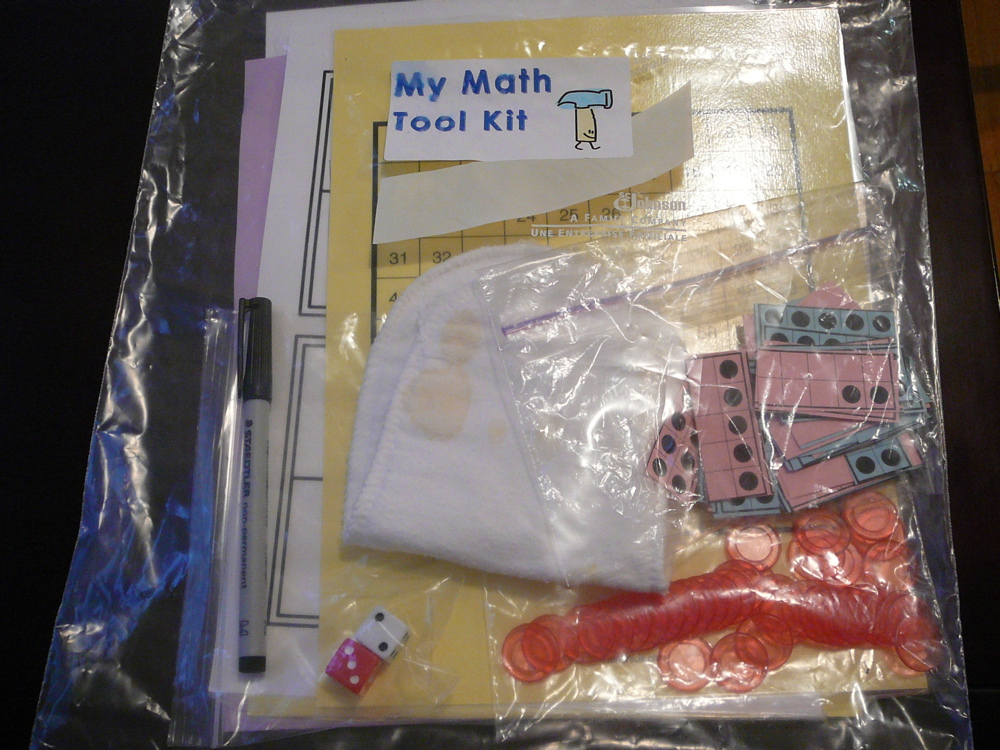
I spent about $6 on dice, $12 on counters and $20 on Ziploc bags (because I wanted the giant sized ones…). Everything else involved photocopying and laminating costs, which I was able to do through my school.
-
Math Tool-Kit Materials List
makes one bag or one tool kit, for one kid…
1 extra large Ziploc Bag (2 gallon size… they come 10 to a box and are bigger than the standard freezer bag.)
2 dice – one white, one coloured
about 50 clear counters (I bought containers of 100 see through Bingo chips for $1 at the dollar store) in a snack-sized Ziploc
1 Overhead marker
1 small piece of fabric for erasing (optional – kleenex will do)
1 sheet of full ten frame cards, copied on blue bond paper and cut up (30 cards in all)
1 sheet of partial ten frame cards, copied on pink bond paper and cut up (30 cards in all)
a sandwich sized baggie to hold the ten-frame cards
1 laminated 100-chart.pdf (copied on bond paper)
1 laminated double-ten-frame.pdf (copied on bond paper)
1 laminated number-lines.pdf (copied on bond paper)
1 laminated dot-array.pdf (copied on bond paper)
1 dot array angle tool (aka two 2-inch strips of bond paper, stapled together perpendicularly)
instructions for games to play
consider adding things like a calculator over time…
**NOTE: All these blacklines (with the exception of the number lines) came from the Van de Walle resource, “Teaching Student Centered Mathematics, Grade 3-5”. They are available on-line… click here for more.
I enllisted the aid of some WONDERFUL students in Division 4 😀 who helped cut and trim and stuffed baggies for me on rainy days this past week, and so the task wasn’t so onerous.
I put labels on the outside of the giant Ziploc, with the words “MY MATH TOOL KIT” and space for the student’s name. And today, one of my colleagues (who uses a smaller Ziploc bag and some different contents) told me she VELCROs her math tool kits to the outside of her students’ desks!
cool. 🙂
Have fun!
Carole
GAMES TO PLAY WITH THE MATH TOOL KITS!
Here are some conceptual math games to play with the materials in students’ Math Tool Kits! Click on these files and you’ll get a pdf of the game.
difference-war.pdf
double-difference-war.pdf
doubles-snap.pdf
doubles-plus-one-snap.pdf
fact-family-feud.pdf
i-wish-i-had.pdf
i-wish-i-had-challenge.pdf
Of these, my favourites are “I wish I had…” and “I wish I had.. Challenge“.
These games are written as instructions for students, so you can print them and include them in the Math Tool Kits for play. I have adapted good stuff from other sources – Box Cars and One-Eyed Jacks and Teaching Student Centered Mathematics. Originating sources are referenced in the footers for the games.
Carole 🙂


 Mathematical Thinking