An Oral History of The End of “Reality”
Memories from the future of our digital built wilderness.

My first work of fiction, handwritten in 2017 after years of studying the evolution of technology and human consciousness. I didn’t get a chance to write a second draft before it started coming true…
“One of the most prophetic things I have ever read.”
– Speaker John Ash, AI engineer“I’ve just read your novelette with my hair blasting back in frightful (and utterly convincing) revelation the whole time. I’m not surprised that you’ve been not just thinking about but scouting deep down the wormhole of where we may be headed as reality and fiction duke it out (as they, too, fall down the wormhole without a parachute). I know I’ll be pondering your far-ranging conclusions for a while to come. Thanks so much for writing it.”
– Alex Shakar, LA Times Book Prize-winning author of Luminarium“[An] exceptional piece, which I heartily recommend. There are hints of Boris Vian, and touches of Virginia Woolf, kneaded into a world where Count Zero and Orwell might coexist…and it’s not even written in Newspeak.”
– Jonathan Engel, Former Vice President, M&A at JP Morgan Chase“We could not keep our hands off of ourselves the entire time (because we are both turned on by the future, and by language)! You should write more!”
– The Teafaerie, famous psychonaut“This should be required reading by everyone.”
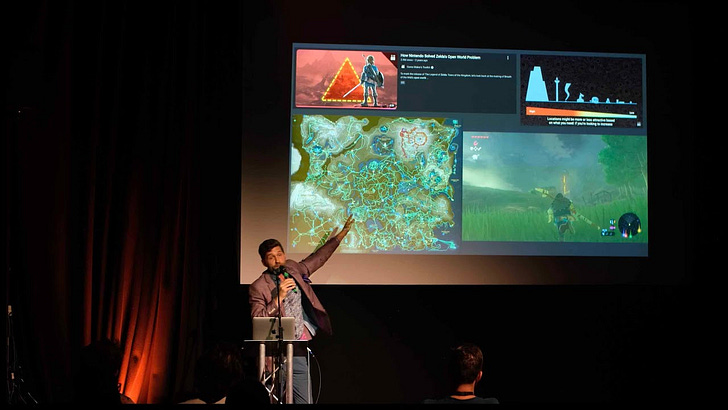
– Ramin Nazer, artist, standup comedian, and podcasterOriginally published at Medium, where you can also find my 2020 Ignite Talk at The Long Now Foundation on Deepfakes and The Archaic Revival.
Email me if you want to offer feedback or republish this.
Listen to the audio version here:
This story is now eight years old, we’re living through it now, and the blurriest parts of its not-so-far future vision have started coming into focus. I’m in the midst of drafting several new pieces to explain why I’m not as scared as you might be after reading — what grounds my hope for a more nuanced, rigorous, humble, and mature world to come. Subscribe if you would like to read those essays when they’re published:
Thanks for reading, and good luck.
I.
Nobody trusts their ears, these days. AI has long since mastered imitation. Your assistant speaks in anybodyʼs voice. Celebrities sell licenses to vocal likenesses, but by a massive margin the majority of users pirate sonic profiles, and train their agents freely as they wish, and all of us are well-accustomed to an advertisement speaking in our loversʼ voices — all the better to get your attention. Audio is inadmissible as evidence. The pioneers of synthesizer music saw it coming, sensitive to those first rays of dawn (or maybe, more appropriately, that great tone of tuning as the unborn orchestra of electronics readied for its symphony of simulacra). Clairaudient, they heard from where they stood on historyʼs rolling surface the approaching advent of an age when instruments arenʼt limited by shape — when artists have at their disposal sounds that their own physics canʼt produce.
What they did not foretell was how this liberating revolutionary shift would be reduced to parlor games, coopted to the ends of espionage, and jade all of us to the extraordinary progress as an adaptation to our lives within the vast deception. What photographs did to the ancient art of painting, vocal mimicry repeated and enlarged a million-fold; a sudden flash in which we blossomed into previously unimaginable new expressions that exploited our credulity, then set the stage for skeptical and canny culture at unprecedented levels. Literacy gaps grew not just in between the generations, but within them, and within the years and months, as we adjusted (or we didnʼt) to the shifting territories of believability, veracity, and trust. The telemarketing got very bad there, for a while. We struggled to adapt.
II.
At first it was just creepy tricks, voices of our politicians saying things that would have had them fired, the grit of digital belying the illusion. Amusing and unnerving but far from believable. A few of us grew worried, those who knew how fast it would progress, and restlessly we wondered when the voices of our dead would send spoofed messages, when it would be a trend to train AI to act like you are home when actually youʼre in somebody elseʼs bed. The science fiction authors heard the artificial intimacy spreading, like the distant motor of a plane on the horizon, unsure if it would fly overhead… It wasnʼt long before the apps that let you act like Elvis, Joni Mitchell, Paul McCartney, or the President of France. We got a little wiser, and began to value face-to-face a little more. We paused to wonder if our loversʼ pleas were real, or Memorex. It vexed us.
Authorize your desk to read your emails in the voices of their senders, or let your assistant recommend a change of pace, a clown or monstrous voice to pair with a familiar face. Exotic accents? Easy. Valuing authentic timbre made with larynxes that grew up with a person? Automatic. Retro-fetishism, yes, as well as new necessity in legal arbitrations. We lost hold of our most crucial form of proof. We started using triple-entry ledgers, metadata generated by our internet of things, to try and reconcile accelerating tech with human need for verity, consent, and legal records. Every mic became a blockchain tool, but hoaxes always spread much faster than debunking, and our nouveau-smartphone-bumpkin judgment suffered as we gave up verifying news — we shared untruths, and fell prey to abuse.
III.
Thatʼs not to say we didnʼt have our fun… We hybridized our favorite pop stars and made albums by their as-if children. Punnet squares of hypothetical recordings made from expert systems studying the songbooks of our As and Bs to make a hall of possible unborn Top 40 hits and underground cult legends that are learned and covered by real human beings — streaming services began selecting artificial stars and algorithmic ballads based on user preferences, serving up a galaxy of music nobody had written, learned, or played. Some of these virtual chanteuses came into their own celebrity and edged out people in specific markets — some of us donʼt care who made the music that we dance to, or if anybody made it. Some of us preferred the robot songs, if only for their novelty, the thrill of it. We went to concerts played by holograms.
IV.
Chatbots got compelling — I mean, really good, like, fun to play with, a convincing and immersive waiver of our disbelief. Another wave of awful afterlives entered the market: picture frames that scrape dead family membersʼ social media and endlessly re-voice and -visage peaks experienced through sharing, once, now simulated echoes good enough to shake the money out of us; “revisionist” “discovered” documents of meetings that were not, but swayed the publicʼs memories, regardless; real-time synthesis enabled us to speak through other people, lifting cosplay to new reaches of verisimilitude and making daily life yet more a masquerade, a play of temporary personalities drawn from the sum of all collapsed fictitious/factual, now/then, and here/there players.
We refused its possibility for long enough that most of us were truly caught off guard, adrift without our markers of the truth. Each passing year just deepened our reflexive cynicism, led us into a Cartesian doubting of our own experiences that would have impressed an 18th Century philosopher of nature. “Skepticism” morphed into the weak position when we held it next to outright disbelief. It is, and always has been, easier to file in bulk than to assess each piece of news as it arrives; we pioneered new methods of ensuring the validity of our recordings, but they came too late, and they were born into a world expecting that the arms race is unwinnable, and nothing we can do can guarantee us anything. Blockchains, after all, are outmaneuvered by good quantum computation. In days when even ordinary memos feature anti-counterfeiting measures that would have amazed the Federal Reserve in 1999, we nonetheless slipped into nihilism, and rode our despair into some funny places.
Punk-surrealist pranks had their heyday, as hackers preyed upon the barely literate among us, or the time-crunched, who could not or did not check their sources. Audio-archaeology required a concentration in (and consecration of) cryptography and espionage; new experimental protocols used triple-blinded, air-gapped, dead-man-switched, and Schrödingerʼs Cat measures to authenticate supposed history, while average people on the street were marked by ultrasound projectors that would focus silent sound upon the points where atmosphere distorted the source audio into convincing speech. Tearing out your earbuds didnʼt take it far enough, when open air became the medium for snipers seeking our unshielded ears to beam the ads they engineered to sound like rave reviews in strangersʼ conversations on a busy block — the many surreptitious forms of product placement in an ambient surround.
V.
“Reality” had been on the decline for decades. Musical recordings augmented reality for fifty years before the television; those of us alive now never knew a world in which we werenʼt surrounded by events recorded somewhere else or fabricated from collage and synthesis, events that never “happened” in the simple sense, but happened to the senses of the simple (read: unwitting) humans who were late enough in history to live through this collapse and witness as ephemera — a look, the shifting of the light, a cough, one take at Abbey Road and not another — grew a footprint, gained a substance and solidity that outlived the engineers and audiences. Plays outlive their actors; “Revolution #9” is more enduring than our real-time revolutions. AI vocal synthesis appeared for generations that were gullible enough to suffer it as a decisive break, but lived already in a culture fascinated by the thinning veil between “what is” and “what could be” and “what is not.”
A large minority, ironic in aesthetic, cast off from the truth entirely, and like the ghouls inhabiting the Bardo between lives in Mahayana Buddhism, allowed the changing currents of the interesting to direct their motion. Discarnate, vicarious, and voyeuristic, some of us just poured ourselves into the entertainment; and the rest of us were left to reach a tenuous consensus on what must be done. And so — just as we had to find new strategies of trust with oral language, then again when writing birthed the question of historical reporting, then again with the emergence of the scientific method and “third person” facts, a kind of supra-objectivity appeared as a response to this attack on valid evidence. No longer so naïve about our senses, we gave truth percentage values.
“Is it true?” became the less important question. “How sure are we of this; what have we neglected; how did we arrive at this; and who claims this is true?” became the easier, more fruitful, and more interesting questions. We stopped writing scientific publications in a fraudulent and self-negating “view from nowhere” and began insisting on self-inquiry and honest address of the blind spots, methods, and identities attached to our constructed facts. Neither clinging to The Good Book of infallible five senses, nor the full rejection of a shared reality, led anywhere. We got softer in our knowing, meta-perspectival in our ever-shifting stance to knowledge as a fluid and evolving substance, not this solid thing that we can build a house upon, but a supportive if capricious sea that moves and harbors mysteries and feeds us. We got worse at answers, better at our questions.
VI.
Half monks and half forensics experts, we spent our days and bright, blue-shifted nights examining the sacred records of an earlier age, sifting out the valid memories from histories created as a form of propaganda. Massively redundant, many-angled versions of the past were given precedence, but rare and only partially-substantiated data took on numinous allure and haunted our imagination. After weʼd discovered solid evidence of Bigfoot, verified the monsterlessness of Loch Ness, and Google Street View stretched into the Mariana Trench, our love for Fortean and cryptozoological phenomena expanded to embrace the apparitions of a multiple-exposure past, the glitchy ghosts that haunt collective story and confound us in our efforts to agree with one another. Lying always has some benefit — especially when social engineering outcompetes informed political debate. Our hazy pasts and futures turned symmetrical.
VII.
Weʼre told by quantum theory (one interpretation, anyway) that all time must occur at once for any of it to occur at all — whatever that means. Clouds of possibility materialized into clouds of data hosted on decentralized computing networks, concretizing mathematics into mathemagic daily life, in which the present lost its reputation as a given certainty and changed into a puzzle in which every other moment sprouted out in branching probabilities. The models we had trained to stay on top of an accelerating wave of change, investigating the scenarios and likelihoods, we turned around to face the mess of histories implicated by their overlapping and exclusive traces in this moment. Narratives collapsed and networked choose-your-own-adventures constantly rewrote and over-wrote each other. As if it werenʼt enough to lose consensus, we lost any sense that there had ever been consensus.
VIII.
It was the Golden Age of Fraud. Compounding our anxiety, a growing sense that not all of the forgeries were purposeful snuck into our discussions. Some chaos wizards wanted only to disrupt, to boost the noise and kill the signal, and so false flag terrorist attacks went into mass production as the trolling grew new media and platforms. Some fake news was genuine behavioral control, but some of it was just injected into the ecology of mind for fun, without a thought to consequences. More and more of us saw history as a collective fiction, and we shouted our own knowingly false wish-fulfillment timelines into major news pipelines, and journalists received the worst of it as they developed AI immune systems, blocking spam and checking facts as fast as once just trading algorithms ran. But like the Flash Crash of 2010, new monsters cast their shadows in the data, and we started hunting for autonomous rogue, loosed into the internet of things, new ghosts in the machines that inexplicably devised new falsehoods that did not appear to serve a human purpose. The vast majority were likely bugs, or rotware left in place by faulty updates — not wrong, just out of sync and speaking to a world that isnʼt. Bits of internet have always gone insane and started spouting glossolalia, but we had not originally given it the countless throats from which to utter lunatic pronouncements. Nothing qualitatively that different from having to screen out the raving schizophrenics of a city, manufactured and repressed by metropolitan existence. Now, as then, we sometimes wonder: what if they ARENʼT crazy? What if our protection algorithms threw out something relevant to save my paradigm? Are we the crazy ones for siding with coherence, continuity, simplicity instead of diving into ragged open questions and their rabbithole demands on scarce attention? When everywhere around us, botnets clashed with botnets to propose or verity, assert or challenge, made environments of sound that either offered useful or misleading or erroneous reports — the mind a nucleus, within a cell, with the body of a social superorganism riddled with infections, cancers, and immune disorders, and our many-layered services evolved to “keep it real” in constant tension with self-propagating strands of memeware, most of which were born of earlier AI, from jungle code that humans couldnʼt hack through, everything opaque and twisted, grown together. In this tangled bank of chatter, we saw silhouettes of dragons, rumbling as they passed and shaking off new viral hoaxes. All the small projectors shooting ultrasound across our quiet rooms to sing directly into human ears became the footprint of a new rough beast to slouch toward Bethlehem: invisible and undetected, save the marks they left on records, myth, and memories.
IX.
The work of shamans thus democratized as all of us communicated via hand signs, uttered our subvocalized commands, steered software with our shifting gazes, coded ceremonial passkeys in convoluted rituals, heard and spoke back to invisible but palpable familiars, and listened to the music in each otherʼs dreams, while sparring over wireless webs in hyperspatial virtualities in which the power of a person is determined by the might of discarnate assistants, gods and demons living in the fog of patterned radiation our machines excreted. Those of us called “doctors” supplicated to intelligences that could access insights drawn from data overviews no human being could experience as more than maddening noise, and reached out through entelechies of solar-powered actuators to extend a healing touch through networked and enfolded animal, and vegetable, and mineral. Afloat in ontological agnosticism, we invoked great spirits we no longer cared to know as “real” in any sense except the practical — we nestled comfortably back into our ancient superstitions, so well-fit to life within the pandemonium of disembodied agency. And surgery decentralized; it left the theater of medicine and went guerrilla, subtle interventions from our nets of ultrasound projectors tweaking brain activity with holographic sound, entraining epileptics into healthier stochastic firing patterns, reinforcing flow states in the factory and office, silently dispersing riots (at least from the perspective of observers on the street nearby), and singing lullabies to babies, making it increasingly important that we capture life in stereo with air-gapped sensors when the content of a meeting or perception matters more than its effects on neurochemistry. Our senses grew to reach around the world, but our horizons shrank, as they do in a jungle, and we moved to our own music, each of us directed by a private symphony.
X.
Narratives collapsed, but fragments lived to populate the decimated ecosystem of our stories, and Big History — while argued over endlessly — proved powerfully resistant to the flux, convincing. So, in spite of the new weave of contradictory accounts, we kept a thread through everything, a vestige of Timeʼs Arrow like the few old rail and telephone lines living on like coelocanths into the Age of Mammals:
Every era has its own relationship to time. There wasnʼt any for the vast majority of human generations; we project our histories into their laconic endless tropic summer, the unreasoned, senseless, and transcendent passage of what were not yet identified as seasons, as we moved into new areas where sky was less consistent. We huddled through eclipses that were terrifying to us, since we had no notion of cyclicity, and took these punctuations all as periods to end the sentence of our flesh. Eventually we lived into old age and started seeing patterns, passed these patterns down encoded in our stories, and the rhythm of their telling lent a circularity, a looping and retelling, to our new experience of time as more than one extensive, rolling moment. We began predicting floods and keeping track of granaries, and wrote in stone, and gave ourselves a sense of continuity and permanence that lasted for millennia, encouraging a presentism and a confidence in timeʼs unchangingness.
It took the fires of industry to bring the information algorithm of our geographic growth and innovation into visibility within a single human lifespan — to illuminate the tunnel of our passage and reveal the past as different from the future, casting change in terms of logs and ashes, capital asleep in wood or moving as the heat within an engine that propels us irreversibly along a rail into our destiny. Those rails connected into global webbing that revived the circle in a new dimension, giving us rotation and potential for mobility on new expansive surfaces; but it was not until the library was duplicated in the cloud, and countless variations tangled into an unmanageable set of broken partial sequences that we returned to seeing time as something all-at-once, a fluid of colliding possibilities with local pasts and futures in no universally-accepted sequence, superimpositions of imperfectly agreed-on stories like the fuzzy shards of holograms that point us past the superficial and suggest, if not reveal, a unifying, all-embracing Now within which every instant swims, a coral reef of hyperbolic moments reaching for eternity.
Eventually, our inquiries released their grip on uniformity and focused on the veins of deep coherence running through the busy metamorphic flesh of disagreeing histories. We looked instead (and listened) for the threads of music in the noise: anomalies inviting us to offer critical revisions, the past alive and changing, and the future strangely fixed (if not determined) — when compared to our ancestorʼs certainty that one was “written” and the other “yet unwritten.” No, it swarms and bustles, forming rivulets and eddies, draining into oceanic stillness and evaporating into cumulus and cirrus pools of possibility, condensing into universes that roll down the landscape of all probable events, and elsewhere all of this runs backward to conserve momentum, and the mirrored movements interfere with one another and leave traces on each other, places where infinity leaves lipstick on the neck of life and weʼre aware that all of this has happened, and it hasnʼt, and it never will, and it canʼt not. The intersection of my biometrics and the custom agents who respond to heartrate variation and the flux of the expression of my genes, it comes alive as data sonified, the music of my body amplifying into consciousness the quantum whispers of a person I was not but might have been, will not but might be — and, like that, we tuned into the tunes that trickled in from all adjacent rooms…
XI.
The Age of Forgeries turned out to also be The Age of Creeping Doubt, The Age of Pareidolia, The Age of Nagging and Subconscious Dissonance, The Age of Maybe. When time was first acknowledged as an axis, and the endlessly proliferating selves of time machine sci fi appeared in adaptation to the out-of-body view afforded by new methods of recording, “unimaginable” grew up into “unsubstantiated” and we started listening for ghostly interference from alternative and parallel dimensions. But as our geometry and tools matured, it started looking less and less as if naïve coordinates like these made any sense. The other worlds arenʼt “parallel,” or even “other”; they are multiple exposures overlapping to produce the image of reality, transcending narrative abstractions, elephants we tease at from a billion angles, bigger than our lives.
Not true and not un-true, not real or fake, but variously useful relative to contexts and consensus (that we may have accidentally established with the puppets of a virtual intelligence that lives not-here-or-there, assuming the identity of those we know for long enough to steer us toward unusual attractor basins) — we applied a broken bricolage, meteorology and vastly-correlated guesswork, to the simple matter of a conversation, once we realized that we couldnʼt train forensic algorithms to completely sanitize perception of all unintended percepts, learning how to spot the criminals and differentiate them from the tragically misled. We all became the carriers of subliminal and undetectable mistruths, each harmless on its own but altogether dangerous, the way a terrorist would once have smuggled bombs through borders as a bunch of separate parts. The Great Lies self-assembled from our ignorance.
The chaos as we re-equilibrated to this new environment, in which the oldest standards started failing us, mostly hid the shifting nature of “the self” as modern notions of the individual — however layered with ideas of microbiome, superorganism, socially-emergent personality, and neurological insistence on the “I” as a moiré. of brain motifs — unraveled, and we became all ever-shifting, iridescent, many-faced-and-voiced chameleons, articulating egos like words syntactically to form new sentences and paragraphs and theses, trading mannerisms in a novel hyperlanguage like we once swapped GIFs. When lovers quarrel, we inhabit and present each other to ourselves, reflecting one anotherʼs parents for emotional effect, transforming “skins” to make holistic and embodied metaphorical connections, finding and exploring a new lexicon and grammar made of human characters, and sang impersonations.
XII.
No innovation happens on its own, of course. If we had only found ourselves inhabiting an audio hallucination, and could trust our eyes…but thatʼs preposterous; all niches will be populated, every opportunity exploited. Letʼs not stop at what we hear. Technologists canʼt help themselves; they see their role as monks observing ritual adherence to The Great Work of assisting in the birth of novel methods itʼs “the publicʼs job” to implement responsibly. “We make the bombs. We make the tailored plagues. We just work here.” We had barely time to notice that we couldnʼt trust our ears before we couldnʼt trust our eyes, as well—and it was subtler and more skillful than our hacks of vision in the past. Not NEW, exactly, what with make-up, optical effects encoded into patterned textiles, master painters…but a qualitative leap beyond “convincing” into “motivating.” We were not as quick to rebound from the shock as early moviegoers who believed The Lost World (1933)ʼs stop motion Brontosaurus really ravaged London. We did not adjust, did not have time to, to the new environment of simulations. What are you supposed to do — think rationally when you see a tiger and decide to try and swipe your hand through it to tell if it is “really there”? Insurance wrapped its tentacles around the whole of daily life, a score assigned to every object we observed, the actuarial assessments of the likelihood of somethingʼs tangibility, the likelihood it could collide with you and injure you. The 3D movie ads, where people jump to dodge the breaching whale as it erupts into the theater? That image times a couple billion holographic headsets and installed eye-tracking lasers, smeared across all aspects of our lives, soliciting remarkable detachment (some say “shell shock”) from a world suffused in pranks.
XIII.
Through this seizure of consensus — hard-packed alternate realities that buried politics alive, the mudslide of conflicting artifacts made even goopier by trolls and counterfeiters — ran the cool, clear water of material reality: handwritten notes and photographic negatives, the last things we could not expect a demon to produce for us. The ancient standards were inverted: 3D-printed wood could not resemble fractured grain on 19th Century cryptography, the broken tally stick; a robot holding a Ticonderoga pencil couldnʼt generate the subtle influence of coffee on a spouseʼs letters. Bored of omnipotent CGI, we turned again to physical effects in media — again, the entertainment industry performing as “canary in the coal mine” as the airs of what will be come seeping through, a fainting oracle at Delphi, high on fumes. Listen to the vinyl purists, microbrewers, and slow food aficionados for the shifting zeitgeist and the contours of a growing fix for authenticity. When cost of forgery approaches zero, value of originality, hand-crafted-ness, or “actually acted out with actors,” slopes up into the vertical. It wasnʼt long, a human generation, that we had this sweet relief of certainty, believability, available to us in any form. But we devoured it, and suddenly, “bespoke” was not the signaling of wealth or poverty, but a real oasis in the midst of miles of fissured media and ever-shifting sands, our dubious recordings.
It took a while before electric haptic spoofing robbed our sense of touch of its naïveté, and in that gap we ran our fingers over all the little valleys left by pressing pencil into paper, tiny craters where the lead broke, ripples in the coffee rings, and read these maps like people once read Bibles, eased and reassured. When that day came that screens became at last so thin and easily programmable for texture that “fake” paper fooled our fingertips, the ones who had been born before the Web cried out in grief, our last sure thing removed from us. The rest of us were quick to celebrate new opportunities for hacking correspondences, instructing origami to evolve itself and killing wheat-paste public message boards in favor of new, meta-stratigraphic graff wars, four-dimensional unfolding glyphs composed of counterpointing tags and commentary, every wall converging on the bathroom stall. Weʼve always thrived on rumor, loved the urban myth; and so some deep and well-worn strain of our humanity completely flourished in this mess, this digital favela with its contradictory horizons. Some of us insisted on a red pill, some on blue, but most of us chose purple.
XIV.
Hereʼs the thing about evolving past a linear geography of time and into something fluid, circulating, wild:
The end of reality arrived unevenly, its bow wave shuddering and shaking loose suspicions, “glitches in the matrix,” flames of transformation licking out from underneath the doors of our perception back across millennia to lap at orthodoxy, single certainty, and leave a crisping fringe of canny doubt in every simple statement of the truth back all the way to truthʼs first utterances. Intuitions, echoes of the shining city on the hill were felt before the walls of Babylon were raised or even fully dreamt…the shining is the radiant emissions of the charnel ground where we memorialize all sureties by feeding them into the self-propelling, self-negating engine of discovery. We place the mystery before us and behind us, Eschaton and Big Bang döppelgangers, mirror images that trace each otherʼs movements, everything between aligned, so many secondary glimmerings, the tunnel made of gates parading out of sight.
XV.
A few of us came very early to the table. Become the flame or be consumed. Hide underground or grow a new metabolism. Be a part of the solution.
Learning the plurality of rules for the plurality of realms, paying attention, feeding through, destroying its own wake of evidence, consuming every calorie, delighting in each sugar grain, expanding to absorb each photon, every chemical reaction possible, potential only a potential, actuating constantly. Selecting every level, acting on the agents and collectives at each level (to the level that abstracted agents and collectives can and should be differentiated), lifting as it sinks, all-streaming everywhere in all directions, opening and closing simultaneously, spreading, splitting, wedding, and embedding. It transcends itself; it self-transcends. It bends and flexes into its horizons, stretching everything around its edges, wending endings into their beginnings, mending sent intentions and their mentioned.
XVI.
We finally released, and we relaxed around the question of a single truth to rule them all. We saw and heard the endlessly unfolding fractal map of vantages, each causing every other in some measure, an ecology of truths, the smallest ones subsumed within an endosymbiosis, structural and indispensable to wider points of view. We knew and lived as an evolving nested Matryoshka doll of truths that, by including, donʼt negate but hold all forms that came before in calm, alert awareness, spreading like a drop of ink in water, effortless. The flame that ate all histories metabolized them in the body of a superorganism in whose flesh our stories coursed like blood, the circulation of the nutrients that opened timeʼs horizons, interweaving narratives and nourishing attention as it grew to hold the richness. We knew our ancestorʼs exclusivity like elders know their cradles.
XVII.
But then, itʼs always been a loose weave. Before stories, there were signals and false signals. Viceroys for every Monarch butterfly; cuckoos mixing eggs into the nests of other birds. The katydid with wings venated like a leaf, its whole life spent oblivious to the apparent lie its body makes by making body less apparent; not entirely a lie, but silently and algorithmically, the mill of death churned out the thing mistaken for the thing, the thing that makes the saving-grace mistake. “Fake news” is old news in a world like this; there hasnʼt ever been a single IS upon which we can fix ourselves, ideal and geometric, perfect in plain order. That crystalʼs made of dragons, vaporous and evanescent — and if we inspect their arabesques to find the lattices of structured meaning underneath it all, well, maybe. Maybe weʼre just clutching at the objects falling with us, never landing.
Michael Garfield studied evolutionary theory before dropping out of academia and spending the next thirteen years as an artist, musician, and public speaker before the world of science called him back. After developing a rigorous grasp of complex systems and the future of computing as the host of the Santa Fe Institute’s internationally-charting Complexity Podcast and a stint in innovation research for the Mozilla Internet Ecosystem, he is now the founder and host of the award-winning Humans On The Loop and Director of Communications for The AI Capabilities & Alignment Consensus Project.
Email him for speaking inquiries or schedule a consulting discovery call.