<?xml version="1.0" encoding="utf-8"?><feed xmlns="http://www.w3.org/2005/Atom" ><generator uri="https://jekyllrb.com/" version="3.10.0">Jekyll</generator><link href="https://jarrome.github.io/feed.xml" rel="self" type="application/atom+xml" /><link href="https://jarrome.github.io/" rel="alternate" type="text/html" /><updated>2025-09-26T09:02:35-07:00</updated><id>https://jarrome.github.io/feed.xml</id><title type="html">Yijun Yuan</title><subtitle>PhD student, Wuerzburg University</subtitle><author><name>Yijun Yuan</name><email>yijun.yuan@uni-wuerzburg.de</email></author><entry><title type="html">Fully Autonomous implementation of Rescue Robots on Tough Terrain</title><link href="https://jarrome.github.io/posts/2020/04/autonomousRescue/" rel="alternate" type="text/html" title="Fully Autonomous implementation of Rescue Robots on Tough Terrain" /><published>2020-04-01T00:00:00-07:00</published><updated>2020-04-01T00:00:00-07:00</updated><id>https://jarrome.github.io/posts/2020/04/autonomous-flipper</id><content type="html" xml:base="https://jarrome.github.io/posts/2020/04/autonomousRescue/"><![CDATA[<p>In this project, I will attempt to make fully autonomous of our small rescue robot on various terrain. 
It will consist of localisation(6DoF), planning and execution(flippers &amp; wheels).</p>]]></content><author><name>Yijun Yuan</name><email>yijun.yuan@uni-wuerzburg.de</email></author><category term="Rescue Robotics" /><category term="Motion Planning" /><summary type="html"><![CDATA[In this project, I will attempt to make fully autonomous of our small rescue robot on various terrain. It will consist of localisation(6DoF), planning and execution(flippers &amp; wheels).]]></summary></entry><entry><title type="html">Point Set Registration</title><link href="https://jarrome.github.io/posts/2019/07/psg/" rel="alternate" type="text/html" title="Point Set Registration" /><published>2019-07-01T00:00:00-07:00</published><updated>2019-07-01T00:00:00-07:00</updated><id>https://jarrome.github.io/posts/2019/07/point-set-registration</id><content type="html" xml:base="https://jarrome.github.io/posts/2019/07/psg/"><![CDATA[<p>This is the project during my research visiting at Andread Nuechter’s group. The goal is to build efficient feature for very large point cloud matching, e.g., the city data, which is a challenge due to the large size of data and the weak capability of recent descriptor in such a dataset.</p>

<p>To achieve the goal, it consists of two subprojects.</p>

<h3 id="a-new-formulating-of-registration-problem">A new formulating of registration problem</h3>
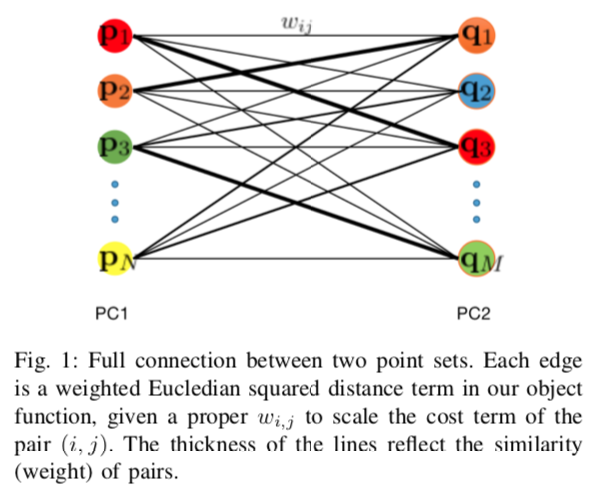
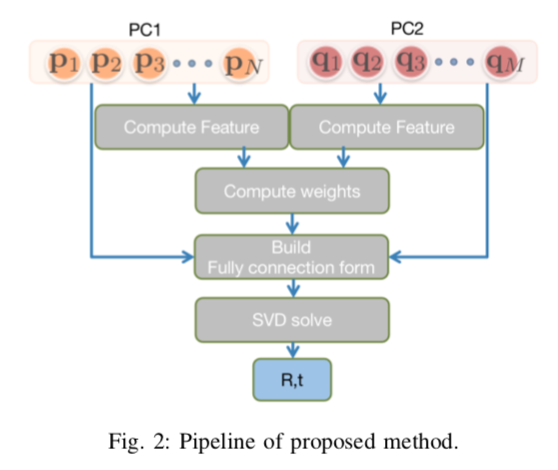
<p>In this work, we propose to directly find the one- step solution for the point set registration problem without correspondences. Inspired by the Kernel Correlation method, we consider the full connected objective function between two point sets, thus avoiding the computation of correspondences. By utilizing least square minimization the transformed objective function is directly solved with existing well-known closed-form solutions, e.g., singular value decomposition, that is usually used for given correspondences. However, using equal weights of costs for each connection will degenerate the solution due to the large influence of distant pairs. Thus, we additionally set a scale on each term to avoid the high cost on non-important pairs. As in feature-based registration methods, the similarity between descriptors of points determines the scaling weight. Given the weights we yield a one step solution. As the runtime is in O(n2), we also propose a variant with keypoints that strongly reduce the cost. The experiments show, that our proposed method gives a one-step solution without an initial guess. Our method exhibits competitive outliers robustness, accuracy compared with various methods. And it is more stable to large rotation. In addition, though feature based algorithms are more sensitive to noise, Our method still provide better result compared with the feature match initialized ICP.</p>

<p align="center">
  <img src="https://jarrome.github.io/files/fc.png?raw=true" alt="Photo" style="width: 450px;" /> 
  <img src="https://jarrome.github.io/files/cf.png?raw=true" alt="Photo" style="width: 450px;" />
</p>

<ul>
  <li>Yuan, Y., Borrmann, D., Nüchter, A., &amp; Schwertfeger, S. (2020). Non-iterative One-step Solution for Point Set Registration Problem on Pose Estimation without Correspondence. arXiv preprint arXiv:2003.00457.</li>
</ul>

<h3 id="deep-feature-by-supervising-on-the-one-step-solved-transformation">Deep feature by supervising on the one-step solved transformation</h3>
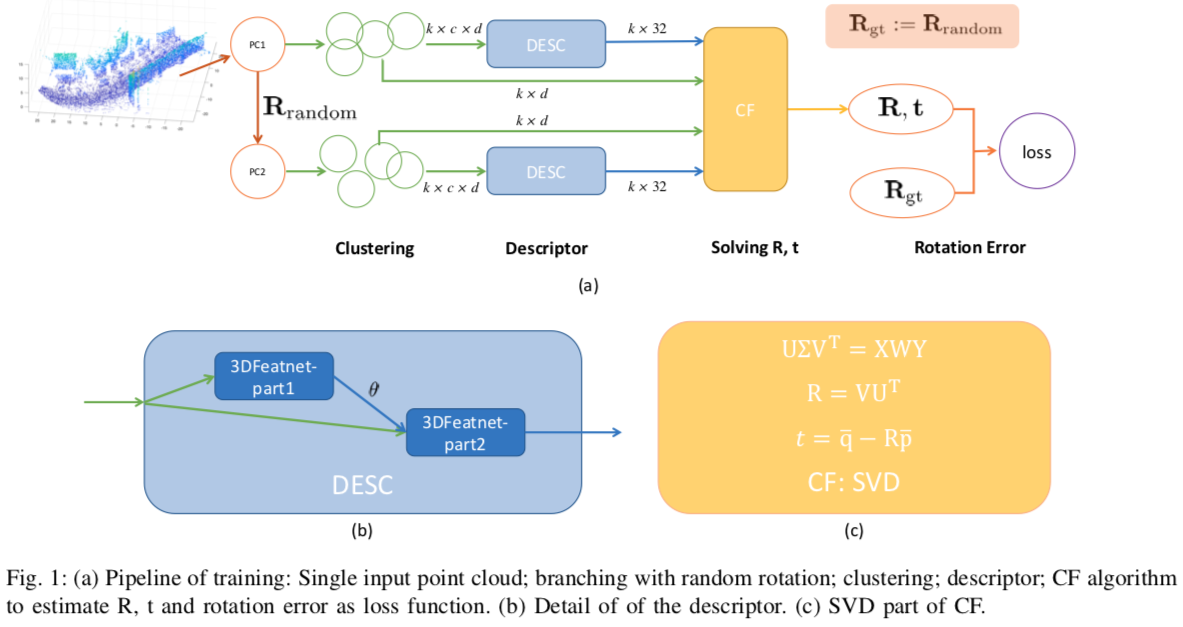
<p>In this work, we propose to learn local descriptors for point clouds in a self-supervised manner. In each iteration of the training, the input of the network is merely one unlabeled point cloud. On top of our previous work, that directly solves the transformation between two point sets in one step without correspondences, the proposed method is able to train from one point cloud, by supervising its self-rotation, that we randomly generate. The whole training requires no manual annotation. In several experiments we evaluate the performance of our method on various datasets and compare to other state of the art algorithms. The results show, that our self-supervised learned descriptor achieves equivalent or even better performance than the supervised learned model, while being easier to train and not requiring labeled data.</p>

<p align="center">
  <img src="https://jarrome.github.io/files/self-supervised.png?raw=true" alt="Photo" style="width: 650px;" /> 
</p>

<ul>
  <li>Yuan, Y., Hou, J., Nüchter, A., &amp; Schwertfeger, S. (2020). Self-supervised Point Set Local Descriptors for Point Cloud Registration. arXiv preprint arXiv: 2003.05199.</li>
</ul>]]></content><author><name>Yijun Yuan</name><email>yijun.yuan@uni-wuerzburg.de</email></author><category term="pose estimation" /><category term="regiatration" /><summary type="html"><![CDATA[This is the project during my research visiting at Andread Nuechter’s group. The goal is to build efficient feature for very large point cloud matching, e.g., the city data, which is a challenge due to the large size of data and the weak capability of recent descriptor in such a dataset.]]></summary></entry><entry><title type="html">Flipper Planning for Rescue Robots</title><link href="https://jarrome.github.io/posts/2019/04/flipper/" rel="alternate" type="text/html" title="Flipper Planning for Rescue Robots" /><published>2019-04-01T00:00:00-07:00</published><updated>2019-04-01T00:00:00-07:00</updated><id>https://jarrome.github.io/posts/2019/04/flipper-planning</id><content type="html" xml:base="https://jarrome.github.io/posts/2019/04/flipper/"><![CDATA[<p>This project propose a very inexpensive method on compute the rescue robot morphology (with flipper) in various terrain.</p>

<p>The implementation consists of 1. desgin the morphology can 2. control robot to achieve it. Generally, recent work focus on 2 while use state machine on 1 which is specifically for certain terrain. In this project, we solved the 1 that can deal with different terrain.</p>

<p>consists of initial flipper planning idea (SSRR2019) and flipper planning on 3D terrains.</p>

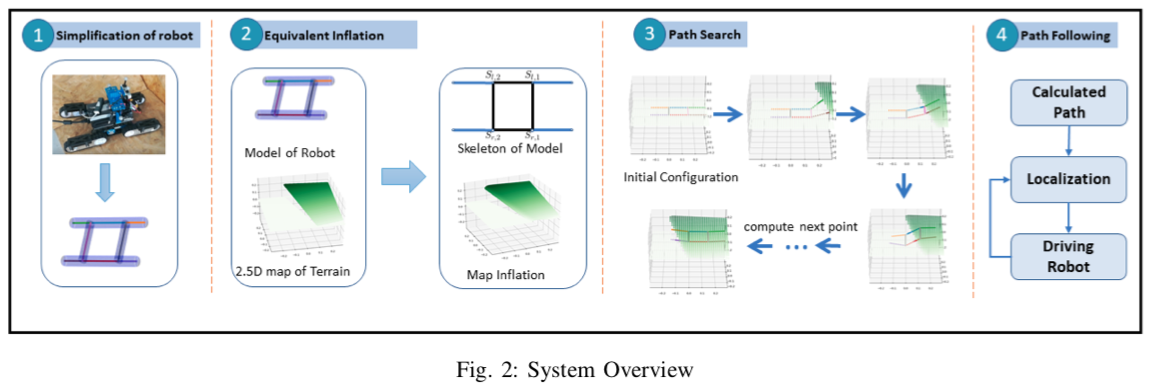
<h3 id="configuration-space-flipper-planning-for-rescue-robots">Configuration-space Flipper Planning for Rescue Robots</h3>

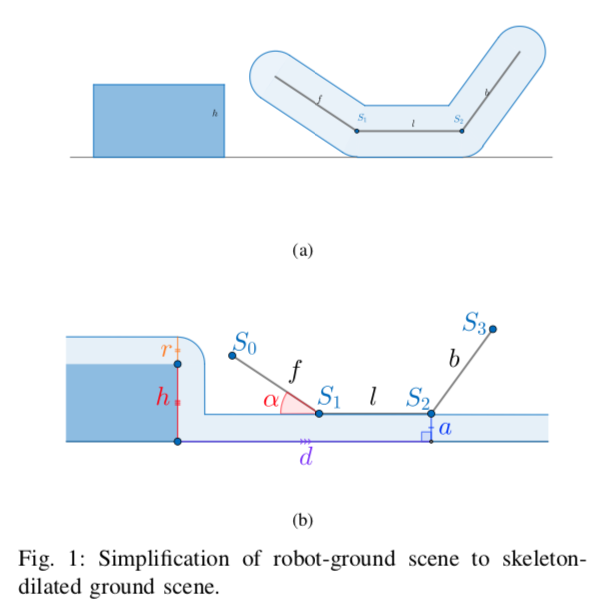
<p>For rescue robots, flipper endows the robot with additional ability to pass through various terrain. Autonomous motion becomes more important. In recent work autonomy is done by either planning with several special states or based on collected data. We are considering if it is possible to find a way to build continues states without collecting old trail data. In this paper, we first model the possible states as a global planning path with parameter configuration of the scene. Then, we follows the path to achieve the autonomous run. We plot the morphology of each path points to show the correctness of the path and implement a simple path following on real robot to demonstrate the performance of our algorithm.</p>

<p align="center">
  <img src="https://jarrome.github.io/files/flipperPlanning.png?raw=true" alt="Photo" style="width: 450px;" /> 
</p>

<ul>
  <li>Yuan, Y., Wang, L. &amp; Schwertfeger, S. (2019). Configuration-space Flipper Planning for Rescue Robots. In 2019 IEEE International Symposium on Safety, Security, and rescue robotics (SSRR). IEEE.</li>
</ul>

<p>The implementation can be found in <a href="https://github.com/STAR-Center/flipperplanning">github</a>.</p>

<h3 id="configuration-space-flipper-planning-on-3d-terrains">Configuration-space Flipper Planning on 3D Terrains</h3>

<p>Flippers are essential components of tracked robot locomotion systems for unstructured terrain, especially within a rescue scenario. Achieving full and semi-autonomy for such rescue robots is the goal of many research efforts. In this work, we propose an algorithm to plan the morphologies of a small rescue robot with four flippers over 3D ground without any extra sensor, such as pressure sensor. To achieve the goal, we simplify the rescue robot as a skeleton on inflated terrain. Its morphology can be represented by configurations of several parameters. Then we plan the mobile movement on 3D terrain with four individually manipulated flippers. We perform real robot experiments on three different obstacles. The results show that we move the flippers very effectively and are thus able to tackle those terrains very well.</p>

<p align="center">
  <img src="https://jarrome.github.io/files/flipperPlanning3D.png?raw=true" alt="Photo" style="width: 800px;" /> 
</p>

<ul>
  <li>Yuan, Y., Xu, Q. &amp; Schwertfeger, S. (2019). Configuration-space flipper planning on 3d terrain. ArXiv preprint arXiv:1909.07612.</li>
</ul>

<p>The source code will be released soon.</p>]]></content><author><name>Yijun Yuan</name><email>yijun.yuan@uni-wuerzburg.de</email></author><category term="Rescue Robotics" /><category term="Motion Planning" /><summary type="html"><![CDATA[This project propose a very inexpensive method on compute the rescue robot morphology (with flipper) in various terrain.]]></summary></entry><entry><title type="html">Incrementally Building Topological Graphs via Distans Maps</title><link href="https://jarrome.github.io/posts/2018/09/incremental-topo/" rel="alternate" type="text/html" title="Incrementally Building Topological Graphs via Distans Maps" /><published>2018-09-01T00:00:00-07:00</published><updated>2018-09-01T00:00:00-07:00</updated><id>https://jarrome.github.io/posts/2018/09/incremental-topo</id><content type="html" xml:base="https://jarrome.github.io/posts/2018/09/incremental-topo/"><![CDATA[<p>The problem want to solve is to generate the topological map incrementally during the investigation of robot such that the motion planning can benefit from it.</p>

<h3 id="incremental-topo">Incremental Topo</h3>

<p>Mapping is an essential task for mobile robots and topological representation often works as a basis for the various applications. In this paper, a novel framework that can build topological maps incrementally is proposed. The algorithm is using a distance map, and in our framework the topological map can grow as we append more sensor data to the map. To demonstrate our algorithm, we show the result of the distance map based method on several popular maps and run the incremental framework with raw sensor data to have a growing topological map, as an example of a robot exploring the environment.</p>

<p align="center">
  <img src="https://jarrome.github.io/files/incrementalTopo.gif?raw=true" alt="Photo" style="width: 800px;" /> 
</p>

<ul>
  <li>Yuan, Y. &amp; Schwertfeger, S. (2019). Incrementally building topology graphs via distance maps. In 2019 IEEE International Conference on Real-time Computing and Robotics (RCAR). IEEE.</li>
</ul>

<p>The implementation can be found in <a href="https://github.com/STAR-Center/IncrementalTopo">github</a>.</p>]]></content><author><name>Yijun Yuan</name><email>yijun.yuan@uni-wuerzburg.de</email></author><category term="map representation" /><category term="distance maps" /><summary type="html"><![CDATA[The problem want to solve is to generate the topological map incrementally during the investigation of robot such that the motion planning can benefit from it.]]></summary></entry><entry><title type="html">Randomized Sketches for Deep Kernel Learning</title><link href="https://jarrome.github.io/posts/2018/09/RS-DKL/" rel="alternate" type="text/html" title="Randomized Sketches for Deep Kernel Learning" /><published>2018-09-01T00:00:00-07:00</published><updated>2018-09-01T00:00:00-07:00</updated><id>https://jarrome.github.io/posts/2018/09/randomized-sketches-on-kernel</id><content type="html" xml:base="https://jarrome.github.io/posts/2018/09/RS-DKL/"><![CDATA[<p>In this project, randomized sketches has been applied on kernel ridge regression for stochastic learning of DNN feature extractor.</p>

<p>The report is in <a href="https://github.com/Jarrome/DKL2018">github</a>.</p>]]></content><author><name>Yijun Yuan</name><email>yijun.yuan@uni-wuerzburg.de</email></author><category term="Kernel Learning" /><category term="DNN" /><summary type="html"><![CDATA[In this project, randomized sketches has been applied on kernel ridge regression for stochastic learning of DNN feature extractor.]]></summary></entry><entry><title type="html">Fast Gaussian Processes Occupancy Maps</title><link href="https://jarrome.github.io/posts/2018/05/fast-gpom/" rel="alternate" type="text/html" title="Fast Gaussian Processes Occupancy Maps" /><published>2018-05-01T00:00:00-07:00</published><updated>2018-05-01T00:00:00-07:00</updated><id>https://jarrome.github.io/posts/2018/05/fast-gpom</id><content type="html" xml:base="https://jarrome.github.io/posts/2018/05/fast-gpom/"><![CDATA[<p>In this project, a real time GPOM has been provided.</p>

<h3 id="fast-gpom">Fast GPOM</h3>
<p>In this paper, we demonstrate our work on Gaus- sian Process Occupancy Mapping (GPOM). We concentrate on the inefficiency of the frame computation of the classical GPOM approaches. In robotics, most of the algorithms are required to run in real time. However, the high cost of computation makes the classical GPOM less useful. In this paper we dont try to optimize the Gaussian Process itself, instead, we focus on the application. By analyzing the time cost of each step of the algorithm, we find a way that to reduce the cost while maintaining a good performance compared to the general GPOM framework. From our experiments, we can find that our model enables GPOM to run online and achieve a relatively better quality than the classical GPOM.</p>

<ul>
  <li>Yuan, Y., Kuang, H. &amp; Schwertfeger, S. (2018). Fast Gaussian Process Occupancy Maps. In 2018 15th International Conference on Control, Automation, Robotics and Vision (ICARCV)(pp. 1502–1507). IEEE.</li>
</ul>

<p>The implementation can be found in <a href="https://github.com/STAR-Center/fastGPOM">github</a>.</p>]]></content><author><name>Yijun Yuan</name><email>yijun.yuan@uni-wuerzburg.de</email></author><category term="mapping" /><category term="gaussian processes" /><summary type="html"><![CDATA[In this project, a real time GPOM has been provided.]]></summary></entry><entry><title type="html">Area Graph</title><link href="https://jarrome.github.io/posts/2018/03/area-graph/" rel="alternate" type="text/html" title="Area Graph" /><published>2018-03-01T00:00:00-08:00</published><updated>2018-03-01T00:00:00-08:00</updated><id>https://jarrome.github.io/posts/2018/03/area-graph</id><content type="html" xml:base="https://jarrome.github.io/posts/2018/03/area-graph/"><![CDATA[<p>This project consists of area graph (ICAR 2019), passage graph and hierarchical area graph (My bachelor thesis).</p>

<h3 id="area-graph">Area Graph</h3>
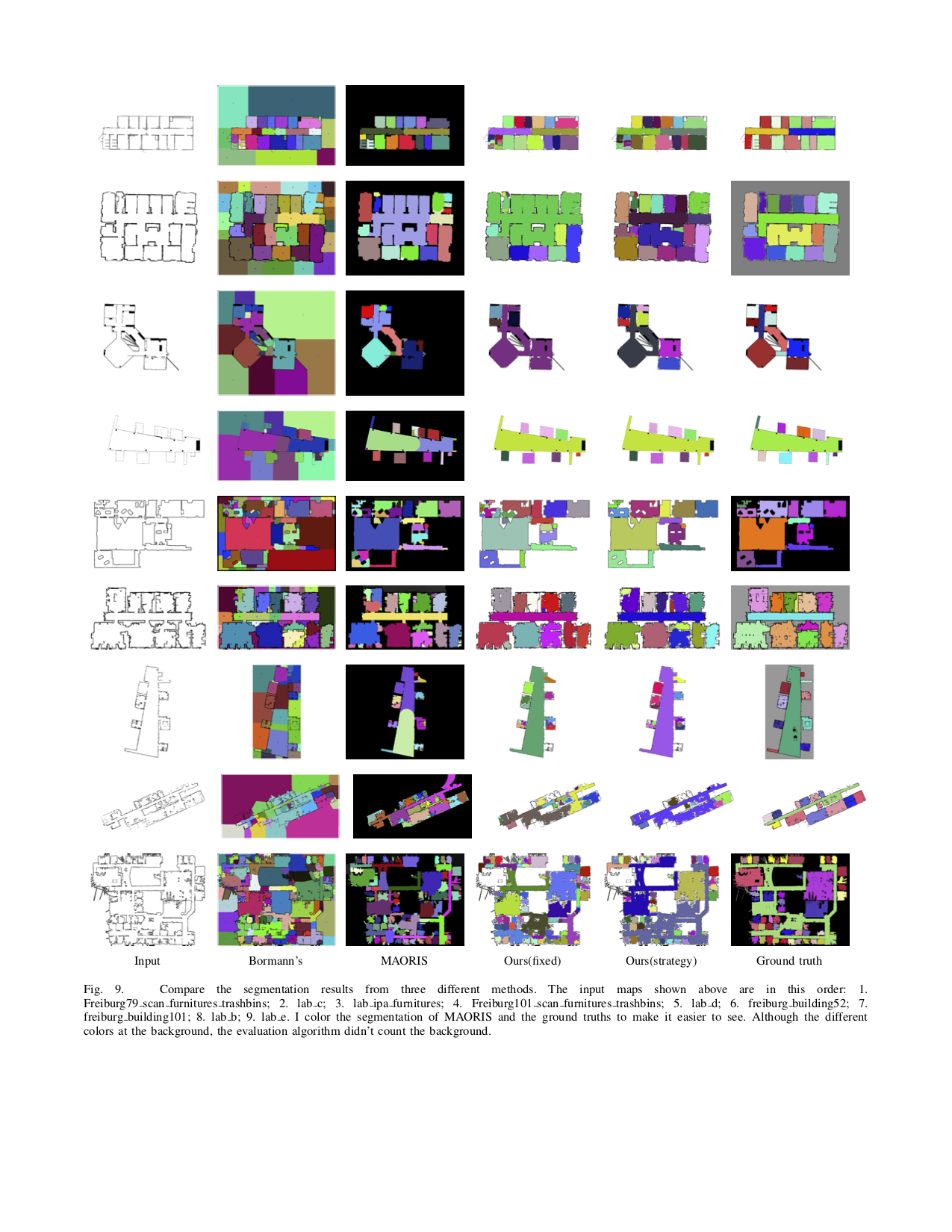
<p>Representing a scanned map of the real environ- ment as a topological structure is an important research topic in robotics. Since topological representations of maps save a huge amount of map storage space and online computing time, they are widely used in fields such as path planning, map matching, and semantic mapping.
We use a topological map representation, the Area Graph, in which the vertices represent areas and edges represent passages. The Area Graph is developed from a pruned Voronoi Graph, the Topology Graph. We also employ a simple room detection algorithm to compensate the fact that the Voronoi Graph gets unstable in open areas. We claim that our area segmentation method is superior to state-of-the-art approaches in complex indoor environments and support this claim with a number of experiments.</p>

<p align="center">
  <img src="https://jarrome.github.io/files/areaGraph.png?raw=true" alt="Photo" style="width: 900px;" /> 
</p>

<ul>
  <li>Hou, j., Yuan, Y. &amp; Schwertfeger, S. (2019). Area graph: Generation of topological maps using the voronoi diagram. In 2019 IEEE International Conference on Advanced Robotics (ICAR). IEEE.</li>
</ul>

<p>The implementation can be found in <a href="https://github.com/STAR-Center/areaGraph">github</a>.</p>]]></content><author><name>Yijun Yuan</name><email>yijun.yuan@uni-wuerzburg.de</email></author><category term="map representation" /><category term="area shape" /><summary type="html"><![CDATA[This project consists of area graph (ICAR 2019), passage graph and hierarchical area graph (My bachelor thesis).]]></summary></entry><entry><title type="html">Crowd Counting with DNN</title><link href="https://jarrome.github.io/posts/2017/07/crowdcounting/" rel="alternate" type="text/html" title="Crowd Counting with DNN" /><published>2017-07-01T00:00:00-07:00</published><updated>2017-07-01T00:00:00-07:00</updated><id>https://jarrome.github.io/posts/2017/07/crowd-counting</id><content type="html" xml:base="https://jarrome.github.io/posts/2017/07/crowdcounting/"><![CDATA[<p>This is my second project about DNN. In this project manage to order people label a crowd counting dataset and get very familiar to tensorflow.</p>

<p>Though still no result. The report is in <a href="https://github.com/Jarrome/crowdcounting2017">github</a>.</p>

<p>But I do learnd. From now on, I start to thinking myself and understanding DNN is not a perfect model.</p>]]></content><author><name>Yijun Yuan</name><email>yijun.yuan@uni-wuerzburg.de</email></author><category term="image regression" /><category term="classification" /><category term="DNN" /><summary type="html"><![CDATA[This is my second project about DNN. In this project manage to order people label a crowd counting dataset and get very familiar to tensorflow.]]></summary></entry><entry><title type="html">Retina Vessel Segmentation with DNN</title><link href="https://jarrome.github.io/posts/2017/05/retina/" rel="alternate" type="text/html" title="Retina Vessel Segmentation with DNN" /><published>2017-05-01T00:00:00-07:00</published><updated>2017-05-01T00:00:00-07:00</updated><id>https://jarrome.github.io/posts/2017/05/retina-vessel-segmentation</id><content type="html" xml:base="https://jarrome.github.io/posts/2017/05/retina/"><![CDATA[<p>This is my first research project. Though not good, but still rememberable for me. The report is in <a href="https://github.com/Jarrome/retinalSegmentation2017">github</a>.</p>]]></content><author><name>Yijun Yuan</name><email>yijun.yuan@uni-wuerzburg.de</email></author><category term="image regression" /><category term="classification" /><category term="DNN" /><summary type="html"><![CDATA[This is my first research project. Though not good, but still rememberable for me. The report is in github.]]></summary></entry></feed>