<?xml version="1.0" encoding="UTF-8"?><feed xmlns="http://www.w3.org/2005/Atom" xml:lang="en"><title>IndiaBioscience - Education</title><link
    rel="alternate"
    href="https://indiabioscience.org/columns/education"
    type="text/html"
    /><link
    rel="self"
    href="https://indiabioscience.org/columns/education/feed"
    type="application/atom+xml"
    /><id>https://indiabioscience.org/columns/education/feed</id><updated>2026-04-20T04:44:22+05:30</updated><entry><title>Gamified teaching tools: Bhojtal lake</title><link
                  rel="alternate"
                  href="https://indiabioscience.org/columns/education/gamified-teaching-tools-bhojtal-lake"
                  type="text/html"
                  /><summary type="html"><![CDATA[
                <p dir="ltr">As per the fourth goal of the <a href="https://unstats.un.org/sdgs/report/2023/" target="_blank" rel="noreferrer noopener">United Nations Sustainable Development Goals (SDGs) 2023</a>, providing quality education for all by 2030 is key to achieving equitable education. This becomes especially relevant after a global pandemic, during which 94% of the world’s student population was affected due to institutional closures. Teachers such as myself (Ananya) had to find emergency ways of handling the pandemic by trying different remote learning strategies. This had a disproportionate effect on students from marginalised communities in low- and middle-income countries.<br /></p>              ]]></summary><id>tag:indiabioscience.org,2025-11-28:/columns/education/gamified-teaching-tools-bhojtal-lake</id><published>2025-11-28T10:00:00+05:30</published><updated>2025-11-17T10:30:54+05:30</updated><author><name>Ananya Mukherjee</name><uri>https://indiabioscience.org/authors/gGWVL6YANpMqA6a</uri></author><content type="html"><![CDATA[
                
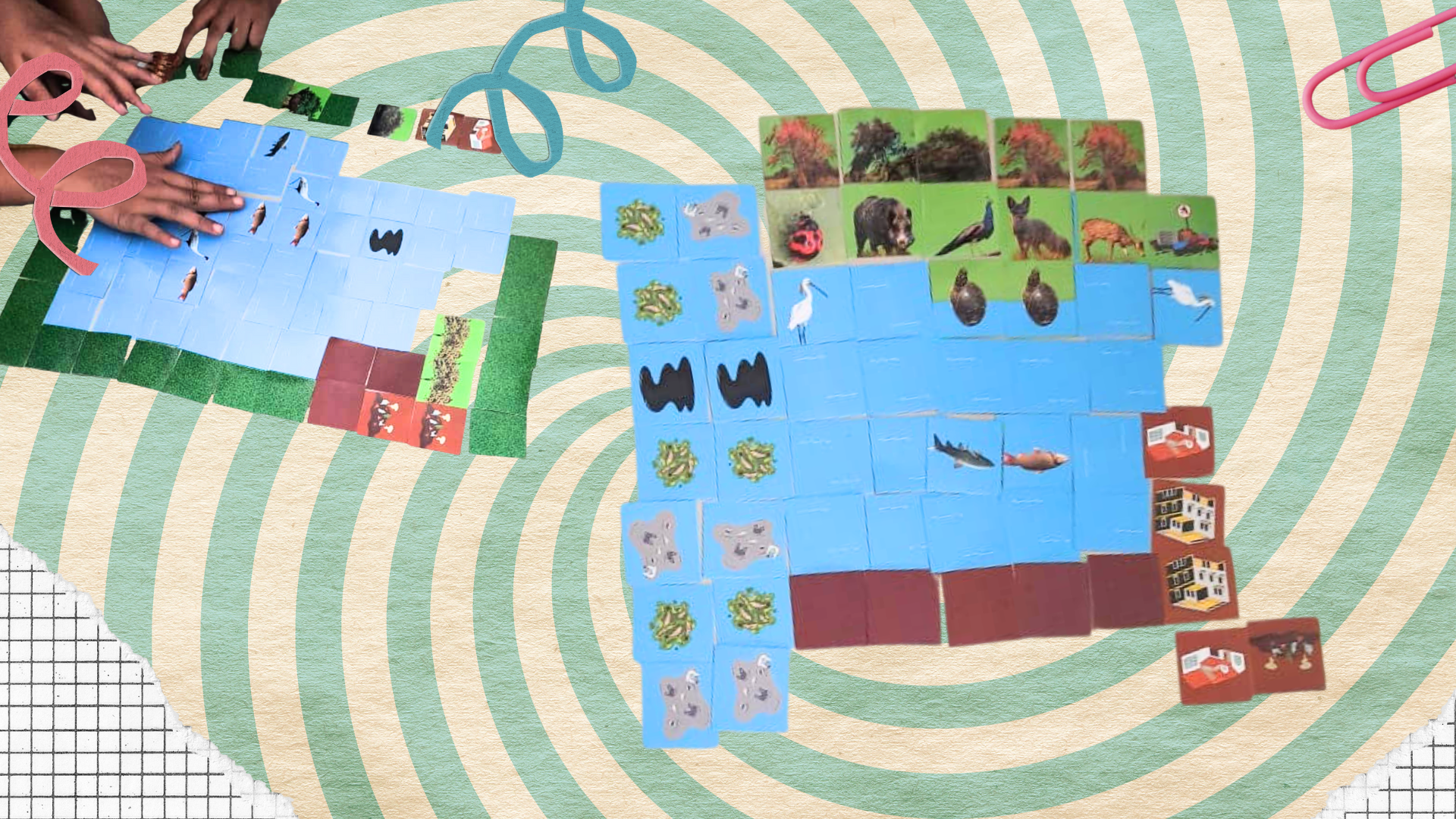
<p><a href="https://www.mdpi.com/1422-0067/21/3/1054" target="_blank" rel="noreferrer noopener"></a>As per the fourth goal of the <a href="https://unstats.un.org/sdgs/report/2023/" target="_blank" rel="noreferrer noopener">United Nations Sustainable Development Goals (SDGs) 2023</a>, providing quality education for all by 2030 is key to achieving equitable education. This becomes especially relevant after a global pandemic, during which 94% of the world’s student population was affected due to institutional closures. Teachers such as myself (Ananya) had to find emergency ways of handling the pandemic by trying different remote learning strategies. This had a disproportionate effect on students from marginalised communities in low- and middle-income countries.</p><figure><a href="https://indiabioscience.org/columns/education/gamified-teaching-tools-bhojtal-lake"><img
                width="1920"
                height="1080"
                style="max-width: 100%; height: auto"
                src="https://cdn.indiabioscience.org/media/articles/PCST-and-Biotales_2025-11-14-062639_ttnk.png"></a></figure><p dir="ltr">The lack of in-person teaching has created a significant learning gap for students from such communities, and a mere return to chalk-and-talk lectures on concepts cannot bridge that gap. Fortunately, several innovative teaching techniques have emerged to make learning more engaging for students and rewarding for teachers. One such technique is the gamification of learning tools, which provides easier access to difficult concepts across different school levels. Gamification can bridge the <a href="http://google.com/url?sa=D&q=https://www.mdpi.com/2227-7102/11/1/22&ust=1763197680000000&usg=AOvVaw3zm7paPyqLiWU3RByK-78m&hl=en" rel="noopener" target="_blank">gap</a> between rote learning and clear understanding because it introduces low-stakes, application-based learning. Learners can be rewarded through peer support and social reinforcement.</p><p dir="ltr">In the context of Indian education, play-based and activity-based pedagogies have gained increased emphasis since the implementation of the <a href="https://www.education.gov.in/sites/upload_files/mhrd/files/NEP_Final_English_0.pdf" target="_blank">National Education Policy (NEP) 2020</a>. It advocates teaching abstract topics in creative and experiential ways, thereby paving the way for gamified education in an age of shrinking attention spans and rapidly evolving learning environments. This approach focuses on enhancing student engagement and retention through a more constructive view of education. Globally, <a href="https://www.unesco.org/en/sustainable-development/education" target="_blank">UNESCO’s Education for Sustainable Development framework</a> underscores the need for experiential and participatory learning methods to foster scientific thinking among students. For concepts such as biodiversity, gamification provides interactive ways to explore environmental and biological systems through student-led discovery rather than rote memorisation.</p><p dir="ltr">In recent years, gamification has received strong attention in education, as reflected in several meta-analyses and systematic reviews. One such study on <a href="https://www.mdpi.com/2227-7102/11/1/22" target="_blank">gamification in science education</a> indicates that this technique can be particularly effective in explaining biology and physics concepts, showing significant improvements in student engagement and positive learning attitudes. With the growing presence of smart devices in classrooms, virtual gamification tools have become increasingly common in curricula worldwide. However, this approach risks excluding marginalised learners who may lack access to such devices or reliable internet connectivity.<br></p><p dir="ltr">With this context in mind, my colleague <a href="https://azimpremjiuniversity.edu.in/people/achyut-kumar-banerjee" rel="noopener" target="_blank">Achyut Banerjee</a> and I, along with game designer <a href="https://www.instagram.com/ektudesign?igsh=MXUxbWRmajNnZTZjcQ%3D%3D" target="_blank">Abhishek Mitra</a>, developed <a href="https://teachinggamified.wixsite.com/bhojtal" target="_blank">biodiversity-themed board games</a> that shine a light on the local biota of Bhopal. The goal was to distribute these board games in and around Bhopal. We wanted to promote behavioural engagement and biodiversity awareness among students from marginalised communities.. The games draw inspiration from the <a href="https://waterknowledgehub.org/system/files/2021-11/India_Conservation_and_management_of_Bhoj_Wetlands_329.pdf" rel="noopener" target="_blank">Bhojtal Restoration Project</a>, addressing themes such as environmental challenges, community impacts, and ecological consequences. Through role play, decision-making, and strategy-building, players grasp biodiversity threats and reflect on environmental management, promoting inclusivity and active learning in the classroom. Over the course of a year, supported by the <a href="https://indiabioscience.org/projects/indiabioscience-outreach-grant-iog" target="_blank">IndiaBioscience Outreach Grants (IOG)</a>, we broadened our perspective to include ecosystem-based approaches rather than focusing solely on species classification and biodiversity issues. We linked the games to middle school Environmental Studies (EVS) and Science curricula, where students draw animals, plants, and ecosystems. Traditionally, biodiversity education was confined to textbooks, rarely connected to students’ immediate surroundings. The<a href="https://ncert.nic.in" target="_blank"> National Council of Educational Research and Training (NCERT)</a> has recently begun integrating local biodiversity into EVS and Science textbooks. Activity columns now encourage students to explore their local environment. </p><blockquote dir="ltr" class="pull-quote">The curricular expectations for middle school include: <em>acquiring awareness about immediate and wider surroundings through lived experiences on various themes related to daily life, such as family, plants, animals, food, water, travel, and shelter.” For high school students: “appreciating how concepts of science evolve with time, giving importance to their historical perspectives”.</em><br></blockquote><p dir="ltr">Specific chapters- Class III EVS Chapter 5: Plants and Animals Live Together, Class V EVS Chapter 6: Every Drop Counts, Class VIII EVS Chapter 2: Microorganisms, and Chapter 5: Conservation of Animals—can all be taught using our gamified tools. Private schools often bridge learning gaps through nature walks, discussions with researchers, educational videos, and digital tools. However, in communities lacking such resources, our board games offer an alternative means of teaching beyond textbooks, without adding to teachers’ or students’ workloads. This approach can enhance conceptual understanding and local environmental awareness, helping communities better connect with their ecosystems.<br></p><p dir="ltr">We also worked on documenting the local biodiversity of Bhopal’s lakes with the help of IOG. Our literature review revealed that apart from a few popular articles and isolated studies on certain phyla, little was known about the microbiome or vegetation around Bhopal’s lakes. This was notable since the last major studies on lake health were published around 2018. Some of these lakes supply nearly 40% of Bhopal’s water, underscoring the importance of raising awareness, especially among school students.</p><p dir="ltr">To ensure contextual relevance, we consulted educators and NGOs working closely with schools in marginalised communities. Their insights shaped the design of the games. Printing and design costs were deliberately kept low to ensure accessibility and scalability. We created an <a href="https://teachinggamified.wixsite.com/bhojtal" rel="noopener" target="_blank">open-access database</a> from our data on vegetation, lake microbiomes, and water health parameters, combined with information from existing literature. This database was then adapted to suit students at different educational levels, aligning with learning outcomes.</p><p dir="ltr">The printed games were distributed to school educators as teaching aids for students in Classes 5–8. One major challenge was encouraging teachers to integrate the games into lessons, given their heavy coursework. To expand reach, we partnered with community libraries and organisations such as the <a href="https://azimpremjifoundation.org/" rel="noopener" target="_blank">Azim Premji Foundation</a>, which kindly hosted the games. Translating them into Hindi significantly improved accessibility compared to the initial English version. Although collecting cohesive feedback was challenging, constructive suggestions indicated the need to simplify gameplay and possibly include timers to fit classroom schedules. In retrospect, we could have used simpler Hindi phrasing in the translations.</p><p dir="ltr">As the creators, we can confidently say that the IOG provided invaluable insight into how science outreach functions in practice. As scientists, we often limit our engagement to writing popular articles, podcasts, or videos. But when we translate research into interactive, educational games, and refine them through feedback, we truly understand how much further we must go to bring science closer to society.<br></p>
              ]]></content><category term="health-and-medicine" label="Health &amp; Medicine" /><category term="policy" label="Policy" /><category term="interdisciplinarity" label="Interdisciplinarity" /></entry><entry><title>A feeling for biological sciences: Stories of early career biologists (Part 2)</title><link
                  rel="alternate"
                  href="https://indiabioscience.org/columns/education/a-feeling-for-biological-sciences-stories-of-early-career-biologists-part-2"
                  type="text/html"
                  /><summary type="html"><![CDATA[
                <p dir="ltr"><a href="https://indiabioscience.org/columns/education/a-feeling-for-biological-sciences-stories-of-early-career-biologists-part-1" target="_blank" rel="noreferrer noopener">Building on her reflections on project Biotales</a>, in this second part, <a href="https://www.hbcse.tifr.res.in/people/faculty/aswathy-raveendran" target="_blank" rel="noreferrer noopener">Aswathy Raveendran</a> delves into the creative journeys of early career biologists. Through workshops enabling artistic expression, participants shared deeply personal narratives that explore the emotional, intellectual, and ethical dimensions of doing science—offering educators and readers a window into the lived experience of life science research.<br /></p>              ]]></summary><id>tag:indiabioscience.org,2025-08-22:/columns/education/a-feeling-for-biological-sciences-stories-of-early-career-biologists-part-2</id><published>2025-08-22T13:00:00+05:30</published><updated>2025-08-14T17:05:22+05:30</updated><author><name>Aswathy Raveendran</name><uri>https://indiabioscience.org/authors/AswathyRaveendran</uri></author><content type="html"><![CDATA[
                
<p><em><a href="https://indiabioscience.org/columns/education/a-feeling-for-biological-sciences-stories-of-early-career-biologists-part-1" target="_blank" rel="noreferrer noopener">Building on her reflections on project Biotales</a>, in this second part, </em><a href="https://www.hbcse.tifr.res.in/people/faculty/aswathy-raveendran" target="_blank" rel="noreferrer noopener"><em>Aswathy Raveendran</em></a><em> delves into the creative journeys of early career biologists. Through workshops enabling artistic expression, participants shared deeply personal narratives that explore the emotional, intellectual, and ethical dimensions of doing science—offering educators and readers a window into the lived experience of life science research.</em></p><figure><a href="https://indiabioscience.org/columns/education/a-feeling-for-biological-sciences-stories-of-early-career-biologists-part-2"><img
                width="1920"
                height="1080"
                style="max-width: 100%; height: auto"
                src="https://cdn.indiabioscience.org/media/articles/Illustration-by-Moumita-Mazumdar.jpg"></a></figure><p dir="ltr"><strong>What is unique about these narratives?</strong><br></p><p dir="ltr">The narratives featured in the Biotales blogs were co-created with the participants in three immersive online workshops. These workshops had three main sessions:<br></p><p dir="ltr">In the first session, <strong>Your origin stories</strong>: Participants explored formative <a href="https://www.biotalesindia.com/blog/editorial/sparks" target="_blank">experiences</a> which led them to develop an interest in life sciences. Participants were asked to write letters to younger selves or other young people describing these experiences. Many of these letters are featured under “<a href="https://www.biotalesindia.com/blog/the-self-in-science" target="_blank">self in science</a>”.<br></p><p dir="ltr">In the second session, <strong>Experiences of the research process:</strong> We began with <a href="https://www.biotalesindia.com/blog/editorial/emotions-around-the-research-process" target="_blank">word association activities </a>around “laboratory,” “field,” “pain,” and “excitement” to enable participants to tap into their emotions around their research. Participants then collectively read and annotated the final chapter of the biography, <a href="https://epistemologies.wordpress.com/wp-content/uploads/2007/10/a-feeling-for-the-organism-comp.pdf" target="_blank"><em>A feeling for the organism</em></a> by Evelyn Fox Keller, a text that discusses Nobel laureate Barbara McClintock’s unique approach to scientific inquiry, built on a worldview and epistemology built on the intimacy with the organism that she studies rather than with existing academic protocols. The evocative nature of the text was revealed in the way participants responded to it, the reflexive observations they brought on the capacity for surprise and fascination in biological sciences research, and the conditions that would enable it. This <a href="https://www.biotalesindia.com/blog/editorial/dialogues-with-feeling-for-the-organism" target="_blank">editorial piece</a> discusses how a feeling for the organism also came to constitute the guiding philosophy of the project.<br></p><figure style="margin-left: auto; margin-right: auto; text-align: center; width: 272px; max-width: 272px;"><img src="https://lh7-rt.googleusercontent.com/docsz/AD_4nXeewJGYgbeFodScpHOW5IwgMH3OQrqetC23nYisF4H0zJPDpjbbRftl9HrVUEvhN4Djj5j_T1O5JNxdK_t59gbPkmRC8oG2xG_LtN13AaOdiqBTD-D3ClmwrTYGS2lZYbdDI5F_?key=DiVlr5MR5KND2Y_zwlcToQ" width="272" height="341" data-image="zkpmli7uzk10"></figure><p>Following this, participants described their relationships with an entity in their lab or field site—be it an organism, technique, or instrument—and developed these into creative pieces during and after the workshop. Many of these are featured in the blog sections- <a href="https://www.biotalesindia.com/blog/a-feeling-for-the-organism" target="_blank">a feeling for the organism</a>, <a href="https://www.biotalesindia.com/blog/field-notes" target="_blank">field notes</a>, and <a href="https://www.biotalesindia.com/blog/lab-life" target="_blank">laboratory life</a>.<br><br>In the third and final session, <strong>You in your research,</strong> participants reflected on how their personalities shift before and after entering the lab. Participants offered interesting <a href="https://www.biotalesindia.com/blog/editorial/inside-and-outside-the-laboratory" target="_blank">observations</a> about what changes, in terms of their personalities and behaviours within and outside laboratory spaces. being controlling, precise, and orderly emerged in particular as “inside the laboratory” personality traits. We tried to collectively think about how aspects of what we understand to be our personality may also be linked to our identities. In two of the workshops, participants read Banu Subramaniam’s allegorical story, <a href="https://www.jstor.org/stable/40004461" target="_blank">Snow Brown and the Seven Detergents</a> which discusses how identity shapes how one is perceived and treated in research spaces. Subsequently, participants drew self portraits of themselves as researchers, many of which are featured in the <a href="https://www.biotalesindia.com/blog/the-self-in-science" target="_blank">self in science</a> section of the blog.<br></p><p dir="ltr">A distinctive feature of the project is its unique use of art as a tool for storytelling and reflection. Art carries emotion, and therefore has a powerful role in communicating a true picture of scientific work where a wide spectrum of emotions, positive and negative, are at play. Our workshops aimed to bring together both reason and emotion in participants’ stories of doing science.</p><p dir="ltr">The work produced by participants in the workshop was further developed in conversation with the facilitators following which the designer and illustrator in the team worked on the illustrations and layout of the piece. In <a href="https://www.biotalesindia.com/blog/editorial/the-internal-monologue" target="_blank">this piece</a>, she talks about her process of engaging with the material and the kind of considerations she brought to bear on the illustrations and the design.<br></p><p dir="ltr">Furthermore, the narratives are autobiographical in nature. where participants fleshed out <em>personal experiences </em>of doing science, as well as their emotional states when engaging with research. Much of the science communicated in the narratives should be accessible to an undergraduate audience. Below I elaborate on some of the key points of focus of these stories.<br><br><strong>Science focused stories</strong></p><p dir="ltr">The science focussed stories include interesting accounts by early career researchers of doing science, often discussing important concepts and ideas within the areas of molecular biology, developmental biology, and evolutionary biology. For example, this <a href="https://www.biotalesindia.com/blog/a-feeling-for-the-organism/crawling-their-way-into-science" target="_blank">story</a> is a first person account of a young molecular biologist’s journey with the model organism <em>Cenorabhditis elegans, </em>how her initial fascination for it gave away to boredom and eventually respect and care. <br></p><figure style="margin-left: auto; margin-right: auto; text-align: center; width: 313px; max-width: 313px;"><img src="https://lh7-rt.googleusercontent.com/docsz/AD_4nXddqJhkVZKd13pYSiM9zq81pz1NoemLGF93uepS54_Aqnz7Bw0cqi-uCFHE34DZxWj3GEwaNAnlvU9NeUrKNpDNos6Mf8p_u_fu_InfKsGDsL7qK4sNNvAMzkTTstIUJC9bgkhO?key=DiVlr5MR5KND2Y_zwlcToQ" width="313" height="257" data-image="fcvcck8b7bcj"></figure><p dir="ltr">A set of stories [<a href="https://www.biotalesindia.com/blog/a-feeling-for-the-organism/masters-of-deception-part-1" target="_blank">1</a>,<a href="https://www.biotalesindia.com/blog/a-feeling-for-the-organism/masters-of-deception-part-2" target="_blank">2</a>] by an evolutionary biologist discusses his journey of working on a fascinating class of ant mimicking spiders. His article grapples with contested ideas such as, “what exactly is a biological species?” Similarly, through an evocative painting of conjoined birds, this <a href="https://www.biotalesindia.com/blog/lab-life/birds-not-of-a-feather" target="_blank">piece</a> by a young evolutionary biologist discusses her initial foray into the field of evolutionary biology and why the field felt right to her.</p><p dir="ltr">Another illustrated <a href="https://www.biotalesindia.com/blog/lab-life/chasing-plant-fragrances" target="_blank">account</a> by an ecologist takes us through her experiences of collecting plant fragrances from Meghalaya and analysing them in her laboratory in Bhopal. <br></p><figure style="margin-left: auto; margin-right: auto; text-align: center; width: 440px; max-width: 440px;"><img src="https://lh7-rt.googleusercontent.com/docsz/AD_4nXehOUTApTxFDQosaXsDDapX1FXNzqL3ccwfVRfUkjFy_jvFoD6yqWjPb_Uh1_UBhP7THW0_dac76cNR1wDzmKJ_yf-UOsNoGcntTiElKSiAssDfPoJIR2f1kwCGpFiBcTsWxLU?key=DiVlr5MR5KND2Y_zwlcToQ" width="440" height="277" data-image="2z10161f6u77"></figure><p dir="ltr">The field of biological sciences is highly interdisciplinary, encompassing a range of laboratory and field-based approaches. This <a href="https://www.biotalesindia.com/blog/lab-life/between-a-rock-and-a-hard-place" target="_blank">account</a>, by an archaeologist, who works with biologists on the question of human evolution, discusses his process of conversing with paleolithic artefacts ( bones, teeth, stone tools) to figure out its story- such as what is it? And Where did it come from? With a view to answering bigger questions such as who are we, and how have we come this far? Another pictorial <a href="https://www.biotalesindia.com/blog/the-self-in-science/bridging-the-nature-culture-divide" target="_blank">account</a> by a field ecologist who studies freshwater fishes talks about his challenges of bridging the nature-culture divide as he studies communities of fishes as well as communities of people with whom they are in a socio-ecological relationship. <br></p><p dir="ltr">An important aspect of doing science is failure. It is very rare that an experiment works in the first trial. The reasons may be multiple- which include limitations of the experimental setup, weather conditions, damaged reagents, erroneous instruments, or problems/limitations in the hypothesis itself. Early career researchers, who do the bulk of the experimental work in laboratories, often find themselves facing these constraints, and helpless when it comes to working around them. These first person accounts, <a href="https://www.biotalesindia.com/blog/lab-life/a-scrapped-cloning-story" target="_blank">one</a> describing a failed attempt at cloning a protein, and <a href="https://www.biotalesindia.com/blog/lab-life/the-positives-in-the-negative" target="_blank">another</a> on researching the mechanism of Small Extracellular vesicles on cellular stress, discuss such experiences.</p><figure style="margin-left: auto; margin-right: auto; text-align: center; width: 359px; max-width: 359px;"><img src="https://lh7-rt.googleusercontent.com/docsz/AD_4nXe1aP-EI1VxwMgZFcG00htcdDrNLikE0-dTaWvtj_LNclZEf80ll00-h0ItNTzHLB3oUE_fUAvkqcK_sDsEG1vxSFXF8L--STegdt7BXsrR9IiV-dSS0fRQ9Fe_hLNagfOhNnjU?key=DiVlr5MR5KND2Y_zwlcToQ" width="359" height="255" data-image="qsm70qkbcbd3"></figure><p dir="ltr"><strong>Stories revealing the emotions of doing science</strong><br></p><p dir="ltr">These stories constitute evocative accounts of the emotional states of doing research, very central, but often missing in popular accounts of doing science, revealing a range of emotions, from contentment, and happiness to pain and anxiety. Some stories [<a href="https://www.biotalesindia.com/blog/a-feeling-for-the-organism/life-cycles-of-the-researcher-and-the-organism" target="_blank">1</a>, <a href="https://www.biotalesindia.com/blog/lab-life/the-shittiest-job-too-may-have-a-probiotic-lining" target="_blank">2</a>, <a href="https://www.biotalesindia.com/blog/lab-life/moody-reagents" target="_blank">3</a>, <a href="https://www.biotalesindia.com/blog/lab-life/lab-troubles" target="_blank">4</a>] use light-hearted humour as a way of talking about experiences that may be frustrating or reveal the drudgery of day to day research-<br></p><p dir="ltr">These pieces by an early career biologist [<a href="https://www.biotalesindia.com/blog/the-self-in-science/oh-my-love-what-happened-to-your-light" target="_blank">1</a>, <a href="https://www.biotalesindia.com/blog/the-self-in-science/oh-my-love-what-happened-to-your-light" target="_blank">2</a>] depict her emotions as she observed the dissection of a mouse for the first time. <br></p><p dir="ltr">She writes, </p><p dir="ltr"><em>“This was an animal that was scuttling around in its little box a while ago, squeaking, nibbling at the food pellets and poking its pink little nose out of the grilled lid. I closed my eyes. I had smelt its acrid odour when alive, sneezed at its dander and was now hit in the nose by the metallic smell of its blood. Then I opened my eyes… It was not easy for the seniors who had been doing this for years, it was hard on me too. Over time, I have made peace with the experiments and hope for a future that has simulation models to take the place of mice models. “We call it a sacrifice and not a killing, to recognise the contribution of mice to the cause of science,” I have been told.”</em><br></p><figure style="margin-left: auto; margin-right: auto; text-align: center; width: 387px; max-width: 387px;"><img src="https://lh7-rt.googleusercontent.com/docsz/AD_4nXdaI1FjA9FmsL_kFz6rx6ZpGo5Dx3B5fgCCvzlo7LM6NE6tB_OtLWkhjrUZRTlLM_YZVHrTQdqObe5GZ2frm1SrP4rzATa-HRvgfS5dibCThORCMxGDJIJAYbP5k-vNkctjFVGq?key=DiVlr5MR5KND2Y_zwlcToQ" width="387" height="379" data-image="fjzwwltxhnvw"></figure><p>In another deeply evocative <a href="https://www.biotalesindia.com/blog/lab-life/disentangling-the-self-from-the-laboratory" target="_blank">piece</a>, a young cancer biologist talks about the deep entanglement of her personal life and laboratory life and her struggle with depression. She also writes about how she wants to be seen as a “<a href="https://www.biotalesindia.com/blog/lab-life/i-am-a-researcher-not-a-scientist" target="_blank">researcher, and not a scientist</a>”, offering important insights on the nature of biological sciences research and pointers on how to create more supportive spaces for early career researchers.<br><br>Beyond the travails of executing <a href="https://www.biotalesindia.com/blog/a-feeling-for-the-organism/from-a-cells-perspective" target="_blank">cell cultures</a>, The hierarchical culture of biological laboratories is another factor that emerged in the discussions in the workshops. In this <a href="https://www.biotalesindia.com/blog/the-self-in-science/my-journey-in-the-lab" target="_blank">piece</a>, for instance, the researcher uses dynamic crayon sketches to talk about her interactions with the laboratory space, which she experienced as toxic. <br></p><p dir="ltr">She writes <em>“Now I am outside of the lab, still trying to find myself, trying to feel joy again, to trust people again. Though I am an outsider again, I know the reality of the lab, and now keep away from its influences.”</em><br></p><p dir="ltr"><strong>An invitation</strong><br></p><blockquote dir="ltr" class="pull-quote">The Biotales project is an invitation for all of us within and outside the scientific community to think about how we bring ourselves into the science that we do, teach and dream about. I see the material in the website as inviting ‘care’-ful attention to the little things that matter when it comes to doing biology research- looking at the organisms that we study as organisms with self respect, how we relate to the people whom we do our research with, across the hierarchy – in the laboratory and in the field, as well as being in touch with what keeps us excited about biological sciences research and what kills it.</blockquote><p dir="ltr">I end with a prescient quote from <em>A feeling for the organism</em> that is revealing of a major challenge that confronts biologists today:</p><p dir="ltr"><em>“There remain, of course, always a few biologists who are able to sustain the kind of "feeling for the organism" that was so productive-both scientifically and personally-for [Barbara] McClintock, but to some of them the difficulties of doing so seem to grow exponentially. One contemporary, who says of her own involvement in research, "If you want to really understand about a tumor, you've got to be a tumor," put it this way: Everywhere in science the talk is of winners, patents, pressures, money, no money, the rat race, the lot; things that are so completely alien . . . that I no longer know whether I can be classified as a modem scientist or as an example of a beast on the way to extinction.”</em><br></p>
              ]]></content><category term="education" label="Education" /><category term="science-communication" label="Science Communication" /><category term="teaching" label="Teaching" /><category term="school-education" label="School Education" /><category term="education" label="Education" /></entry><entry><title>A feeling for biological sciences: Stories of early career  biologists (Part 1)</title><link
                  rel="alternate"
                  href="https://indiabioscience.org/columns/education/a-feeling-for-biological-sciences-stories-of-early-career-biologists-part-1"
                  type="text/html"
                  /><summary type="html"><![CDATA[
                <p dir="ltr">This article explores a personal narrative by <a href="https://www.hbcse.tifr.res.in/people/faculty/aswathy-raveendran" target="_blank" rel="noreferrer noopener">Aswathy Raveendran</a> from <a href="https://www.hbcse.tifr.res.in/" target="_blank" rel="noreferrer noopener">Homi Bhabha Centre for Science Education, Mumbai</a>, an awardee of the <a href="https://indiabioscience.org/meetings/5th-indiabioscience-outreach-grants" target="_blank" rel="noreferrer noopener">5th IndiaBioscience Outreach Grant (IOG)</a> who leads project <a href="https://www.biotalesindia.com/" target="_blank" rel="noreferrer noopener">Biotales</a>. The project captures personal journeys of early career biologists through creative writing and art, offering insights into the nature and culture of biological sciences research. <br /></p>              ]]></summary><id>tag:indiabioscience.org,2025-08-04:/columns/education/a-feeling-for-biological-sciences-stories-of-early-career-biologists-part-1</id><published>2025-08-04T13:00:00+05:30</published><updated>2025-08-14T17:05:42+05:30</updated><author><name>Aswathy Raveendran</name><uri>https://indiabioscience.org/authors/AswathyRaveendran</uri></author><content type="html"><![CDATA[
                
<p><em>This article explores a personal narrative by </em><a href="https://www.hbcse.tifr.res.in/people/faculty/aswathy-raveendran" target="_blank" rel="noreferrer noopener"><em>Aswathy Raveendran</em></a><em> from </em><a href="https://www.hbcse.tifr.res.in/" target="_blank" rel="noreferrer noopener"><em>Homi Bhabha Centre for Science Education, Mumbai</em></a><em>, an awardee of the </em><a href="https://indiabioscience.org/meetings/5th-indiabioscience-outreach-grants" target="_blank" rel="noreferrer noopener"><em>5th IndiaBioscience Outreach Grant (IOG)</em></a><em> who leads project </em><a href="https://www.biotalesindia.com/" target="_blank" rel="noreferrer noopener"><em>Biotales</em></a><em>. The project captures personal journeys of early career biologists through creative writing and art, offering insights into the nature and culture of biological sciences research. </em></p><figure><a href="https://indiabioscience.org/columns/education/a-feeling-for-biological-sciences-stories-of-early-career-biologists-part-1"><img
                width="1920"
                height="1080"
                style="max-width: 100%; height: auto"
                src="https://cdn.indiabioscience.org/media/articles/Untitled-design.jpg"></a></figure><p dir="ltr"><strong>Project Biotales</strong><br></p><p dir="ltr"><em>What does the world of biological sciences research feel like?</em></p><p dir="ltr"><em>What does the everyday life of an early career biologist look like?</em></p><p dir="ltr"><em>What are the joys, anxieties and hopes of early career biologists?</em></p><p dir="ltr"><em>What messages do they have for young people curious </em><em>about</em><em> biological sciences research?</em><br></p><figure style="margin-left: auto; margin-right: auto; text-align: center; width: 483px; max-width: 483px;"><img src="https://lh7-rt.googleusercontent.com/docsz/AD_4nXc5Zg6clPmcuXxsupoDNOAQRDvBcp-aG3j54_Wt7HSJ4kWcPdnu7Optwwoda91zEOUyxqnkUfmFhD9oUN8-y9gSxwhZEWoJb6cdrhBPPpUwx83NPuWUeGNfOhOLj6C0D1htGt3M?key=IiGZK9y90P1q-yPd3iWmqg" width="483" height="335" data-image="2qz5j9h4iwum"></figure><p><br>These were some of the questions explored in project <a href="https://www.biotalesindia.com/" target="_blank">Biotales</a>, an outreach project that unravels personal journeys of early career biologists through creative writing and art. In this article, I discuss the concept and process behind the project. I focus on aspects such as why the project is centred around the standpoints of early career biologists, what is unique about the material produced, and what are the kinds of themes explored by some of the narratives. <br></p><p dir="ltr"><strong>The importance of early career biologists voices in articulating the “strangeness”of research spaces</strong><br></p><p dir="ltr">As a student pursuing a Masters in Biotechnology almost two decades ago, I interned in some of the premiere research institutions in the country. There, I encountered biological sciences research mainly through close interactions with PhD scholars (who were often tasked with demonstrating techniques to me and so on). In these spaces, I realised that research laboratories functioned very differently from the undergraduate and postgraduate laboratories that I had been a part of. <br></p><p dir="ltr">Beyond the thrill of experiencing “cutting-edge scientific research”—</p><p dir="ltr">which most undergraduate and postgraduate students who study in Indian colleges and universities without PhD programmes miss out on—</p><blockquote dir="ltr" class="pull-quote">I began to realise that there are various aspects related to the nature and culture of biological sciences research that one gets a first hand experience of, only while doing research. </blockquote><p dir="ltr">Sociologists often talk about how an important aspect of understanding the world is about “making the familiar strange”. Biological laboratories are social spaces where human beings interact and produce knowledge of the living world. Understanding the dynamics of knowledge production within these spaces, as a human endeavour as well as making it explicit to the public is, therefore, necessary. <br></p><p dir="ltr">PhD students are uniquely placed in this regard–as people who can uniquely articulate the ‘strangeness’ of laboratory spaces, simultaneously as insiders and outsiders, as they acculturate into these spaces. As a young student, insights from interacting with them were valuable.<br></p><p dir="ltr">Some insights include the curious nature of how scientists generate a hypothesis- how far have their questions travelled, and mutated (often a research question being pursued in a laboratory in India would have its genesis in the postdoctoral research of the PI in a laboratory in the USA), why are certain questions considered “hot”? What kinds are deserving of grants and so on. <br></p><p dir="ltr">I also began being acutely conscious of the culture and the organisation of the laboratory, its constitutive hierarchies (the chain of command that runs from the Principal Investigators of the project, to the sanitation worker who cleans the laboratory), gender dynamics, laboratory protocols that require constant attention to precision, avoiding contamination, waste, and frustrations associated with repeated failures of experiments and so on.<br></p><p>For these reasons, project Biotales takes as its focus the narratives of early career biologists’ experiences of their research, through the lens of <em>strangeness.</em> These narratives offer a raw and honest picture of how research spaces function.<br></p><p><em>Please read the second part of this piece (soon to be published) for a peek into what some of the materials look like and how the materials were co-created. </em></p>
              ]]></content><category term="education" label="Education" /><category term="science-communication" label="Science Communication" /><category term="teaching" label="Teaching" /><category term="school-education" label="School Education" /><category term="education" label="Education" /></entry><entry><title>A cultural perspective in academic publishing</title><link
                  rel="alternate"
                  href="https://indiabioscience.org/columns/education/a-cultural-perspective-in-academic-publishing"
                  type="text/html"
                  /><summary type="html"><![CDATA[
                <p dir="ltr"><a href="https://indiabioscience.org/authors/AditiJain" target="_blank" rel="noreferrer noopener">Aditi Jain</a>, an India-based publishing professional discusses how scientific communication thrives at the intersection of culture, clarity, and community. Drawing from her interactions within the global research ecosystem, she highlights why being culturally sensitive is necessary to disseminating research—to turn feedback into learning, communication into collaboration, and science into a genuinely inclusive and meaningful undertaking.<br /></p>              ]]></summary><id>tag:indiabioscience.org,2025-08-01:/columns/education/a-cultural-perspective-in-academic-publishing</id><published>2025-08-01T01:00:00+05:30</published><updated>2025-07-14T10:30:34+05:30</updated><author><name>Aditi Jain</name><uri>https://indiabioscience.org/authors/AditiJain</uri></author><content type="html"><![CDATA[
                
<p dir="ltr"><a href="https://indiabioscience.org/authors/AditiJain" target="_blank" rel="noreferrer noopener">Aditi Jain</a>, an India-based publishing professional discusses how scientific communication thrives at the intersection of culture, clarity, and community. Drawing from her interactions within the global research ecosystem, she highlights why being culturally sensitive is necessary to disseminating research—to turn feedback into learning, communication into collaboration, and science into a genuinely inclusive and meaningful undertaking.<br /></p><figure><a href="https://indiabioscience.org/columns/education/a-cultural-perspective-in-academic-publishing"><img
                width="1146"
                height="529"
                style="max-width: 100%; height: auto"
                src="https://cdn.indiabioscience.org/media/articles/unnamed-2_2025-06-29-134653_zebd.jpg"></a></figure><p dir="ltr">When I think about the future of scientific discovery, I no longer view classrooms and labs solely as spaces for experimentation. They are cultural ecosystems where individuals from diverse backgrounds come together, bringing their own ways of thinking, working, and communicating. During my academic training, this diversity fueled creativity, but it also emphasised something I did not fully appreciate at the time: how deeply cultural nuances shape the way we understand and express ideas. In an era marked by rapid innovation, our achievements will come not just from new technologies, but also from our ability to understand one another across cultures. </p><p dir="ltr">One can hear experiences and read books to learn about cultural nuances, but the most valuable lessons often come from real-life interactions. A presentation that didn’t strike the chord, a group email that came across more urgent than intended, or a well-meaning suggestion that missed the mark—each incident presents a learning opportunity. I have gradually begun to observe how tone, intent, and context shift dramatically across borders.</p><p dir="ltr"><strong>There is no “one-size-fits-all”</strong></p><p dir="ltr">I often come across posts on social media where authors discuss editorial decisions. While some celebrate acceptance, others reflect on rejection. At times, the editorial message acknowledges the research as sound, while also pointing out limitations in the approach warranting a rejection. What reads as encouragement to one person might feel like rejection sugar-coated in ambiguity to another. </p><blockquote dir="ltr" class="pull-quote">This disconnect reflects something fundamental: there is no “one-size-fits-all” in how feedback, scientific or otherwise, is received. </blockquote><p dir="ltr">In the digital world where tone and context can be easily misread, ambiguity, even when well-intentioned, can feel personal and unfair. Yet this also opens an opportunity to build a more empathetic and inclusive academic culture. One where we recognise that clarity, kindness, and cultural awareness can coexist, and where every piece of feedback becomes a stepping stone, not a stumbling block. Academic platforms, including journals that embrace cross-cultural expression, are better positioned to attract the diverse workforce, reduce publication delays, and amplify global impact. </p><p dir="ltr"><strong>Learning from cross-cultural encounters</strong></p><p dir="ltr">Engaging more closely with a global community on LinkedIn, X (formerly Twitter), or through international platforms, I see how culture enriches what we say and also how it is perceived. Differences in tone, communication preferences, and even use of emojis can be interpreted in many ways—highlighting the beauty and complexity of cross-cultural communication. </p><blockquote dir="ltr" class="pull-quote">What I have come to embrace is that approaching conversations with curiosity, calmness, and positive intent builds trust. </blockquote><p dir="ltr">Learning to see things from a different perspective, even when it’s unfamiliar, can transform challenges into growth and lay a foundation for rock-solid partnerships. </p><p dir="ltr"><strong>Towards a global mindset</strong></p><p dir="ltr">The hope is always that science should be read, appreciated, and built upon. That begins with effective communication. Cultivating a global mindset around sharing science means recognising that impact isn’t just about what we discover—it is about how we share it. For research scholars, the pressure to publish while figuring out unfamiliar publishing workflows can feel like weathering a storm. But here’s the catch: when we write a paper or present our work, we are not just sharing findings, we are welcoming people into our research journey. The way we structure that pitch matters for us to receive valuable inputs. Some guidance from experienced peers or clear examples of successful communication can alleviate stress and instill a spirit of collaboration.</p><p dir="ltr"><strong>A toolkit for cultural agility</strong></p><p dir="ltr">Understanding the cultural subtleties early on in one’s publishing journey can be beneficial. Incorporating mindful strategies into daily practices can ease this transition. Some examples include::</p><p dir="ltr"><strong><em>Clearly articulating what’s the highlight of the manuscript.</em></strong> This “elevator-pitch” approach invites readers to focus on your main contribution and hook them into appreciating your data as a story.</p><p dir="ltr"><strong><em>Engaging in journal clubs and scientific forums</em></strong> to practice intercultural conversations helps build contextual and mutual understanding.</p><p dir="ltr"><strong><em>Seeking guidance from mentors experienced in international collaborations</em></strong>, who can provide practical examples on decoding cultural nuances effectively. Their insights on how to phrase a rebuttal, when to follow up, and what level of detail to include can save months of uncertainty and anxiety.<br></p><p dir="ltr"><strong>Why we should care</strong></p><p dir="ltr">We would wonder why universities, academic platforms, or individuals should invest in raising cultural awareness. </p><blockquote dir="ltr" class="pull-quote">The answer is a bit deep-rooted: cultural sensitivity instills deeper engagement and sense of belonging which fuels team spirit and scientific impact. </blockquote><p dir="ltr">Academic programmes must emphasise intercultural communication to better equip researchers for global collaboration and leadership. In an age, where interdisciplinary, cross-border projects tackle humanity’s biggest challenges be it pandemics or climate change, cultural sensitivity is a competitive advantage.</p><p dir="ltr"><strong>As a competitive edge </strong></p><p dir="ltr">Excellence in science must be matched by excellence in how we share it. Just as microbes thrive in a well-balanced growth substrate, ideas flourish when shared with cultural intelligence. </p><p dir="ltr">Cultural intelligence is not inherent; it is a continuous learning curve. And like any skill, it gets stronger with mindful practice. The more we invest in understanding how others think, speak, and share, the more impactful science becomes.</p><p dir="ltr">If the goal is to solve the world’s biggest problems, then the way we work together matters just as much as the work itself. Cultural fluency can be that multiplier and we may be surprised by just how much more we can accomplish together.<br></p>
              ]]></content><category term="other" label="Other" /><category term="education" label="Education" /><category term="training" label="Training" /><category term="personal-experience" label="Personal Experience" /><category term="outreach" label="Outreach" /><category term="school-education" label="School Education" /></entry><entry><title>A kitchen tool to learn protein estimation</title><link
                  rel="alternate"
                  href="https://indiabioscience.org/columns/education/a-kitchen-tool-to-learn-protein-estimation"
                  type="text/html"
                  /><summary type="html"><![CDATA[
                <p>Can a simple kitchen test provide an estimate of protein in grains and pulses? Researchers from <a href="https://indiabioscience.org/orgs/cbs" target="_blank" rel="noreferrer noopener">University of Mumbai-DAE Centre for Excellence in Basic Sciences</a> have come up with a laboratory-free method using foam generation to teach students about protein estimation. The DIY approach provides a fun and scientific way to investigate nutrition of grains at home.</p>              ]]></summary><id>tag:indiabioscience.org,2025-07-28:/columns/education/a-kitchen-tool-to-learn-protein-estimation</id><published>2025-07-28T13:00:00+05:30</published><updated>2025-07-28T15:11:12+05:30</updated><author><name>Rohini Karandikar</name><uri>https://indiabioscience.org/authors/an8deK8VXoMrGjk</uri></author><content type="html"><![CDATA[
                
<p><a href="https://drils.org/team/aarti-sevilimedu/" target="_blank" rel="noreferrer noopener"></a>Can a simple kitchen test provide an estimate of protein in grains and pulses? Researchers from <a href="https://indiabioscience.org/orgs/cbs" target="_blank" rel="noreferrer noopener">University of Mumbai-DAE Centre for Excellence in Basic Sciences</a> have come up with a laboratory-free method using foam generation to teach students about protein estimation. The DIY approach provides a fun and scientific way to investigate protein in grains at home.</p><figure><a href="https://indiabioscience.org/columns/education/a-kitchen-tool-to-learn-protein-estimation"><img
                width="1920"
                height="1080"
                style="max-width: 100%; height: auto"
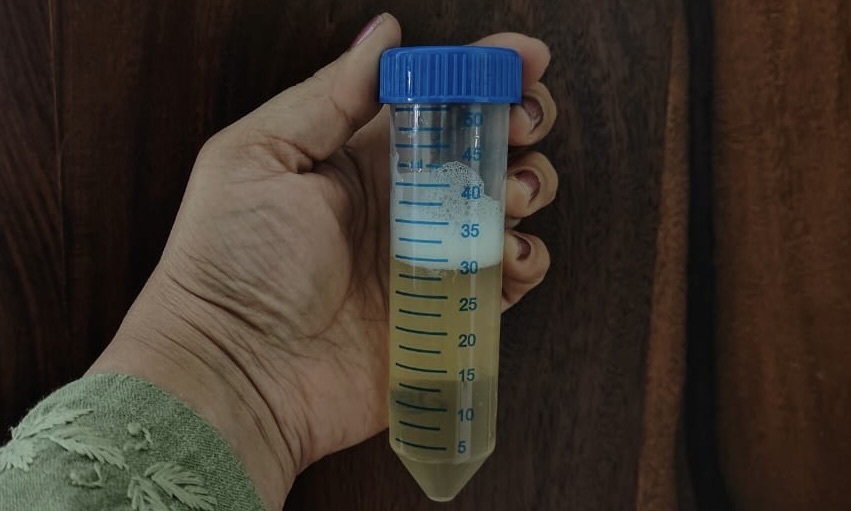
                src="https://cdn.indiabioscience.org/media/articles/Title-image-protein-in-grains.jpg"></a></figure><p dir="ltr">It is widely known that the Indian diet lacks adequate protein. Limited nutritional awareness remains a significant cause of protein deficiency, in addition to factors such as affordability, and local and cultural preferences for protein-rich foods. </p><p dir="ltr"></p><p dir="ltr">The internet and social media are abuzz with the benefits of protein-rich diets. But, how often do we check if the pulses and grains we routinely consume contain the same amounts of protein as nutrition charts show? </p><blockquote dir="ltr" class="pull-quote">Can we roughly estimate our daily protein consumption? Surprisingly, a kitchen test could help us find out!<br></blockquote><p dir="ltr">Researchers from the <a href="https://indiabioscience.org/orgs/cbs" target="_blank">University of Mumbai-DAE Centre for Excellence in Basic Sciences (CEBS), Mumbai </a>have designed a 'laboratory-free' method for school students to estimate the protein content of pulses and grains. Their <a href="https://www.currentscience.ac.in/Volumes/128/05/0495.pdf" target="_blank">study</a> elaborates on a simple method for estimating protein in soaked grain extracts. It is based on the principle that liquids containing protein generate foam when shaken vigorously. <br></p><p dir="ltr">Building on a module developed under the <a href="https://vigyanpratibha.in/" target="_blank">Vigyan Pratibha</a> project at the <a href="https://indiabioscience.org/orgs/hbcse" target="_blank">Homi Bhabha Centre for Science Education (HBCSE), Mumbai</a>, students can easily estimate the protein content in grains at home with minimal adult supervision. </p><p dir="ltr">The idea to further develop this module into an educational tool gained momentum during the pandemic, when schools and laboratories were closed. “<em>During COVID-19, we wanted to develop assays that students could perform even at home, so they could learn simple scientific methodology and understand how to develop controls in a scientific experiment”,</em> says <a href="https://www.cbs.ac.in/faculty/subhojit-sen" target="_blank">Subhojit Sen</a>, Assistant Professor at CEBS, Mumbai. <em>“It started as a small summer project with our first-year undergraduate students, Shyam and Neelima”</em>, adds Sen, the corresponding author of the paper along with Rashmitha Madamakki, an alumna of the integrated <a href="https://www.cbs.ac.in/Academics/overview" target="_blank">B.Sc–M.Sc</a>. programme at CEBS.<br><br>In their study, the team selected 13 grains and pulses commonly available in local markets and widely consumed in Indian homes. These included whole <em>moong </em>beans (whole green gram), chickpeas, <em>rajma </em>(kidney beans), <em>ragi </em>(finger millet), and wheat, among others. They soaked the grains in twice the amount of water overnight and either used the supernatant directly as soaked extracts, or boiled it. This was then added back to the soaked grains to create the ‘boiled extracts’.<br></p><p dir="ltr">The team analysed several parameters, such as, grain pulse size, bubble dispersion, foam generation, and volume of water absorbed (VA) after soaking. Among these, the boiled extracts showed a promising correlation between protein content, foam stability, volume absorbed, and foamability (upon vigorous shaking for 15 seconds and resting it for 60 seconds). They used foam index (FI) – a ratio of the height of just the foam to the total height of the foam plus the liquid underneath as a quantitative parameter. <br></p><figure style="margin-left: auto; margin-right: auto; text-align: center; width: 451px; max-width: 451px;"><img src="https://cdn.indiabioscience.org/media/articles/WhatsApp-Image-2025-06-27-at-16.51.44.jpeg" data-image="783405" alt="Rohini in text image" width="451" height="271"><figcaption style="text-align: center;">Foaming in soaked extracts of protein-rich grains</figcaption></figure><p dir="ltr">Before testing these parameters, the team developed the foam index standards using known concentrations of casein — a milk protein — to develop a set of standards for FI. These values correlated well with the protein concentration of casein in the range of 20–100 μg/ml, showing a linear fit. <br></p><p dir="ltr">Next, they measured the foam index of the 13 grains under investigation. The aim was to determine the specific parameter(s) that correlated best across multiple grains when compared with laboratory standards – the Folin-Lowry method and UV absorbance for protein estimation. “<em>By comparing it with gold-standard laboratory methods, the measurement of foam index can be a reliable estimate of the protein content of daals and grains”</em>, says Sen. <br></p><p dir="ltr"><strong>Challenges and solutions</strong><br></p><p dir="ltr">The experiment involves vigorous shaking, foam generation, and a foam index that can vary across grain types, especially when students conducting the experiment are not adequately trained. This can be challenging if they deviate from the predetermined protocol. However, the experiment aims to introduce the idea of protein estimation using a simple, laboratory-free method. Hence, learning to measure volumes accurately with available resources and controlling the shaking of liquids will help in maintaining uniformity across samples. </p><blockquote dir="ltr" class="pull-quote">It is important to train students in ideas of controlled experimentation and learn the scientific method”,</blockquote><p dir="ltr"><em>says Sen. </em></p><p dir="ltr">He adds that methods such as these aim to develop ‘scientific temper’, and should be accessible to all.<br></p><p dir="ltr">Secondly, foaming can also occur due to surfactants such as saponins present in certain seeds. To distinguish between the foam generated due to proteins versus saponins, the team designed a dye-diffusion assay. After shaking the soaked and boiled extracts, a small drop of Camlin® fountain pen ink was laid on top of the foam layer. The ink diffused immediately in samples with surfactant-foam, whereas it was distinctly retarded in samples with protein-foam, taking anywhere between five and 30 minutes to diffuse through— depending on protein content. <br></p><p dir="ltr">Further, extracts from pulses with high protein content generate a thick foam upon shaking. The foam index of such extracts may not fall in the linear range of the standard curve. Hence, such extracts need to be diluted appropriately. Students trying the experiment may require guidance at this stage.<br></p><p dir="ltr"><strong>The way forward</strong><br></p><p dir="ltr">The method is a user-friendly tool, particularly in light of the limited funding available to educational institutions nationwide. It serves as a stepping stone towards understanding the concept of estimation using resources in students’ immediate vicinity. </p><blockquote dir="ltr" class="pull-quote">What’s more, the technique is sustainable, and leads students to think about nutritional aspects of food, diversity of protein sources and local availability of protein-rich grains. <br></blockquote><p dir="ltr">One of the leading experts believe the method has strong potential to be developed into an educational tool, particularly, in view of the low intake of protein in India. “<em>The research paper comparing the estimation tools of plant proteins along with foam index is interesting from a scientific point of view. The Folin-Lowry method along with the foam index can be correlated to the estimates of protein content using the micro Kjeldahl method. Thus, plant proteins being the primary protein source in India can be estimated by a simple tool</em>”, says Pubali Dhar, Professor, Laboratory of Food Science Technology, <a href="https://www.caluniv.ac.in/academic/Home-Sc.html" target="_blank">Department of Home Science</a>, <a href="https://www.caluniv.ac.in/" target="_blank">University of Calcutta</a>, who is an independent expert. <br></p><p dir="ltr">At CEBS, Sen’s team has bigger plans. Their ambition is to transform this simple tool into ‘educational kits’ that will be part of a larger citizen science project. The project will aim at collecting data on the diversity of protein-rich grains and mapping preferred protein sources across the country towards knowledge of cultivars with higher protein content. “<em>Thanks to smartphones, and because more people are online, we can develop an app-based method to do all of this country-wide. Such a data-collection drive can be useful to governments not only to figure out which parts of the country need interventions for malnutrition, but also what kind of environments or agricultural practices yield higher protein in grains”</em>, says Sen. <br></p>
              ]]></content><category term="education" label="Education" /><category term="science-communication" label="Science Communication" /><category term="teaching" label="Teaching" /><category term="school-education" label="School Education" /><category term="education" label="Education" /></entry><entry><title>What simple toys teach us about science (and learning)</title><link
                  rel="alternate"
                  href="https://indiabioscience.org/columns/education/what-simple-toys-teach-us-about-science-and-learning"
                  type="text/html"
                  /><summary type="html"><![CDATA[
                <p><a href="https://drils.org/team/aarti-sevilimedu/" target="_blank" rel="noreferrer noopener"></a>In a world where science often feels distant, <a href="https://www.arvindguptatoys.com/" target="_blank" rel="noreferrer noopener">Arvind Gupta</a>, a science educator, brings it back to the basics—play, curiosity, and everyday objects. At the <a href="https://www.lodhageniusprogramme.com/seminars" target="_blank" rel="noreferrer noopener">Great Ideas Seminars 2025</a>, hosted by the <a href="https://www.lodhageniusprogramme.com/" target="_blank" rel="noreferrer noopener">Lodha Genius Programme (LGP)</a> at <a href="https://www.ashoka.edu.in/" target="_blank" rel="noreferrer noopener">Ashoka University</a>, Sonipat, his handmade toys show how learning can be joyful, hands-on, and imaginative. </p>              ]]></summary><id>tag:indiabioscience.org,2025-07-14:/columns/education/what-simple-toys-teach-us-about-science-and-learning</id><published>2025-07-14T10:00:00+05:30</published><updated>2025-07-14T12:23:11+05:30</updated><author><name>Ankita Rathore</name><uri>https://indiabioscience.org/authors/Ppx8KpvnoRMVQ5W</uri></author><content type="html"><![CDATA[
                
<p><a href="https://drils.org/team/aarti-sevilimedu/" target="_blank" rel="noreferrer noopener"></a>In a world where science often feels distant, <a href="https://www.arvindguptatoys.com/" target="_blank" rel="noreferrer noopener">Arvind Gupta</a>, a science educator, brings it back to the basics—play, curiosity, and everyday objects. At the <a href="https://www.lodhageniusprogramme.com/seminars" target="_blank" rel="noreferrer noopener">Great Ideas Seminar 2025</a>, hosted by the <a href="https://www.lodhageniusprogramme.com/" target="_blank" rel="noreferrer noopener">Lodha Genius Programme (LGP)</a> at <a href="https://www.ashoka.edu.in/" target="_blank" rel="noreferrer noopener">Ashoka University</a>, Sonipat, his handmade toys show how learning can be joyful, hands-on, and imaginative. </p><figure><a href="https://indiabioscience.org/columns/education/what-simple-toys-teach-us-about-science-and-learning"><img
                width="2048"
                height="1152"
                style="max-width: 100%; height: auto"
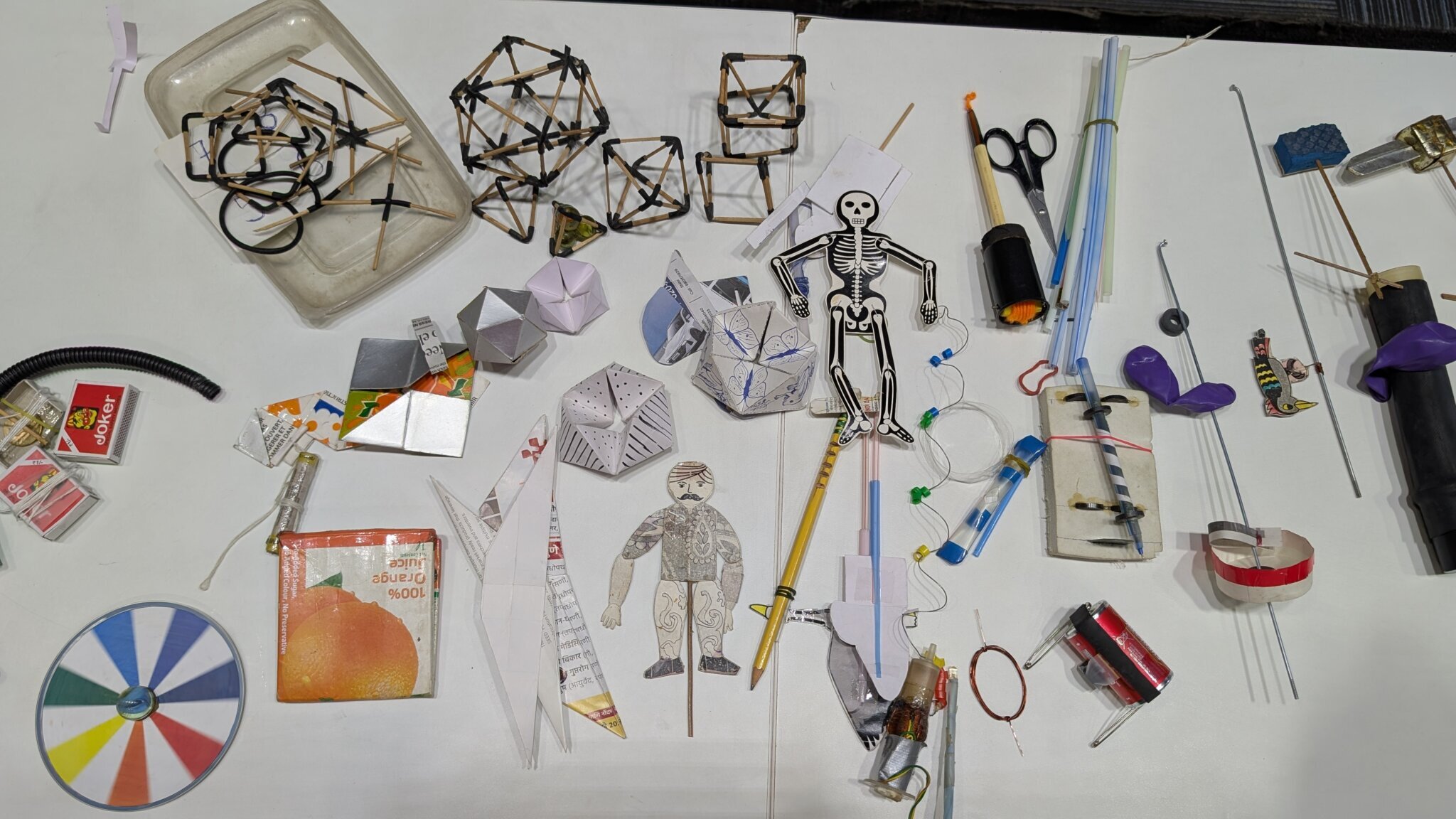
                src="https://cdn.indiabioscience.org/media/articles/2_2025-06-06-053943_ciwc.jpg"></a></figure><blockquote class="pull-quote"><em>The best toy," Arvind Gupta says, "is one that has a bit of child in it."</em></blockquote><p>In a packed auditorium of school children, Gupta picks up an ordinary plastic straw. He cuts it while blowing into it, producing a medley of notes — a makeshift flute that sounds like magic. Moments later, he folds a piece of paper into a "flying fish" that glides through the air and lands on the floor, eliciting a collective <em>ooohhh</em>. These aren’t just tricks. They are, as Gupta puts it, “tools for learning, made from trash — from the world that children already inhabit.”</p><p>Arvind Gupta, a science educator and a toy-maker, delivered the talk, <em>‘Simple Science Toys’</em>, as part of the <a href="https://www.lodhageniusprogramme.com/seminars" target="_blank"><em>Great Ideas Seminar 2025</em></a><a href="https://www.lodhageniusprogramme.com/seminars"></a>— an on-campus engagement organised by the <a href="https://indiabioscience.org/columns/indian-scenario/in-conversation-with-k-vijayraghavan-the-making-of-the-lodha-genius-programme" target="_blank">Lodha Genius Programme (LGP)</a>. LGP is a joint initiative between the <a href="https://www.lodhagroup.com/lodhafoundation/" target="_blank">Lodha Foundation</a> and <a href="https://www.ashoka.edu.in/" target="_blank">Ashoka University</a>. This fully funded, multi-year educational programme nurtures India’s brightest young minds from Grade 9 to Grade 12. The LGP team is a part of the <a href="https://www.ashoka.edu.in/page/ashoka-global-research-alliances/" target="_blank">Ashoka Global Research Alliances (AGRA)</a>.</p><p><strong>From a childhood without toys to a life of tinkering</strong></p><p>Gupta’s journey into science education didn’t begin in a lab — it began in a home without toys. Growing up in a modest household, he made do with what he found around him: bits of paper, bottle caps, plastic straws. “Play came from imagination,” he recalls. “And science, I soon realised, was everywhere.”</p><p>The pivotal moment came in the 1970s, when Gupta met Anil Sadgopal, the visionary behind the <a href="https://www.kishorebharati.org/hstp/" target="_blank">Hoshangabad Science Teaching Programme (HSTP)</a>, a programme designed to transform how science was taught in rural government schools. The HSTP aimed to improve science education for students in grades 6 to 8 in government schools across Hoshangabad district, Madhya Pradesh.</p><p>This encounter changed the course of Gupta’s life. He set out to reform science education for children, not by importing costly equipment, but by promoting observation, questioning, and hands-on exploration. At the time, most Indian schools lacked science laboratories. Rote learning dominated classrooms, and the education system often stifled curiosity in favour of memorisation.</p><p>Leaving a corporate career after graduating from the <a href="https://www.iitk.ac.in/" target="_blank">Indian Institute of Technology Kanpur</a> (IIT Kanpur), he took a year off to live in a village. There, at the weekly bazaar, he was captivated by the ingenuity embedded in ordinary objects. </p><blockquote class="pull-quote">All my life I’ve been making toys,” he reflected in the talk. “It’s a fun job.”</blockquote><p><strong>Rethinking education: Toys that teach</strong></p><p>To the untrained eye, Gupta’s creations might look like junk: matchboxes, straws, rubber bands, old newspapers. But in his hands, they become instruments of inquiry.</p><p>Combine two matchsticks and you have a line; add a third, a triangle; four, a square — and so on, until geometry is no longer a concept trapped in textbooks but something you can build and hold. He reminds us that <em>science and math</em><em>ematics</em> are about patterns. “It’s not about money. It’s about the joy of doing it.”</p><p>He demonstrated how to build a simple toy hand pump using only straws and bottle caps, materials that are easily available around the house. He explained that when children make it themselves, it helps them understand the concepts of valves and pressure better than most textbooks. “That’s what models do,” he said. “They bring a gleam to your eyes. When you play with them, the concepts fall into place.”</p><figure style="margin-left: auto; margin-right: auto; text-align: center; width: 537px; max-width: 537px;"><img src="https://cdn.indiabioscience.org/media/articles/newsletters/1.jpg" data-image="782235" width="537" height="302"><figcaption style="text-align: center;">Arvind Gupta’s toys displayed during the Great Ideas Seminar at the Lodha Genius Programme 2025. Photo Credit: Ankita Rathore</figcaption></figure><p><strong>Science of </strong><strong>i</strong><strong>nclusion</strong></p><p>Gupta’s work is underpinned by a deep belief: science is democratic. It should be accessible to all, not just those who can afford labs or English-medium instruction.</p><p><a href="https://www.arvindguptatoys.com/" target="_blank">His website</a> is filled with hundreds of short, multilingual videos demonstrating how to build toys and has over 110 million views. His book, published by the National Book Trust, offers step-by-step instructions to make 40 such toys, almost entirely from waste.</p><p>He speaks with pride about his work with the National Association for the Blind, where he helped design tactile toys to teach science to the visually impaired children. One model had shapes cut into slippers; another used wool on velcro — making science not just visible, but touchable</p><blockquote class="pull-quote">Every child is a scientist,” Gupta says. “White coats have nothing to do with it.”</blockquote><p>The most important trait, he insists, is curiosity. “The best thing a child can do with a toy is break it. That means they’re learning.”</p><p><strong>Rote to hands-on</strong></p><p>Gupta returns to this idea often — that science is about <em>doing</em>, <em>tinkering</em>, <em>testing</em>. He said the true definition of science is, “Believe nothing because your grandfather said so. Test everything against reality. If it’s true, find evidence. Authority alone is not proof.”</p><p>This spirit was echoed by the Community Science Centre in Ahmedabad, set up by Vikram Sarabhai and inaugurated by C.V. Raman. These were not elite spaces but community efforts to bring science into every home and school. </p><p>Gupta is part of this long lineage of educators who believe that <strong>doing is learning</strong>. His influences include Anil Sadgopal, the mathematician P.K. Srinivasan, and toy designer Sudarshan Khanna — all of whom saw play and learning as intertwined.</p><figure style="margin-left: auto; margin-right: auto; text-align: center; width: 653px; max-width: 653px;"><img src="https://cdn.indiabioscience.org/media/articles/newsletters/3.jpg" data-image="782237" width="653" height="367"><figcaption style="text-align: center;">Arvind Gupta demonstrating how Bernoulli’s principle works, with the help of a student volunteer. Photo Credit: Ankita Rathore</figcaption></figure><p><strong>Can classrooms embrace play?</strong></p><p>For educators and institutions, Gupta’s work serves as both an inspiration and a challenge. Can we bring curiosity and play into classrooms constrained by rigid curricula? Can hands-on, low-cost learning become the norm rather than the exception? His approach aligns closely with the vision of India’s National Education Policy, which promotes experiential and inquiry-based learning.</p><p>More importantly, Gupta invites us to rethink who gets to do science and how it is done. He places the child, the community, the street, and the home at the center as legitimate spaces for learning.</p><p>Toward the end of his session, Gupta narrates the story of Captain Gopishankar by folding a newspaper into different shapes. First, four different hats. Then a boat. And finally, a life jacket. Like all his toys, this story does more than entertain. It teaches — about imagination, intellect, design, and the power of narrative.</p><p>As he waves the boat through the air one last time, you realise: the best toy really does have a bit of child in it.</p>
              ]]></content><category term="education" label="Education" /><category term="networking" label="Networking" /><category term="school-education" label="School Education" /><category term="education" label="Education" /></entry><entry><title>Short Summer Courses: Breaking barriers in science education in India</title><link
                  rel="alternate"
                  href="https://indiabioscience.org/columns/education/short-summer-courses-breaking-barriers-in-science-education-in-india"
                  type="text/html"
                  /><summary type="html"><![CDATA[
                <p><a href="https://drils.org/team/aarti-sevilimedu/" target="_blank" rel="noreferrer noopener"></a>The IISER Kolkata Alumni Association's Short Summer Courses (SSC) programme fills gaps in traditional science education by bringing together Indian university students and early-career researchers from around the world. In July 2025, SSC hopes to promote academic innovation and democratise scientific knowledge throughout India by offering engaging, state-of-the-art courses.</p>              ]]></summary><id>tag:indiabioscience.org,2025-06-30:/columns/education/short-summer-courses-breaking-barriers-in-science-education-in-india</id><published>2025-06-30T13:00:00+05:30</published><updated>2025-06-30T13:03:52+05:30</updated><author><name>Debanuj Chatterjee</name><uri>https://indiabioscience.org/authors/Debanuj</uri></author><content type="html"><![CDATA[
                
<p><a href="https://drils.org/team/aarti-sevilimedu/" target="_blank" rel="noreferrer noopener"></a>The IISER Kolkata Alumni Association's Short Summer Courses (SSC) programme fills gaps in traditional science education by bringing together Indian university students and early-career researchers from around the world. Starting this July 2025, SSC hopes to promote academic innovation and democratise scientific knowledge throughout India by offering engaging, state-of-the-art courses.</p><figure><a href="https://indiabioscience.org/columns/education/short-summer-courses-breaking-barriers-in-science-education-in-india"><img
                width="740"
                height="440"
                style="max-width: 100%; height: auto"
                src="https://cdn.indiabioscience.org/media/articles/Debanuj-article.png"></a></figure><blockquote dir="ltr" class="pull-quote">Traditional curricula in most Indian universities often lack the exposure to the latest developments in scientific research. As a result, many students remain confined within the rigid and often outdated coursework structures, never receiving the opportunity to engage with real-world scientific problems or the state-of-the-art techniques driving global innovation. </blockquote><p dir="ltr">To address this crucial gap, the <a href="https://www.iiserkol.ac.in/web/en/#gsc.tab=0" target="_blank">Indian Institutes of Science Education and Research (IISER) Kolkata </a>Alumni Association has launched a unique initiative: <a href="https://sites.google.com/view/ikaa-courses/home?authuser=0" target="_blank">Short Summer Courses</a> (SSC), to be held in July this year (2025). This programme offers a platform for Indian early career researchers—currently conducting cutting-edge research in reputed laboratories around the world—to share their knowledge with young university students in India through intensive, short term courses. </p><p dir="ltr">This innovative programme, currently in its pilot phase, aims to bridge the long-standing gap between academic learning and scientific research that prevails across much of India’s higher education landscape.</p><p dir="ltr"><strong>Scope of the programme: </strong></p><p dir="ltr">The courses offered in the SSC programme are mainly designed for Bachelors’ and Masters’ students in STEM disciplines. However, some courses might even be attractive for doctoral students working in a related field. Currently for the summer session in 2025, there are nine available courses across diverse scientific disciplines: </p><ol><li dir="ltr"><p dir="ltr"><a href="https://sites.google.com/view/ikaa-courses/home/from-lab-to-clinical-market?authuser=0" target="_blank">From research lab to clinical market: Building DeepTech in Health, Biotech and AI</a> (in collaboration with <a href="https://www.neurobit.com/" target="_blank">Neurobit Inc.</a>)</p></li><li dir="ltr"><p dir="ltr"><a href="https://sites.google.com/view/ikaa-courses/home/nonlinear-fiber-optics?authuser=0" target="_blank">Nonlinear fiber optics</a></p></li><li dir="ltr"><p dir="ltr"><a href="https://sites.google.com/view/ikaa-courses/home/genomics-and-bioinformatics?authuser=0" target="_blank">Genomics and bioinformatics</a></p></li><li dir="ltr"><p dir="ltr"><a href="https://sites.google.com/view/ikaa-courses/home/quantum-error-correction?authuser=0" target="_blank">Quantum error correction</a></p></li><li dir="ltr"><p dir="ltr"><a href="https://sites.google.com/view/ikaa-courses/home/computational-material-modeling?authuser=0" target="_blank">Computational molecular and materials modeling</a></p></li><li dir="ltr"><p dir="ltr"><a href="https://sites.google.com/view/ikaa-courses/home/crystal-engineering-in-organisms?authuser=0" target="_blank">Biomineralization: crystal engineering in organisms</a></p></li><li dir="ltr"><p dir="ltr"><a href="https://sites.google.com/view/ikaa-courses/home/physics-inspired-introduction-to-lie-groups-and-lie-algebras?authuser=0" target="_blank">Physics inspired introduction to Lie groups and Lie algebras</a></p></li><li dir="ltr"><p dir="ltr"><a href="https://sites.google.com/view/ikaa-courses/home/comparative-cognition-and-behavior?authuser=0" target="_blank">Comparative cognition and behavior in companion animals: theory to application</a></p></li><li dir="ltr"><p dir="ltr"><a href="https://sites.google.com/view/ikaa-courses/home/labview-programming?authuser=0" target="_blank">LabVIEW programming for research applications</a></p></li></ol><p dir="ltr"> It is worthwhile to mention that the first course, viz. “<em>From research to clinical market</em>”, is a unique one, owing to its goal of providing ample exposure to students on navigating from an academic research environment to the industrial-sectors that are driven by scientific research. </p><p dir="ltr">Further details on the courses can be found <a href="https://sites.google.com/view/ikaa-courses/home" target="_blank">here</a>. </p><p dir="ltr"><strong>A two-way street of growth:</strong></p><p dir="ltr">By design, the SSC programme is bi-directionally beneficial, inducing growth for both the students as well as the course instructors. For students, it provides access to advanced knowledge and an opportunity to interact with young experts in the field, at a nominal cost. On the other hand, the course instructors benefit from gaining teaching experience (beneficial for obtaining a faculty position in academic institutions), clarifying their own concepts through teaching and also some monetary support. </p><p dir="ltr"><strong>Building the ecosystem:</strong></p><p dir="ltr">India has the world’s largest youth population and an enormous research potential. By harnessing the expertise provided by early career researchers, and the enthusiasm of young students, programmes like the SSC can usher in a new era in Indian science. However, scaling the SSC programme and laying a solid foundation requires support from the Indian scientific community. Thus, it is an open call to students and teachers alike, to join us in building an educational system that democratises access to modern scientific knowledge and initiates a paradigm shift in the Indian academic framework. </p><p dir="ltr">For more information, write to<em> ikaashortcourses@gmail.com</em><br></p>
              ]]></content><category term="education" label="Education" /><category term="training" label="Training" /><category term="career-development" label="Career Development" /><category term="research" label="Research" /><category term="education" label="Education" /></entry><entry><title>10 Women, 10 Questions: Aarti Sevilimedu</title><link
                  rel="alternate"
                  href="https://indiabioscience.org/columns/education/10-women-10-questions-aarti-sevilimedu"
                  type="text/html"
                  /><summary type="html"><![CDATA[
                <p><a href="https://drils.org/team/aarti-sevilimedu/" target="_blank" rel="noreferrer noopener">Aarti Sevilimedu</a>, Principal Research Scientist at <a href="https://drils.org/" target="_blank" rel="noreferrer noopener">Dr Reddy’s Institute of Life Sciences</a> (DRILS), shares her insights on working with rare diseases in India. In this “10 Women, 10 Questions” she highlights her career journey and also the different initiatives on developing treatment for rare diseases in India. </p>              ]]></summary><id>tag:indiabioscience.org,2025-05-30:/columns/education/10-women-10-questions-aarti-sevilimedu</id><published>2025-05-30T13:00:00+05:30</published><updated>2025-06-18T11:30:54+05:30</updated><author><name>Aishwarya Segu</name><uri>https://indiabioscience.org/authors/rbydKYwo8pMAJjG</uri></author><content type="html"><![CDATA[
                
<p><a href="https://drils.org/team/aarti-sevilimedu/" target="_blank" rel="noreferrer noopener">Aarti Sevilimedu</a>, Principal Research Scientist at <a href="https://drils.org/" target="_blank" rel="noreferrer noopener">Dr Reddy’s Institute of Life Sciences</a> (DRILS), shares her insights on working with rare diseases in India. In this “10 Women, 10 Questions” she highlights her career journey and also the different initiatives on developing treatment for rare diseases in India.</p><figure><a href="https://indiabioscience.org/columns/education/10-women-10-questions-aarti-sevilimedu"><img
                width="720"
                height="440"
                style="max-width: 100%; height: auto"
                src="https://cdn.indiabioscience.org/media/articles/Aarti-Sevilimedu_Title-image.png"></a></figure><p dir="ltr"><strong>1. Can you tell us about yourself, your educational background, and the key milestones in your career journey? </strong><br>I am <a href="https://drils.org/team/aarti-sevilimedu/" target="_blank">Aarti Sevilimedu</a>, I completed my bachelor's in industrial biotechnology at <a href="https://www.annauniv.edu/" target="_blank">Anna University</a> before pursuing a PhD at <a href="https://www.cornell.edu/" target="_blank">Cornell University</a> in <a href="https://cals.cornell.edu/john-t-lis" target="_blank">John Lis’s</a> lab. A pivotal milestone for me was my PhD, which solidified my commitment to research and helped me shape my essential life skills. It enhanced my ability to stay organised, plan effectively, manage multiple tasks, and navigate stress. I consider PhD as a multi-degree program. I now work as a Senior Principal Research Scientist at DRILS. <br></p><p dir="ltr"><strong>2. Do you have any role models in life? Who are the individuals who have inspired you the most? </strong><strong></strong><strong><br></strong>During my PhD, I was inspired by a highly efficient postdoc–<a href="https://bcmp.hms.harvard.edu/faculty-staff/karen-adelman" target="_blank">Karen Adelman</a> in John Lis’s Lab. She had an intense focus with a structured workday. She showed me that research doesn’t have to consume your entire life and you can excel scientifically while pursuing other interests. In my recent years, I have drawn inspiration from Radha Rama Devi, who is a renowned doctor, in her late 70s. She continues to see patients and drive research in rare diseases with unwavering dedication in the hope of finding solutions and also getting scientists to work on these problems. </p><p dir="ltr"><strong>3. As a mentor for YIM 2025, what advice would you give to young scientists striving to make a mark in research? </strong><strong></strong><strong><br></strong>We do science because something about it excites and interests us. My advice would be to trust your instincts and follow your passion. Concerns about funding, publications, or attracting students are valid, but they shouldn’t dictate your path. </p><blockquote dir="ltr" class="pull-quote">If you truly enjoy your work and pursue what excites you most, success will follow naturally. Satisfaction in your research is the key to success<br></blockquote><p dir="ltr"><strong>4. You work on rare genetic diseases. Can you tell us more about that?</strong><br>A <a href="https://rarediseases.org/rare-diseases/" target="_blank">rare genetic disease</a> is defined as any disease affecting fewer than 1 in about 2,000 people. While each rare genetic disorder impacts a small group, collectively, over 7,000 rare diseases affect 70–90 million people in India alone, predominantly children. Developing treatments is challenging as these are genetic disorders with limited commercial interest from pharma companies due to the small market size. Additionally, the lack of models hinders research. However, if the scientific community leverages its expertise to study relevant genes, meaningful progress can be made.<br></p><p dir="ltr"><strong>5. How can scientists and policymakers improve rare disease diagnosis and treatment in India?</strong><br>Rare disease patients face two major challenges: diagnosis and treatment. Diagnosis can sometimes take 7–10 years due to a lack of awareness. While sequencing helps confirm cases, functional validation by scientists is crucial to support clinicians. Small experimental studies can aid this process. <br>On the therapy front, only 5% of rare diseases have treatment options. Developing disease models and studying relevant genes can accelerate therapy discovery. Though India has a <a href="https://rarediseases.mohfw.gov.in/uploads/Content/1624967837_Final-NPRD-2021.pdf" target="_blank">National rare disease policy</a>, the long-term solution lies in implementing stringent <a href="https://www.ncbi.nlm.nih.gov/books/NBK558983/" target="_blank">newborn screening</a> programs, which are still lacking in public healthcare. Expanding these programs could significantly improve early diagnosis and treatment access<br></p><p dir="ltr"><strong>6. To support this, </strong><a href="https://drils.org/crdm/" target="_blank"><strong>Center for Rare Disease Models</strong></a><strong> (CRDM) has been established at DRILS. Can you tell us more about it?</strong><br>Yes. The center was established in 2024. The lack of proper models to research rare disorders led us to establish this centre. Through the centre, we are trying to establish a research community and also industrial collaborations to develop therapies. Our goal is to create disease models using zebrafish and cell culture and make them freely available if possible. We welcome collaborations for developing therapies or screening molecules.</p><ol></ol><p dir="ltr">The centre also accepts PhD students through the institute. We routinely host master's students for thesis work, preferably for at least six months. Additionally, we welcome high school students interested in research.<strong><br></strong></p><p dir="ltr"><strong>7. You are part of a Research and Development (R&D) institution, but it's not a typical academic institution. Could you explain your objectives in choosing your career?</strong><br>I have always loved research. However, the constant stress of securing grants and managing multiple students was not something I wanted in my professional life. Further, I am comfortable outsourcing the initial stress of ideation while driving projects forward. Such roles are rare in India, but this position in DRILS allowed me to be an ‘academic’ while also being part of “industry” projects, so I took it. Earlier, immediately after my training, my anxiety and risk aversion held me back despite my mentors’ confidence in me. Now, with more experience and fewer family obligations, I enjoy my role as an academic researcher.</p><p dir="ltr"><strong>8. Do you think more research positions with a specific focus on (R&D), without the burden of training students would help more researchers? </strong><br>Training students is an integral aspect of doing science - so I don't think that is the problem. Finding funding, and deciding on an area to work on, to me, seems like a bigger issue. Many student postdocs still face this dilemma. Most choose research areas that closely align with their PhD or postdoc work, rather than exploring new fields. This is partly due to the system—grant applications often require preliminary data, expertise, and a proven track record, pushing researchers to stay within familiar territory. But it seems unlikely that, in a lifetime, one would be deeply interested in only two topics. Many researchers are open to broader explorations but feel constrained by these expectations.<br></p><p dir="ltr"><strong>9. Are there any personal anecdotes from your journey that you believe would inspire the next generation of scientists? </strong><strong></strong><strong><br></strong>All my stories are from my students. My current PhD student comes from a family where she is the first one, and a girl, to aim for a postgraduate degree. However, she was determined to pursue research. She worked as a JRF to gain experience before committing to a PhD in my lab and has since become highly independent, securing fellowships and presenting at international conferences. Students like these continue to inspire me every day.<br></p><p><strong>10. What is your key message for aspiring women in science?</strong><strong></strong><br></p><ol></ol><blockquote class="pull-quote">Every journey is different and personal. Finding your way and adapting to the flow of life is the key to thriving if science is your passion.</blockquote>
              ]]></content><category term="education" label="Education" /><category term="networking" label="Networking" /><category term="school-education" label="School Education" /><category term="education" label="Education" /></entry><entry><title>Innovating science education and empowering the next generation: In conversation with Somdatta Karak</title><link
                  rel="alternate"
                  href="https://indiabioscience.org/columns/education/innovating-science-education-and-empowering-the-next-generation-in-conversation-with-somdatta-karak"
                  type="text/html"
                  /><summary type="html"><![CDATA[
                <p>Science isn’t a luxury—it’s a way to understand and navigate the world,” says <a href="https://www.linkedin.com/in/somdatta-karak?originalSubdomain=in" target="_blank" rel="noreferrer noopener">Somdatta Karak</a>, biologist and science communicator. In this interview, she recounts her journey from <a href="https://www.teachforindia.org" target="_blank" rel="noreferrer noopener">Teach For India</a> to spearheading pioneering outreach programmes at CSIR-CCMB. From empowering underrepresented students through projects such as <a href="https://www.ccmb.res.in/presscovrg/pressnote_29_04_2022.pdf" target="_blank" rel="noreferrer noopener">Milo CCMB</a> and <a href="https://x.com/ccmb_csir/status/1036547802589999104" target="_blank" rel="noreferrer noopener">Project Abhilasha</a> to constructing mentorship bridges between scientists and learners, Somdatta presents an unassailable argument for inclusive, experiential, and value-based science education in India.<br /></p>              ]]></summary><id>tag:indiabioscience.org,2025-05-23:/columns/education/innovating-science-education-and-empowering-the-next-generation-in-conversation-with-somdatta-karak</id><published>2025-05-23T13:00:00+05:30</published><updated>2025-06-18T11:31:12+05:30</updated><author><name>Moumita Mazumdar</name><uri>https://indiabioscience.org/authors/moumita</uri></author><content type="html"><![CDATA[
                
<p>Science isn’t a luxury—it’s a way to understand and navigate the world,” says <a href="https://www.linkedin.com/in/somdatta-karak?originalSubdomain=in" target="_blank" rel="noreferrer noopener">Somdatta Karak</a>, biologist and science communicator. In this interview, she recounts her journey from <a href="https://www.teachforindia.org/" target="_blank" rel="noreferrer noopener">Teach For India</a> to spearheading pioneering outreach programmes at CSIR-CCMB. From empowering underrepresented students through projects such as <a href="https://www.ccmb.res.in/presscovrg/pressnote_29_04_2022.pdf" target="_blank" rel="noreferrer noopener">Milo CCMB</a> and <a href="https://x.com/ccmb_csir/status/1036547802589999104" target="_blank" rel="noreferrer noopener">Project Abhilasha</a> to constructing mentorship bridges between scientists and learners, Somdatta presents an unassailable argument for inclusive, experiential, and value-based science education in India.</p><figure><a href="https://indiabioscience.org/columns/education/innovating-science-education-and-empowering-the-next-generation-in-conversation-with-somdatta-karak"><img
                width="720"
                height="440"
                style="max-width: 100%; height: auto"
                src="https://cdn.indiabioscience.org/media/articles/BioWorld24_2025-04-11-060401_oiez.png"></a></figure><p dir="ltr"><strong>1. Can you introduce yourself and tell us about your work with science communication and how it aligns with your broader goals in science education?</strong></p><p dir="ltr">I am primarily trained as a biologist But I have also been a Teach for India fellow. Combining my expertise in science and education, and my current primary focus is exploring how science communication can be made more experiential and hands-on. The space I work in lies at the intersection of science education and science communication. During my time as a <a href="https://www.teachforindia.org" target="_blank">Teach For India</a> fellow from 2014 to 2016, I observed that the education system in our country largely emphasises employable skills such as literacy and numeracy. Unfortunately, science is often viewed as a subject of luxury within many communities. As a biologist, this perspective doesn't sit well with me. I’m curious about biology. It helps us make sense of the living world around us. With rapid advancements in biotechnology and medicine, it’s crucial that people not only stay informed but also learn how to ask the right questions, understand the applications of scientific developments, and make informed decisions about their use. Additionally, there are important safety considerations that must be understood when handling such technologies.</p><p dir="ltr">I feel passionate about bridging this gap by helping people access the complexities in science and technologies.<br></p><p dir="ltr"><strong>2. What do you think are the key challenges science educators face today, particularly in India?</strong></p><p dir="ltr">My work is not in primary education or what teachers typically teach in schools. But science communication can fall within the framework of education. Simplistically, one can think of education in a rubric with three buckets.</p><blockquote dir="ltr" class="pull-quote">The three buckets of education are: improving rigour, access to knowledge, and implementation of values.</blockquote><p dir="ltr">Science communication can help improve outcomes in all these three buckets for an educator. It creates the possibility for one to know more than what the textbooks say (which often covers what is already established) at one’s own pace and comfort. It is not for the sake of degrees but for fostering one’s curiosity or intrinsic need for understanding matters deeply. <br></p><p dir="ltr"><strong>3. </strong><strong>In your experience, how can partnerships between research institutions and educational organisations enhance science learning? How do you think science education in India can be more inclusive and accessible to diverse student populations, including those from underrepresented communities?</strong></p><p dir="ltr"><a href="https://www.ccmb.res.in" target="_blank">CSIR-Centre for Cellular and Molecular Biology (CCMB) </a>has a 15-year-old programme called the <a href="https://e-portal.ccmb.res.in/ccmb_yip/" target="_blank">Young Innovators Program</a>, an initiative where 200–300 students from schools in Hyderabad and beyond write a test each year, and we select 25 students to visit and work at CCMB. But we have also noticed that it’s mostly students from more-privileged socio–economic backgrounds who are the ones who get selected.</p><figure style="margin-left: auto; margin-right: auto; text-align: center; width: 490px; max-width: 490px;"><img src="https://cdn.indiabioscience.org/media/articles/BioWorld24-2.png" data-image="759857" alt="CCMB Young Innovators Program" width="490" height="299"><figcaption style="text-align: center;">CCMB Young Innovators Program. Photo Credit: CSIR-CCMB</figcaption></figure><p dir="ltr">So, keeping the aspirations of students from the lesser-privileged backgrounds at the center, a new programme called Milo CCMB was started. It first started in collaboration with <a href="https://tgswreis.telangana.gov.in" target="_blank">TSWREIS—Telangana Social Welfare Residential Educational Institutions Society</a>. and spread to tribal welfare schools run by the state government. This work has been funded by the <a href="https://dst.gov.in" target="_blank">Department of Science and Technology (DST)</a>, Government of India, and later on by CSIR. We first made the students familiar with CCMB’s work through these videos and interaction with scientists working in these areas online. We made videos on topics not only based on CCMB’s expertise but also relatable to the lives of socially backward students who come from discussions on caste and races are common, belong to agrarian communities and have aspirations to make it big. We conducted seven sessions where we shared one video each month, facilitated online discussions with scientists through Q&A sessions, and conducted an online test. Based on the results, we selected 30 students to visit CCMB for 4–5 days. We conducted this programme for two consecutive years. It was designed keeping students’ goals and aspirations in mind to provide access to institutions like CCMB. </p><p dir="ltr">Social welfare colleges also requested videos showing how scientists work in real labs, rather than animated content. The videos were prepared with a unique angle based on experiments relevant to their curriculum, showing lab work and technical skills. We need to focus on how these programmes can be taken further.</p><blockquote dir="ltr" class="pull-quote">I think the best-positioned entities in India are science institutions and scientists, where science communicators can highlight the utility of studying science as scientists, students, and members of the life sciences community.<br></blockquote><p dir="ltr"><strong>4. Can you share a few examples of successful initiatives or collaborations with educators that have had a meaningful impact on science education?</strong></p><p dir="ltr">We observed that some of the students from the <a href="https://www.ccmb.res.in/presscovrg/pressnote_29_04_2022.pdf" target="_blank">Milo CCMB program</a> started getting selected for the Young Innovators Program. It was a great outcome, and we understood that the Milo CCMB program was able to train students to qualify for such programmes. Other CSIR institutes are beginning to participate in similar programmes, and the parent body, CSIR is creating the structures for those. These are steps towards running such programmes more sustainably.<br></p><figure style="margin-left: auto; margin-right: auto; text-align: center; width: 531px; max-width: 531px;"><img src="https://cdn.indiabioscience.org/media/articles/Screenshot-2025-04-11-at-11.40.24-AM.png" data-image="759859" alt="Somdatta CCMB Milo" width="531" height="205"><figcaption style="text-align: center;">Milo CCMB students with organisers of the programme. Photo Credit: CSIR-CCMB</figcaption></figure><p dir="ltr">CCMB also made a mobile science exhibition called the <a href="https://www.ccmb.res.in/presscovrg/Gene-Health%20Connect%20inauguration_080523.pdf" target="_blank">Gene-Health Connect</a>. Set in a bus, it has been going around schools and colleges in the state of Telangana and Andhra Pradesh in the last two years. It has been very successful because it explains genes and genetic diseases - topics that are prescribed in the syllabi but are much too abstract for many teachers and students to feel comfortable with the topic. The interactive models in the exhibit helped in easing that.</p><p dir="ltr">Colleges have also now started to think about becoming more self-sufficient with respect to scientific lab setups and equipment utility. We should see to it how to support them in their growth.</p><p dir="ltr">These steps help the science communicators dedicate their time to come up with novel offerings for educational spaces while the established programmes should be undertaken by the teachers/educators in schools and colleges or beyond the traditional learning spaces. </p><p dir="ltr"><strong>5. What role do you believe mentorship plays in science education, and how can institutions better foster mentorship programmes for aspiring scientists and educators?</strong></p><p dir="ltr">Before COVID, I tried running a programme at CCMB called <a href="https://x.com/ccmb_csir/status/1036547802589999104" target="_blank">Project Abhilasha</a>. One of the observations that led to this initiative was that college students in Hyderabad were not interested in doing science research. These students didn’t know how to follow a career in science. We ran the programme for two years—reaching out to certain colleges, selecting specific groups of students, and pairing them with PhD students of CCMB.</p><figure style="margin-left: auto; margin-right: auto; text-align: center; width: 446px; max-width: 446px;"><img src="https://cdn.indiabioscience.org/media/articles/Project-Abhilasa.jpg" data-image="759861" alt="Project Abhilasa Somdatta Karak" width="446" height="251"><figcaption style="text-align: center;">Launch of project Abhilasha. Photo Credit: CSIR-CCMB </figcaption></figure><p dir="ltr">The PhD students helped them navigate scientific literature. Academic papers are extremely inaccessible to these students—the language is very technical, and they didn’t know how to read them. The PhD students guided them on how to read scientific papers, similar to how one reads a newspaper. This also provided undergraduate students the opportunity to build friendships with CCMB’s PhD students.</p><p dir="ltr">It was extremely intensive work. And in this process, I appreciated the need for more popular science articles for young minds. I realised the need to build forums for people from different backgrounds to contribute and collaborate at the science communication interface. We can utilise the support of young people to build enough opportunities and content around them so they know about science, get excited, and feel inspired to meet scientists. We have <a href="https://www.ccmb.res.in/Outreach/Programs" target="_blank">CCMB’s Shadow Scientist</a> programme where we invited interested students to pitch their interest, work for a week in a lab, and if they were able to impress the lab and were clear about why they wanted to be there, they were welcomed. It is interesting to note that students came from different cities.</p><blockquote dir="ltr" class="pull-quote">I really want young people to look at science with excitement, navigating through their interests instead of learning it only for the sake of employment.</blockquote><p dir="ltr"><strong>6. Looking ahead, what changes or improvements do you envision in the way research institutions engage with and contribute to science education in India?</strong></p><p dir="ltr">Science education is the easier part that most scientists relate to. Many of them have the sentiment of better science communication, giving back to society, and inspiring the next generation of young scientists.</p><p dir="ltr">Most labs have started organising open days. Thanks to CSIR, CCMB has a structured programme to communicate with students, such as <a href="https://jigyasa-csir.in" target="_blank">JIGYASA</a>, which provides scientists the opportunity to collaborate with such initiatives.</p><p dir="ltr">Many scientists have started to work more actively with media, newspapers, and communicators for science communication and outreach, or for publicity, which I feel is a progress. All these help in talking about science and technology in its various facets of curiosity to utility on more accessible platforms.<br></p>
              ]]></content><category term="education" label="Education" /><category term="networking" label="Networking" /><category term="school-education" label="School Education" /><category term="education" label="Education" /></entry><entry><title>Science for all: How citizen science is transforming research through community participation</title><link
                  rel="alternate"
                  href="https://indiabioscience.org/columns/education/science-for-all-how-citizen-science-is-transforming-research-through-community-participation"
                  type="text/html"
                  /><summary type="html"><![CDATA[
                <p dir="ltr">Citizen science is research conducted with the help of the general public, where amateur, non-professional, and passionate individuals are provided with an opportunity to contribute to science. It serves as a medium to foster scientific curiosity and collaboration between scientists and society, enabling individuals to contribute to data collection, organisation, and analysis—which are key elements in evidence-based decision-making and addressing community challenges through research and policy initiatives. Additionally, it also helps alleviate the workload and conserve the bandwidth of scientists and experts, allowing them to focus better on advancing research and innovation.<br /></p>              ]]></summary><id>tag:indiabioscience.org,2025-05-19:/columns/education/science-for-all-how-citizen-science-is-transforming-research-through-community-participation</id><published>2025-05-19T01:00:00+05:30</published><updated>2025-07-04T11:58:58+05:30</updated><author><name>Madhura Panse</name><uri>https://indiabioscience.org/authors/5oVpdMWp3WL9EZ7</uri></author><content type="html"><![CDATA[
                
<p>Citizen science is research conducted with the help of the general public, where amateur, non-professional, and passionate individuals are provided with an opportunity to contribute to science. It serves as a medium to foster scientific curiosity and collaboration between scientists and society, enabling individuals to contribute to data collection, organisation, and analysis—which are key elements in evidence-based decision-making and addressing community challenges through research and policy initiatives. Additionally, it also helps alleviate the workload and conserve the bandwidth of scientists and experts, allowing them to focus better on advancing research and innovation.</p><figure><a href="https://indiabioscience.org/columns/education/science-for-all-how-citizen-science-is-transforming-research-through-community-participation"><img
                width="2048"
                height="1217"
                style="max-width: 100%; height: auto"
                src="https://cdn.indiabioscience.org/media/articles/PKC-Citizen-Science.png"></a></figure><p dir="ltr"><a href="https://www.pkc.org.in" target="_blank">Pune Knowledge Cluster (PKC)</a>, is one of the eight knowledge clusters in the country, which aims to bring together a diverse range of stakeholders, including scientists, government officials, and citizen representatives, to solve regional challenges and problems using an ecosystem approach. Rooted in this vision, PKC has conceptualised two citizen science programmes that leverage the strengths and skills of citizens for advancement of the science and technology ecosystem:</p><ol><li dir="ltr"><p dir="ltr"><strong><a href="https://cst.pkc.org.in/" target="_blank">ConnecTree</a>: Citizen-enabled Digital Monitoring of Sapling Plantations and Carbon Growth Estimations</strong></p></li><li dir="ltr"><p dir="ltr"><strong><a href="https://csa.pkc.org.in/" target="_blank">One Million Galaxies</a>: Understanding galaxy formation and morphology through citizen-driven data collection </strong></p></li></ol><p dir="ltr"><a href="https://www.pkc.org.in/about-pkc/meet-our-team/dr-priya-nagaraj/" target="_blank">Priya Nagaraj</a>, CEO, PKC, elaborates more about the programmes, </p><blockquote dir="ltr" class="pull-quote"><em>The citizen science programmes at PKC have been a culmination of PKC’s efforts in the Big Data and Artificial Intelligence (AI) and Sustainability and Environment verticals. The programmes are designed to leverage high-end technology to help citizens collect and analyse data effectively and also contribute towards building large and open-source databases. Depending on the complexity and significance of the data, citizens may participate solely in data collection or also in analysis. They receive online or on-ground training to equip them with relevant scientific knowledge to engage in such initiatives.”</em></blockquote><figure style="margin-left: auto; margin-right: auto; text-align: center; width: 163px; max-width: 163px;"><img src="https://lh7-rt.googleusercontent.com/docsz/AD_4nXdlHydsbu2oQxjdPNtsyR35ZoQNcok8uNVKjPqUvzZprHDggNZ4d2_AhaGd1Mc7EPngotDBCwtrcJTSRU4MLGF5c1Mxp6pzi-tD5SgeGjW7RcsjxO_v12SjJlfEQJYcBHKsH2pnp311hsa62QDd7x4?key=iLYSY-mLbV9tzyr982J2mPkz" width="163" height="80" data-image="ods2rjpmwhh4"></figure><p dir="ltr">Through the ConnecTree programme, citizens can help in monitoring sapling growth, survival and biodiversity in a particular region. <a href="https://www.linkedin.com/in/anita-kane-9401291/" target="_blank">Anita Kane</a>, Senior Advisor at the Environment and Sustainability vertical, stresses the participatory nature of the programme where interested stakeholders, including civic bodies, NGOs as well as corporates can contribute towards maintaining as well as enhancing the biodiversity and green cover within a particular region by monitoring sapling growth. </p><p dir="ltr">Local civic bodies in Pune, such as <a href="https://pmc.gov.in/mr/?main=true" target="_blank">Pune Municipal Corporation</a> (PMC), <a href="https://www.pcmcindia.gov.in" target="_blank">Pimpri Chinchwad Municipal Corporation</a> (PCMC) and <a href="https://punesmartcity.in/smart-city/feeds" target="_blank">Pune Smart City</a>, have collaborated with PKC for this initiative. Ashok Ghorpade, Chief Garden Superintendent of PCMC says, <em>“According to </em><a href="https://prsindia.org/files/bills_acts/acts_states/maharashtra/1975/1975MH44.pdf" target="_blank"><em>Maharashtra (urban areas) Protection and Preservation of Trees Act</em></a><em>, 1975, there is a provision to adopt and nurture trees by citizens and government bodies, which is in line with PKC’s ConnecTree programme; and we are glad to collaborate with them for monitoring the saplings planted through our garden department.”</em></p><p dir="ltr"><a href="https://www.linkedin.com/in/dr-sanjay-kolte-ias-7a9a485a/?originalSubdomain=in" target="_blank">Sanjay Kolte</a>, former CEO of Pune Smart City adds <em>“PKC’s “ConnecTree” programme has tremendous synergy with the plantation initiatives of Pune Smart City, especially in the Aundh-Baner-Balewadi regions. The community engagement aspect of this programme is an important step in deepening the connection between the smart city and the citizens; as well as between the environment and the citizens.” </em></p><figure style="margin-left: auto; margin-right: auto; text-align: center; width: 340px; max-width: 340px;"><em><img src="https://lh7-rt.googleusercontent.com/docsz/AD_4nXclqRD_mvRFimSe7dxZB8fhPmcdrxK18JwOpEHjVTGayvGuumcOjcwa_Yf0KVyiZRMyLgO04-e4RqUaGzruWO6xx7QKMpNXfdWcXuAV2ny_vbcVsP--p2HoETtnefgUewJnMIcPzwIE_U95XLoBP0Y?key=iLYSY-mLbV9tzyr982J2mPkz" width="340" height="190" data-image="f6h4r7yzgcgm" alt="ConnecTree programme"></em><figcaption style="text-align: center;">Engaging communities in science through the ConnecTree programme. Photo Credit: Pune Knowledge Cluster</figcaption></figure><p> By enrolling in this programme, citizens can ‘adopt’ a sapling through geo-tagging, which allows all the data related to that sapling to be recorded on an AI-enabled, web-based platform developed in-house by PKC. On-ground training regarding data collection and usage of the platform is provided by the PKC team as per requirement. </p><p dir="ltr">PKC routinely collaborates with NGOs as well as colleges to engage residents and students in this programme. </p><figure style="margin-left: auto; margin-right: auto; text-align: center; width: 503px; max-width: 503px;"><img src="https://lh7-rt.googleusercontent.com/docsz/AD_4nXe5peuus8X8e8TDUWbbW-kdj-NRw-zN1VDQtXaMcEgWiGMviWPhCKkHDHl9LTWxwnrj6mETSnMMPzXqLJZbjtUpY0ANi4GtUQl-WjqzsHVTcQ2X7AXhjSFor2mmfCx7E-m9KHJjnzu4UZf20AbIi7g?key=iLYSY-mLbV9tzyr982J2mPkz" width="503" height="192" data-image="06p3o0vls08i" alt="sapling through geo-tagging"><figcaption style="text-align: center;">Sapling through geo-tagging data. Photo Credit: Pune Knowledge Cluster</figcaption></figure><p dir="ltr">Sikandar Ghodke, a senior citizen associated with the NGO- <a href="https://www.ecaworld.org">Environment Conservation Association </a>(ECA), says, </p><blockquote dir="ltr" class="pull-quote"><em>Being a shepherd and butcher by profession, I have always felt strongly about invasive species that soak up all the groundwater and hamper the healthy growth of native species. Being a part of a programme such as ConnecTree helps me in my aim towards making the country free of ‘white-top weed’, which is not only invasive but also has adverse effects on cattle grazing."</em></blockquote><p dir="ltr">Through this programme, PKC has engaged over 200 citizens, onboarded four NGOs and four colleges and mapped over 900 saplings on the platform through five mini-projects across the city. Along with this, PKC is also piloting the use of drones for data collection, especially for large-scale plantations undertaken by PCMC. </p><figure style="margin-left: auto; margin-right: auto; text-align: center; width: 133px; max-width: 133px;"><img src="https://lh7-rt.googleusercontent.com/docsz/AD_4nXflviMm0U7rfPvT0ejdKMwMSeTxXomLs5PUHWh-7Yu8J822_Vwypj7FJtQyke2jJkZQVsrcXLzocsBLGJji7Kqe7JJ7XYi0EfOkfgXZrAAHuxp8GkGgjzp8m_itR1cXiV8YHwuUMH4FiqZLFanISyQ?key=iLYSY-mLbV9tzyr982J2mPkz" width="133" height="74" data-image="13bedv5wtlr7"></figure><p dir="ltr">PKC’s second citizen science programme- <a href="https://www.pkc.org.in/pkc-focus-area/big-data-ai/" target="_blank">One Million Galaxies</a>s, lies on the other end of the spectrum, where one can go from the earth to the sky and help astronomers gain important information regarding various galaxies. </p><p dir="ltr"><a href="https://web.iucaa.in/~akk/" target="_blank">Ajit Kembhavi,</a> founder, PKC, Emeritus Professor, <a href="https://www.iucaa.in/en/" target="_blank">Inter-University Center for Astronomy and Astrophysics</a> (IUCAA), who has also been instrumental in setting up the One Million Galaxies programme, says, <em>“Together with experts from IUCAA, Pune and the </em><a href="https://www.iiap.res.in" target="_blank"><em>Indian Institute of Astrophysics</em></a><em> (IIA), Bengaluru the programme is conceptualised with an aim towards understanding galaxy formation and identifying the galaxy morphology by studying the different structures such as spiral arms, bars and rings in the galaxies.”</em></p><p dir="ltr">The features are analysed from the galaxy images taken by the Subaru Telescope located in Hawaii. Sudhanshu Barway, Associate Professor at IIA, while explaining the rationale behind choosing a particular set of images says, <em>“We opted to showcase these particular images, due to the availability of an extensive dataset, which would provide us with the deepest exposure capable of capturing even the faintest features within galaxies. Examining these galaxies promises to unveil valuable nuances that will enhance our understanding of their formation and evolution.”</em></p><p dir="ltr">In order to collect and store information gathered by the citizens, PKC has built an in-house <a href="https://csa.pkc.org.in/resources/" target="_blank">web-based platform</a> where citizens can enroll to join this programme. Enrolled citizens are provided with online training, which empowers them with the necessary information required for identifying galaxy features. </p><figure style="margin-left: auto; margin-right: auto; text-align: center; width: 415px; max-width: 415px;"><img src="https://lh7-rt.googleusercontent.com/docsz/AD_4nXd9Wii-qMoeaxYbBoe1y-H7aowg9jB9N6wnFvRaMo6_CHW6nI2nyxSiG4T2rraw-mPHGwge06BaBUG1CR3gl8A07vWJ6LQqw_tcv7TmM328I3pgjBS-Kp8TNWP3rN3aR-fYx2JSSAUKxvA5n0matug?key=iLYSY-mLbV9tzyr982J2mPkz" width="415" height="261" data-image="5h1krv0chrne"><figcaption style="text-align: center;">Web-based platform for identifying galaxy features. Photo Credit: Pune Knowledge Cluster</figcaption></figure><p dir="ltr">Currently, over 1900 citizens across India as well as other countries have been enrolled on the platform including individuals from all walks of life- such as school students, homemakers as well as senior citizens. </p><p dir="ltr">Amod Rairikar, a senior citizen, who has been a part of this programme since the past two years shares his experience, “<em>As they say, age is just a number! Even though I am 72 years old, my passion for astronomy has not faded at all. Being a part of the One Million Galaxies programme has been a fantastic experience for me as it provides me with an avenue to keep learning new things about the galaxies and contribute towards the knowledge from the comfort of my home or wherever I am!”</em></p><p dir="ltr">Chhaya Sawant, who retired from her bank job a few years ago and is now pursuing her lifelong passion for writing as well as contributing to the housing society’s routine work says, <em>“Even though I do not have any background in science, this platform provides me with an avenue to utilise my time in an innovative and sustainable manner, while also enhancing my knowledge and observation skills.”</em></p><blockquote dir="ltr" class="pull-quote"><em>Astronomy being my favourite topic, learning more about spiral galaxies through this programme has been a very enjoyable and informative exercise for me!”, </em></blockquote><p dir="ltr">says Sanvi Shanbag, a student of the Lexicon International School, Wagholi, Pune, who might be the youngest citizen scientist associated with this programme.</p><p dir="ltr">While citizen science in India has immense potential, key challenges for implementing such programmes are scalability and diversification. The vigilance of citizens can be utilised to monitor pertinent issues within the region and then reward them with better urban planning, policies and governance. For these different citizen science themes to materialise, PKC depends upon citizen groups, as well as interested and committed stakeholders. If you wish to get in touch with PKC and help in the co-conceptualisation of a citizen science programme having multi-dimensional results, get in touch: <a href="mailto:contact@pkc.org.in" target="_blank">contact@pkc.org.in</a><br></p>
              ]]></content><category term="education" label="Education" /><category term="science-communication" label="Science Communication" /><category term="training" label="Training" /><category term="teaching" label="Teaching" /><category term="school-education" label="School Education" /><category term="education" label="Education" /></entry><entry><title>Nurturing resilience through student-centric retreat</title><link
                  rel="alternate"
                  href="https://indiabioscience.org/columns/education/nurturing-resilience-through-student-centric-retreat"
                  type="text/html"
                  /><summary type="html"><![CDATA[
                <p>The relentless pursuit of knowledge in the world of scientific research often comes at a cost. Demanding deadlines, intense competition, and the pressure to publish groundbreaking results frequently lead to overwhelming stress and burnout among researchers. This is a global phenomenon, but the impact is particularly acute in rapidly developing nations like India, where resources are limited, and the pressure to contribute significantly to the global scientific landscape is immense. </p>              ]]></summary><id>tag:indiabioscience.org,2025-05-12:/columns/education/nurturing-resilience-through-student-centric-retreat</id><published>2025-05-12T13:00:00+05:30</published><updated>2025-04-02T15:26:30+05:30</updated><author><name>Saran Kumar</name><uri>https://indiabioscience.org/authors/saran</uri></author><content type="html"><![CDATA[
                
<p>The relentless pursuit of knowledge in the world of scientific research often comes at a cost. Demanding deadlines, intense competition, and the pressure to publish groundbreaking results frequently lead to overwhelming stress and burnout among researchers. This is a global phenomenon, but the impact is particularly acute in rapidly developing nations like India, where resources are limited, and the pressure to contribute significantly to the global scientific landscape is immense. </p><figure><a href="https://indiabioscience.org/columns/education/nurturing-resilience-through-student-centric-retreat"><img
                width="720"
                height="440"
                style="max-width: 100%; height: auto"
                src="https://cdn.indiabioscience.org/media/articles/BioWorld24.png"></a></figure><p dir="ltr">BioWorld, a student-focused retreat held in the tranquil environment of Naukuchiatal, India from November 26th to 29th, 2024, provided a significant intervention that emphasised the critical, yet frequently neglected, role of mental well-being in the Indian scientific community. The retreat's success serves as a compelling model for fostering resilience, collaboration, and a supportive academic culture. Bioworld 2024 marks the third retreat of its kind, and being the first to take place in a post-COVID landscape, fostering renewed connections and innovative discussions.</p><p dir="ltr">The demanding nature of doctoral research can foster feelings of isolation and overwhelm. Students often grapple with the immense pressure to produce high-quality research, navigate complex methodologies, and secure funding, all while managing the usual challenges of daily life. This <em>pressure cooker</em> environment can significantly impact mental health, leading to anxiety, depression, and burnout. </p><blockquote dir="ltr" class="pull-quote">The traditional academic structure, often emphasising individual achievement and competition, can inadvertently exacerbate these challenges, hindering collaboration and creating a culture of silence surrounding mental health struggles.</blockquote><p dir="ltr">BioWorld directly tackled this critical issue by creating a supportive and collaborative environment. The retreat’s meticulously planned programme seamlessly integrated academic sessions with engaging outdoor activities like trekking, boating, and cultural events. This holistic approach recognised the interconnectedness of mental well-being and academic success, fostering a balanced approach to both research and personal growth. The emphasis on a holistic approach underscores a growing understanding that mental well-being is not merely a personal concern but a crucial factor influencing both individual productivity and overall research output.</p><p dir="ltr">A key element of BioWorld success was its student-led organisation and management. By entrusting students with the planning and execution of the event, the retreat empowered them to develop their leadership and organisational skills while simultaneously promoting a sense of ownership and responsibility. This model demonstrated the remarkable capabilities of students to take initiative and create a truly impactful event, enhancing their self-confidence and collaborative abilities. This approach fostered essential leadership skills crucial for future academic success, proving that empowerment and trust can be transformative elements in academic settings.</p><p dir="ltr">The serene setting of Naukuchiatal further contributed significantly to the retreat's impact. The tranquil environment, away from the distractions of city life, allowed for focused yet relaxed interactions, promoting deeper engagement and fostering a sense of calm amidst the pressures of academic life. This mindful integration of nature and academic activity fostered mental rejuvenation and promoted a healthier work-life balance. This demonstrates the significant benefit of incorporating mindful practices and nature-based activities into academic programmes to mitigate stress and promote well-being.</p><p dir="ltr">The presence of distinguished speakers such as <a href="https://www.iitk.ac.in/bsbe/index.php/jayandharan-g-rao" target="_blank">Jayandharan Rao</a> (<a href="https://www.iitk.ac.in" target="_blank">IIT Kanpur</a>), <a href="https://biotech.iitm.ac.in/innerfaculty.php?fname=Nitish%20R%20Mahapatra&__ncforminfo=UpqiGNHgNScvdPuGXKAgT83FQFwDsETVyjKrM1m4QFAztfkkdqsbC7Hx79l0YvAkcXVi_OmgrwPnjYV8Z-JtXNEWHaDDTHxh" target="_blank">Nitish R. Mahapatra</a> (<a href="https://www.iitm.ac.in" target="_blank">IIT Madras</a>), <a href="https://www.aiims.edu/index.php/hi/2014-12-19-06-55-43/faculty" target="_blank">Sujata Mohanty </a>(<a href="https://www.aiims.edu/index.php/en" target="_blank">AIIMS Delhi</a>), and <a href="http://rcb.ac.in/rcb_website/faculty/dr-sam-j-mathew" target="_blank">Sam Mathew</a> (<a href="https://rcb.res.in/i3c/" target="_blank">BRIC-RCB, Faridabad</a>) enriched the discussions and provided invaluable mentorship opportunities. The inclusion of poster sessions, student-led oral presentations, and vibrant cultural programmes further enhanced the sense of community and created opportunities for extensive interaction between students, faculty, and delegates. </p><p dir="ltr">BioWorld's success transcends its immediate impact. It serves as a powerful model for other institutions seeking to cultivate a more supportive and collaborative academic culture within India. The retreat's demonstrably positive effects on the mental well-being and collaborative spirit of the participants showcase how strategic interventions can significantly improve the research environment. By adopting similar initiatives, other institutions can address the often-unacknowledged challenges faced by researchers, leading to a more thriving and resilient academic community.</p><blockquote dir="ltr" class="pull-quote">The current landscape of scientific research demands a paradigm shift. The traditional emphasis on individual achievement and productivity must be balanced with a genuine concern for the mental well-being of researchers. </blockquote><p dir="ltr">By creating supportive environments, fostering collaboration, and providing access to resources and mentorship, institutions can cultivate a more resilient and thriving research community. Investing in the well-being of researchers is not just an ethical imperative but a crucial investment in the future of scientific advancement in India and beyond. The success of BioWorld 2024 stands as a powerful testament to the transformative power of carefully designed initiatives that prioritise both academic excellence and the mental well-being of the individuals who drive scientific progress.<br></p>
              ]]></content><category term="education" label="Education" /><category term="networking" label="Networking" /><category term="school-education" label="School Education" /><category term="education" label="Education" /></entry><entry><title>Arts and culture in discussing AMR</title><link
                  rel="alternate"
                  href="https://indiabioscience.org/columns/education/arts-and-culture-in-discussing-amr"
                  type="text/html"
                  /><summary type="html"><![CDATA[
                <p dir="ltr">Imagine Raj from the movie, <em>Dilwale Dulhaniya Le Jayenge </em>rushing to Balwant Singh’s store to buy an antibiotic without a prescription. How would and should Singh react to this? If Raj is buying the antibiotic for Singh’s dear daughter, Simran, would those reactions change?<br /></p>              ]]></summary><id>tag:indiabioscience.org,2025-04-28:/columns/education/arts-and-culture-in-discussing-amr</id><published>2025-04-28T13:00:00+05:30</published><updated>2025-04-02T15:30:29+05:30</updated><author><name>Somdatta Karak</name><uri>https://indiabioscience.org/authors/SomdattaKarak</uri></author><content type="html"><![CDATA[
                
<p dir="ltr">Imagine Raj from the movie, <em>Dilwale Dulhaniya Le Jayenge </em>rushing to Balwant Singh’s store to buy an antibiotic without a prescription. How would and should Singh react to this? If Raj is buying the antibiotic for Singh’s dear daughter, Simran, would those reactions change?<br /></p><figure><a href="https://indiabioscience.org/columns/education/arts-and-culture-in-discussing-amr"><img
                width="1600"
                height="900"
                style="max-width: 100%; height: auto"
                src="https://cdn.indiabioscience.org/media/articles/Dilwale-AMR-ko-Bhagayenge-par-kaise.png"></a></figure><p dir="ltr">These are the kinds of role-play led conversations we, at <a href="https://sasuperbugs.org/" target="_blank">Superheroes against Superbugs</a> (SaS), had with students of pharmacy at a college in Ropar, Punjab. The movie that was our muse is well-celebrated across generations in the region. This setting helped the young people connect with the context in a light-hearted but intimate manner. Once in a relatable setting, we put them at the helm of making the right decisions in their future professional careers as pharmacists to fight antimicrobial resistance (AMR).</p><p dir="ltr"><a href="https://www.who.int/news-room/fact-sheets/detail/antimicrobial-resistance" target="_blank">AMR</a> is a situation where the antimicrobial drugs such as antibiotics aren’t as effective in stopping microbial infections. This happens when microbial populations in proximity to antimicrobial drugs evolve to resist the action of the same drugs. Such microbes are also called superbugs. </p><blockquote dir="ltr" class="pull-quote">Millions of people die due to AMR globally each year, and experts estimate these numbers will look extremely grim in the next two decades.</blockquote><p dir="ltr">Experts have also identified different ways to slow the microbes’ evolution into superbugs. In a nutshell, it will need less frequent usage of antimicrobial drugs. That will require various stakeholders – antimicrobial manufacturing industries, medical doctors, pharmacists, animal and plant farmers, the general public – to all contribute to the judicious use of these drugs and policymakers to regulate their usage. At SaS, so far, we have focused most of our conversations on the overuse and misuse of antibiotics among three categories of people – future medical doctors, future pharmacists and consumers of antibiotics.</p><p dir="ltr">Antibiotics are one of the most widely used and misused antimicrobial drugs. These drugs kill bacteria. However, they are hailed as miracle drugs and assumed to cure any infection such as the ones caused by viruses. In a place like India where not everyone has the luxury to wait for an infection to subside or to access healthcare, the practice of self-medicating with antibiotics is very common. Pharmacists are hand-in-glove in this practice. Medical doctors can also feel pressured to prescribe antibiotics as they fear losing their patients to other practitioners who offer what the patients want.</p><p dir="ltr">We have interacted with young students of medicine, pharmacy, and those in schools and colleges, ages 15-23 — to inform them of the AMR crisis and help them find their individual roles in curbing the problem. We mostly engage through workshops in the schools and colleges they study in. We work with carefully selected subject experts to inspire the young people to take action against the problem. However, simply listening to talks from experts often don’t suffice to gather and hold the attention of young people in a topic they are uninitiated in. So, we infuse it with various formats of storytelling and art; these help place AMR in the cultural context of each group.</p><p dir="ltr">In addition to the example mentioned right at the beginning of this article, we have designed role plays and case studies for medical students to think through the various kinds of scenarios they might need to solve in their careers as doctors. We have designed an escape room keeping in mind the essence of urgency that doctors generally have to function under. It is intended to inspire doctors to practice evidence-based medicine against infectious diseases, such as by accessing the modern diagnostic tools to confirm the cause of diseases and collaborating with microbiologists in their hospitals to keep track of the antibiotic-resistance patterns in the patients visiting them. We invite medical doctors to highlight the importance of having open conversations with patients on when and how to use antibiotics.</p><figure style="margin-left: auto; margin-right: auto; text-align: center; width: 539px; max-width: 539px;"><img src="https://cdn.indiabioscience.org/media/articles/SAS-image-2.jpeg" data-image="753785" alt="Medical students solving puzzles in an escape room" width="539" height="303"><figcaption style="text-align: center;">Medical students solving puzzles in an escape room. Photo Credit: Somdatta Karak</figcaption></figure><p dir="ltr">Similarly, <a href="https://sasuperbugs.org/educational-resources-for-pharmacy-students/" target="_blank">for pharmacy students</a>, we have emphasised the unique role they play for people who might access pharmacists without going to doctors. The pharmacists need to realise their responsibility of playing a similar role as that of a doctor in explaining the usage protocols of antibiotics.</p><p dir="ltr">We worked with <a href="https://sasuperbugs.org/lessons-activities/" target="_blank">high school</a> and college students largely probing their antibiotic usage patterns, informing them of the gravity of the problem and enabling them with tools of storytelling to contextualise AMR in their lives. This is important because most people don’t know AMR as a health concern. It is not one disease but a deterrent to treatment of many infectious diseases. Our medical reports do not show AMR as a cause of disease or death. It remains in the background often limited to the knowledge of the medical practitioner.</p><p dir="ltr">We trained these students to make comics depicting their understanding of the problem and their imagination of how they can fight it. Many of the school students we worked with made simple black and white comics divided into four panels telling a simple story of AMR. These comics, called the grassroots comics made it evident for all of us that AMR plays out differently for a high-income urban community with easy access to antibiotics, in a low-income community with problems of hygiene, in an agrarian setting where farmers overuse antibiotics or in a riverside town where their river gets routinely polluted. The makers of these comics shared these stories with their peers who were not a part of our workshops directly.</p><figure style="margin-left: auto; margin-right: auto; text-align: center; width: 527px; max-width: 527px;"><img src="https://cdn.indiabioscience.org/media/articles/SAS-image-3.jpeg" data-image="753787" alt="High school students exhibiting their comics to peers. Photo Credit: Somdatta Karak" width="527" height="702"><figcaption style="text-align: center;">High school students exhibiting their comics to peers. Photo Credit: Somdatta Karak</figcaption></figure><p dir="ltr">Others had the opportunity of co-designing their comics with artists and translating them for wall murals in Hyderabad and New Delhi. These murals became a reminder of AMR for people in these cities. Some even made songs and plays on AMR and used them in their schools and colleges to inform others of the problems of antibiotic misuse and AMR.</p><blockquote dir="ltr" class="pull-quote">And, that’s what we want – we want young people to connect with the problem of AMR deeply enough to identify the changes they can bring about in their lives and communities to fight the problem. </blockquote><p dir="ltr">We acknowledge that we can engage with only a relatively small number of young people closely. So, it is only when they become our partners to take the cause ahead, we can hope to bring about changes.<br></p>
              ]]></content><category term="education" label="Education" /><category term="science-communication" label="Science Communication" /><category term="school-education" label="School Education" /><category term="education" label="Education" /></entry><entry><title>Catalysts of change: How PKC is aligning with NEP 2020 to build a brighter future</title><link
                  rel="alternate"
                  href="https://indiabioscience.org/columns/education/enhancing-pedagogies-through-digital-tools-and-gamified-learning"
                  type="text/html"
                  /><summary type="html"><![CDATA[
                <p><a href="https://www.education.gov.in/nep/about-nep" target="_blank" rel="noreferrer noopener">India's National Education Policy 2020 (NEP 2020)</a> envisions an education system that aligns with the aspirations of 21<sup>st</sup> century learning. It highlights the importance of nurturing human potential, strengthening institutional capacity, and fostering regional ecosystems for education, research, and innovation. The policy also aims to promote inclusivity and equitable quality education while cultivating a culture of innovation and entrepreneurship.<br /><br /></p>              ]]></summary><id>tag:indiabioscience.org,2025-04-21:/columns/education/enhancing-pedagogies-through-digital-tools-and-gamified-learning</id><published>2025-04-21T01:00:00+05:30</published><updated>2025-04-15T16:51:43+05:30</updated><author><name>Madhura Panse</name><uri>https://indiabioscience.org/authors/5oVpdMWp3WL9EZ7</uri></author><content type="html"><![CDATA[
                
<p><a href="https://www.education.gov.in/nep/about-nep" target="_blank" rel="noreferrer noopener">India's National Education Policy 2020 (NEP 2020)</a> envisions an education system that aligns with the aspirations of <em>21<sup>st</sup> century</em> learning. It highlights the importance of nurturing human potential, strengthening institutional capacity, and fostering regional ecosystems for education, research, and innovation. The policy also aims to promote inclusivity and equitable quality education while cultivating a culture of innovation and entrepreneurship.<br /></p><figure><a href="https://indiabioscience.org/columns/education/enhancing-pedagogies-through-digital-tools-and-gamified-learning"><img
                width="720"
                height="440"
                style="max-width: 100%; height: auto"
                src="https://cdn.indiabioscience.org/media/articles/Untitled-design_2025-04-01-084720_ansh.png"></a></figure><p><a href="https://pkc.org.in/" target="_blank">Pune Knowledge Cluster (PKC)</a>, which is one of the eight knowledge cluster initiatives in India, brings together stakeholders from academia, industry, and civic bodies to create and enable an environment that promotes inclusivity and quality education for all. Elaborating more upon its vision, <a href="https://www.linkedin.com/in/priyanagaraj/">Priya Nagaraj</a>, CEO of Pune Knowledge Cluster says,<em></em></p><blockquote class="pull-quote"><em>Our initiatives are aimed towards promoting digital literacy and 21<sup>st</sup> century skills among students and teachers. PKC’s projects focus on innovative pedagogy training for teachers and empowering women to pursue STEM education and careers.</em></blockquote><p><strong>Enhancing pedagogies through digital tools and gamified learning</strong><u><br></u></p><p><u>1. <a href="https://www.pkc.org.in/pkc-focus-area/capacity-building/stem-education/stem-lenovo/" target="_blank">Teach with </a></u><u><a href="https://www.pkc.org.in/pkc-focus-area/capacity-building/stem-education/stem-lenovo/" target="_blank">T</a></u><u><a href="https://www.pkc.org.in/pkc-focus-area/capacity-building/stem-education/stem-lenovo/" target="_blank">ech</a></u></p><ol></ol><p>Supported by Lenovo, India, the Teach with Tech programme was conceptualised with a vision to empower both teachers as well as students by integrating digital resources into their teaching-learning journey. </p><p>The programme commenced through a survey conducted by the PKC team, together with the <a href="https://educationforallinindia.com/district-institute-of-educational-training-diets/">District Institute of Education and Training</a> (DIET), Pune to understand the usage of digital tools for teaching during the pandemic, and the findings revealed that over 90% of the 1,500 teachers who were surveyed had not used any digital tools or resources during the pandemic – this included open-access videos, simulations, games, puzzles, and quizzes. Surprisingly, despite having access to digital devices such as phones or computers, students were largely unaware of such resources. </p><p>To address this gap, the Teach with Tech programme was designed to equip teachers with digital pedagogy skills while also training students in the effective use of digital tools. In order to curate the relevant resources, PKC has collaborated with academic institutions such as the <a href="https://www.iucaa.in/en/" target="_blank">Inter-University Center for Astronomy and Astrophysics</a> (IUCAA), <a href="http://www.unipune.ac.in/" target="_blank">Savitribai Phule Pune University</a> (SPPU), as well as NGOs such as <a href="https://cspathshala.org/" target="_blank">CS Pathshala</a> and <a href="https://www.meghshala.online/" target="_blank">Meghshala</a>. These partnerships have resulted in the development of digital resources that are mapped to the regular teaching curriculum of science and mathematics for grades 6<sup>th</sup> to 8<sup>th </sup>students. Phase I of the programme focused on developing digital content and on-ground training of teachers and students, while phase II of the programme focused on training teachers and providing tablets containing e-lessons covering broad topics in science and mathematics. To ensure accessibility, training workshops and classroom sessions are conducted in a bilingual format. </p><p>Over the last four years, the programme has been implemented across 25 schools in Pune, benefitting over 700 teachers and 1800 students. </p><p>While the programme has created significant impact, implementing it has not been without challenges. Some schools lacked fundamental digital infrastructure, such as display screens, computers, and, in some cases, even a consistent power supply. By addressing these hurdles and expanding access to digital learning<em>, </em>the programme strives to create a more inclusive and technology-driven education platform for students and teachers alike.</p><p><a href="https://www.linkedin.com/in/pratimaharite" target="_blank">Pratima Harite</a> from Lenovo India, says, </p><blockquote class="pull-quote"><em>It is Lenovo’s endeavour to inspire young students to pick up STEM Education and be able to make informed choices in STEM Careers in the long run. Hence, the Tech with Tech initiative is close to our heart as it engages young students in Maharashtra to build upon essential <em>21<sup>st</sup> century </em>skills and empowers teachers to use digital pedagogy techniques, which in turn transforms STEM Education into an enjoyable and practical experience for young students.</em></blockquote><figure style="margin-left: auto; margin-right: auto; text-align: center; width: 560px; max-width: 560px;"><img src="https://cdn.indiabioscience.org/media/articles/12.jpg" data-image="753705" alt="Teach with Tech Program. Photo Credit: Pune Knowledge Closer | Collage by Moumita Mazumdar" width="560" height="315"><figcaption style="text-align: center;">Teach with Tech Program. Photo Credit: Pune Knowledge Closer | Collage by Moumita Mazumdar</figcaption></figure><p><u><br></u><u><br></u><u>2. <a href="https://www.pkc.org.in/pkc-focus-area/capacity-building/platform-for-gamified-learning-in-chemistry/" target="_blank">ChemAmaze</a></u></p><ol></ol><p>Supported by <a href="https://www.basf.com/in/en">BASF Chemicals India Pvt. Ltd</a>., this initiative was conceptualised with a vision to improve the teaching-learning journey and outcomes for grades 6 – 8 students and school teachers. The programme uses gamification elements to help students improve their conceptual understanding of chemistry, thereby, creating an engaging and stimulating learning environment. Apart from the introduction of tools and techniques for game-based learning in classrooms, the programme also envisions the development of a national open-source repository of educational games that are mapped to the school curriculum. </p><p>As a cluster, PKC has the unique advantage of bringing together the best experts in implementing this project. For example, IIT Madras has been an important implementation partner for the programme and is also involved in designing the games. A team at PKC and IIT Madras works on developing the games which are tailored to align with either the <a href="https://www.cbse.gov.in" target="_blank">Central Board of Secondary Education </a>(CBSE) or state curricula of the beneficiary schools. To ensure quality and effectiveness, selected games are validated through in-person workshops where students from various schools play the games and provide their feedback. </p><p>Elaborating upon the development of games and the various underlying factors involved, <a href="https://www.linkedin.com/in/karticv/" target="_blank">Kartic Vaidyanathan</a> (ex-faculty, IIT Madras) says, </p><blockquote class="pull-quote"><em>The levels of </em><em>teaching and infrastructure available in schools differ greatly. For example, the State Government and Zilla Parishad schools usually do not have the facilities that are available in Private Schools. Therefore, these aspects play an important role while deciding the mode of the games i.e. digital, printable, board games or card games.</em></blockquote><p>A key aspect of this programme is to build the capacity of the teachers and empower them to effectively utilise gamification as a pedagogical tool. In order to achieve this, the team conducts online pan-India teacher training workshops that not only introduce the teachers to the different games but also a range of game development resources, enabling them to create their own games tailored to their specific needs. Apart from tackling the challenges involved with limited infrastructure, the team also needs to address the language barriers faced in state board schools. The games are, therefore, translated into vernacular languages to ensure strong engagement and participation. In schools catering to students from extremely marginalised communities, the barrier towards low literacy levels is overcome by developing games that are more visual than text-heavy. </p><p>Over the last two years, the programme has enabled the development of 88 games, catering to students from 6 to 8 grade from government and private schools. The team has conducted 12 workshops pan-India, including offline game validation workshops with students; and online teacher training workshops, with over 1,200 beneficiaries. </p><p>However, the true success of the programme lies in the fact that it encompasses a variety of unique approaches to spread the joy of game-based learning, including the involvement of students in conducting workshops for their peers from different economic backgrounds, which not only enhances their conceptual understanding but also develops a sense of empathy and community spirit. </p><p>Talking about BASF’s commitment towards the programme, <a href="https://www.linkedin.com/in/sunita-sule-52779319/" target="_blank">Sunita Sule</a> from BASF Chemicals India Pvt. Ltd. says, </p><blockquote class="pull-quote"><em>“As one of the global leaders in the chemical industry, we believe that in order to drive progress in the chemical industry, one needs to have a base of good manufacturing. Our CSR initiatives are aimed towards creating an ecosystem that can bring in more manufacturing by promoting the magic of chemistry at school levels. The </em><a href="https://www.pkc.org.in/pkc-focus-area/capacity-building/platform-for-gamified-learning-in-chemistry/"></a><em>ChemAmaze</em><em>program</em><em>me</em><em> is a live example of how we can create chemistry not just with our products but through other means, too!”</em></blockquote><figure style="margin-left: auto; margin-right: auto; text-align: center; width: 595px; max-width: 595px;"><img src="https://cdn.indiabioscience.org/media/articles/Beige-Brown-Minimal-Modern-Aesthetic-Fashion-Clothes-Brand-Sales-Collage-Presentation.png" data-image="753731" alt="ChemAmaze Programme. Photo Credit: Pune Knowledge Cluster | Collage by Moumita Mazumdar" width="595" height="335"><figcaption style="text-align: center;">ChemAmaze Programme. Photo Credit: Pune Knowledge Cluster | Collage by Moumita Mazumdar</figcaption></figure><p><strong><br></strong><strong><br></strong><strong>Scholarship and Mentorship Programme for Women</strong></p><p>Statistics reveal that very few women take up STEM subjects during their higher education studies, and even amongst those that do, there is a significant dropout rate in the workforce, especially at advanced career stages. PKC’s flagship scholarship and mentorship initiative – <a href="https://www.pkc.org.in/pkc-focus-area/capacity-building/stem-education/wenyan/" target="_blank">WEnyan</a>, is designed to incentivise women to pursue careers in science, especially chemistry and to address the gender disparity by improving the enrollment and retention of women in the workforce. It is a first-of-its-kind programme in Maharashtra, supported by BASF Chemicals India Pvt. Ltd. The programme aims to empower women from tier 2 and tier 3 cities in Maharashtra and fuel their passion towards building a career in STEM. The programme provides financial support in the form of research scholarships given to Bachelors and Masters students and prototyping grants given to doctoral students with nascent business ideas in the fields of chemistry, sustainability, and allied areas. </p><p>The funding support provided within the programme allows awardees to work on their existing project ideas in the comfort of their college premises, and with the support and guidance from their mentors. Thus, the programme uniquely integrates and brings together faculty and mentors from different colleges, building a network of experts that the awardees can reach out to, during their professional journeys. </p><p>WEnyan is largely a “for women, by women” initiative, where women in leadership positions play an active and important role in selecting and mentoring candidates, making it a unique opportunity for women researchers, industry professionals, and entrepreneurs to give back to their community and nurture fresh talent. </p><p>Apart from funding support, the programme also provides the awardees with mentorship opportunities in topics such as-project management, fund management, intellectual property rights, and entrepreneurship. In order to help the awardees gain more knowledge and insights of the wider academic, research, and industry ecosystem in and around Pune, several field visits are also arranged. An online talk series- <a href="https://youtube.com/playlist?list=PLvXU62c33bqiW2Ufx5ITegagbSQParChh&si=XlJ0GFZH8eefA4JZ" target="_blank">Conversations with Women Role Models in STEM</a> is one of the highlights of this programme. In this programme, young girls get an opportunity to interact with women in leadership positions across different areas in STEM and gain inspiration from their personal and professional journeys. Over the last three years, the programme has benefitted 86 women, from 28 colleges and 19 districts across Maharashtra. </p><p><em>“For many awardees, the process of preparing and presenting in front of a highly accomplished jury itself is quite an experience and hence, WEnyan goes beyond being just a program</em><em>me</em><em>. It serves as a force to break barriers and we look forward to scaling it in the coming years to impact many more women in STEM”</em>, concludes <a href="https://www.linkedin.com/in/ritika-ganguly-a02767266" target="_blank">Ritika Ganguly</a> from PKC who has been instrumental in implementing this programme over the last three years. <br></p><figure style="margin-left: auto; margin-right: auto; text-align: center; width: 595px; max-width: 595px;"><img src="https://cdn.indiabioscience.org/media/articles/Beige-Brown-Minimal-Modern-Aesthetic-Fashion-Clothes-Brand-Sales-Collage-Presentation.jpg" data-image="753709" alt="WEnyan awardees. Photo Credit: Pune Knowledge Cluster | Collage by Moumita Mazumdar" width="595" height="335"><figcaption style="text-align: center;">WEnyan awardees. Photo Credit: Pune Knowledge Cluster | Collage by Moumita Mazumdar</figcaption></figure>
              ]]></content><category term="education" label="Education" /><category term="science-communication" label="Science Communication" /><category term="training" label="Training" /><category term="teaching" label="Teaching" /><category term="school-education" label="School Education" /><category term="education" label="Education" /></entry><entry><title>10 Women, 10 Questions: Deepti Jain</title><link
                  rel="alternate"
                  href="https://indiabioscience.org/columns/education/10-women-10-questions-anupama-raj-2"
                  type="text/html"
                  /><summary type="html"><![CDATA[
                <p>Deepti Jain, Professor at the <a href="http://rcb.ac.in/" target="_blank" rel="noreferrer noopener">Regional Centre for Biotechnology</a>, Faridabad shares her career trajectory, advice and opinions on striving as a researcher in life sciences in India. The mentor of YIM 2025, in this “10 Women, 10 Questions” addresses the necessity of equality and the power of mentorship in science.<br /></p>              ]]></summary><id>tag:indiabioscience.org,2025-04-18:/columns/education/10-women-10-questions-anupama-raj-2</id><published>2025-04-18T13:00:00+05:30</published><updated>2025-06-18T11:31:40+05:30</updated><author><name>Aishwarya Segu</name><uri>https://indiabioscience.org/authors/rbydKYwo8pMAJjG</uri></author><content type="html"><![CDATA[
                
<p>Deepti Jain, Professor at the <a href="http://rcb.ac.in/" target="_blank" rel="noreferrer noopener">Regional Centre for Biotechnology</a>, Faridabad shares her career trajectory, advice and opinions on striving as a researcher in life sciences in India. The mentor of YIM 2025, in this “10 Women, 10 Questions” addresses the necessity of equality and the power of mentorship in science.</p><figure><a href="https://indiabioscience.org/columns/education/10-women-10-questions-anupama-raj-2"><img
                width="720"
                height="440"
                style="max-width: 100%; height: auto"
                src="https://cdn.indiabioscience.org/media/articles/10-women-10-questions.png"></a></figure><p><strong>1. Can you tell us about yourself, your educational background, and the key milestones in your career journey?</strong></p><ol></ol><p>I am <a href="http://rcb.ac.in/rcb_website/faculty/dr-deepti-jain" target="_blank">Deepti Jain</a>, a Professor of biophysics and structural biology at the <a href="http://rcb.ac.in/rcb_website/" target="_blank">Regional Centre for Biotechnology</a> (RCB), Faridabad. I completed my master's degree from <a href="https://www.iitr.ac.in/" target="_blank">IIT Roorkee</a> and pursued my PhD at the National Institute of Immunology (NII), Delhi, under the supervision of <a href="https://www.icgeb.org/group-leader-dinakar-salunke/" target="_blank">Dinakar M Salunke</a> and moved to <a href="https://www.rockefeller.edu/" target="_blank">Rockefeller University</a> for my Postdoctoral studies in the laboratory of <a href="https://www.rockefeller.edu/our-scientists/heads-of-laboratories/959-seth-a-darst/" target="_blank">Seth A Darst.</a> The key milestone in my career includes establishing my laboratory at RCB, which was a pivotal moment, granting me the freedom to explore fundamental questions in biology. Currently, our research focuses on unravelling the mechanisms of biofilm and flagellar gene regulation in the pathogenic bacteria <em>Pseudomonas aeruginosa</em>.<br><br><strong>
2. Do you have any role models in life? Who are the individuals who have inspired you the most? </strong></p><p>My parents and teachers have been my greatest role models. During my postgraduate studies at IIT Roorkee, the biophysics course taught by <a href="http://people.iitr.ernet.in/facultyresume/ritubfbs.pdf" target="_blank">Ritu Barthwal</a> sparked my interest in the field. This foundation led me to pursue a PhD in structural biology, where I was trained in X-ray crystallography under the mentorship of Salunke. In addition, my parents deeply inspired me—my mother’s dedication to her work and my father’s encouragement to pursue science played a pivotal role in shaping my career.</p><p><strong>3. As a mentor for YIM 2025, what advice would you give to young scientists striving to make a mark in research? </strong></p><p>Everyone should seek mentorship. Having mentorship in your journey helps in facing the hurdles of a race. In science, subsistence is not a straight path, it is often accompanied by ups and downs. Mentors help in building persistence and resilience which goes a long way in the journey. </p><p><strong>4. What drives your passion for structural biology, and what inspired you to pursue this field? </strong></p><p>My passion for structural biology stems from a deep fascination with understanding life at the molecular level—how biological macromolecules function, interact, and drive complex cellular processes. Structural biology is a fascinating field because it allows you to see the atomic level details of the molecules and understand their in-depth mechanism. Structural biology plays a key role in drug discovery, protein engineering, and fundamental understanding of diseases at the molecular level. The idea that my research could contribute to real-world applications—such as developing new drugs or therapeutics—drives my enthusiasm for the field.</p><p><strong>5. Without delving into political aspects, the current scenario suggests a decline in funding for science. What are your thoughts on this, and do you have any suggestions to navigate these challenges? </strong></p><p>One probable way to deal with this could be by tapping into international funding sources. Another possibility is sharing resources. The <a href="https://www.istem.gov.in/" target="_blank">I-STEM portal </a>has a list of high-end equipment present across different institutes. These initiatives help people to carry out cutting-edge research without having to invest in the very expensive infrastructure and fostering possible collaborations. </p><p><strong>6. Collaborations are a key to academic success. However, in India, it still lacks transparency. What are your thoughts about this?</strong><br></p><p>In my personal experience, collaboration works best when it happens organically. While Indian and international funding opportunities encourage collaboration, their success depends on clear communication.<br></p><blockquote class="pull-quote">At the outset, it’s crucial to transparently discuss authorship, data sharing policies, roles, and contributions to ensure a smooth and productive partnership.</blockquote><p><strong>7. You have experienced science from multiple perspectives—earning a PhD in India, conducting research abroad, and now serving as an independent faculty member in the Indian education system. Based on this diverse experience, what changes or adaptations do you believe the Indian system needs? </strong></p><p>One key consideration is extending the duration of research funding. Currently, grants typically last between one to three years, but science requires sustained support over longer periods—five to ten years—to encourage researchers to tackle more challenging questions. Additionally, fundamental research must be supported without the mandatory inclusion of a translational component, allowing investigators to explore foundational scientific inquiries freely. Secondly, I would also emphasise the importance of timely disbursement of funds, be it grants or student stipends.</p><p><strong>8. As a female researcher, do you believe the journey to your current position was more challenging? How did you navigate those challenges? </strong></p><p>Women scientists face unique challenges, balancing responsibilities at home and in the lab while managing the time-intensive demands of research. </p><blockquote class="pull-quote">A strong support system, both at home and within institutions, is crucial. Facilities like daycare can significantly aid in this balance. Most importantly, women in science should know that they belong and can thrive in this field.</blockquote><p><strong>9. Are there any personal anecdotes from your journey that you believe would inspire the next generation of scientists? </strong></p><p>In my early years of independent research, when I was a young PI, I faced a challenging setback when my student and I spent over two years crystallising and solving a protein structure, only to find the same structure from the same organism published. It was disheartening, especially for my student. However, instead of giving up, we analysed the structure in greater detail, conducted additional experiments, and turned our findings into a compelling story, ultimately publishing it in a respected journal. This experience taught me that failures are not dead ends but stepping stones in breakthroughs. </p><p><strong>10. The field of research is constantly evolving. What do you think are the most exciting future directions in your area of expertise, and how can young researchers contribute to them?</strong></p><p>The recent (2024) <a href="https://www.nobelprize.org/prizes/chemistry/2024/popular-information/" target="_blank">Nobel Prize </a>in chemistry was awarded for computational protein design and protein structure prediction, which highlights the structural biology field’s rapid progress. Artificial Intelligence-driven tools like <a href="https://alphafold.ebi.ac.uk/" target="_blank">AlphaFold</a> and RosettaFold have revolutionised structure prediction, while cryo-EM now enables the atomic-level resolution of macromolecular complexes. Additionally, protein engineering is opening new possibilities for synthetic biology and functional protein design. These areas are poised to drive significant scientific and medical advancements.<br><br></p>
              ]]></content><category term="education" label="Education" /><category term="networking" label="Networking" /><category term="school-education" label="School Education" /><category term="education" label="Education" /></entry><entry><title>Introducing foldscope to young minds</title><link
                  rel="alternate"
                  href="https://indiabioscience.org/columns/education/introducing-foldscope-to-young-minds"
                  type="text/html"
                  /><summary type="html"><![CDATA[
                <p>The <a href="https://www.ashoka.edu.in/academic-programme/lodha-genius-programme/" target="_blank" rel="noreferrer noopener">Lodha Genius Programme (LGP)</a> at <a href="https://www.ashoka.edu.in/" target="_blank" rel="noreferrer noopener">Ashoka University</a>, Sonipat, introduced 9th and 10th graders to the microscopic world through foldscope-based hands-on learning. Students explored antimicrobial resistance, cellular diversity, and scientific problem-solving, gaining independence, patience, and teamwork skills while cultivating curiosity and a love for exploration.</p>              ]]></summary><id>tag:indiabioscience.org,2025-01-20:/columns/education/introducing-foldscope-to-young-minds</id><published>2025-01-20T01:00:00+05:30</published><updated>2025-01-20T15:48:37+05:30</updated><author><name>Anupma  Harshal</name><uri>https://indiabioscience.org/authors/AnupmaHarshal</uri></author><content type="html"><![CDATA[
                
<p>The <a href="https://www.ashoka.edu.in/academic-programme/lodha-genius-programme/" target="_blank" rel="noreferrer noopener">Lodha Genius Programme (LGP)</a> at <a href="https://www.ashoka.edu.in/" target="_blank" rel="noreferrer noopener">Ashoka University</a>, Sonipat, introduced 9th and 10th graders to the microscopic world through foldscope-based hands-on learning. Students explored antimicrobial resistance, cellular diversity, and scientific problem-solving, gaining independence, patience, and teamwork skills while cultivating curiosity and a love for exploration.</p><figure><a href="https://indiabioscience.org/columns/education/introducing-foldscope-to-young-minds"><img
                width="2048"
                height="1246"
                style="max-width: 100%; height: auto"
                src="https://cdn.indiabioscience.org/media/articles/Anupama-harshal_title-image.png"></a></figure><p>The <a href="https://www.ashoka.edu.in/academic-programme/lodha-genius-programme/" target="_blank"></a><a href="https://www.ashoka.edu.in/academic-programme/lodha-genius-programme/" target="_blank" rel="noreferrer noopener">Lodha Genius Programme (LGP)</a> at <a href="https://www.ashoka.edu.in/" target="_blank">Ashoka University</a>, Sonipat, hosted a unique workshop in May-June 2024 that left a lasting impression on both participants and organisers. The programme brought together 9th and 10th graders who were away from home for over four weeks, offering them a four-day journey into the microscopic world through foldscope workshops. These workshops aimed to introduce students to topics like antimicrobial resistance, cellular diversity, and coexistence while fostering curiosity and a hands-on learning experience.<br></p><p>During the workshops, we encouraged students to reflect on their experiences by discussing their "glow" and "grow" points. You might be wondering what this means—it provided students with an opportunity to share the challenges they faced, such as making slides, using the Foldscope, focusing, and taking pictures, as well as the aspects they enjoyed or found rewarding.</p><p>The workshop was conducted in a classroom set up, with no specialised tools provided as part of the learning design. Students were encouraged to use their hands, fingers, and nails to prepare and tease out the samples. Cello tape was provided to seal the sample before observation. Strict caution was taken to ensure safety; no blood or biological samples were used, and participants thoroughly washed their hands well post the workshop each day.</p><p><strong>Learning through hands-on experience</strong></p><p>The class began with a lively hip-hop inspired “chirpy birdy” dance to shake off any post-lunch fatigue that they might have had. The workshop then introduced a new portable and accessible microscope—the <a href="https://foldscope.com/?srsltid=AfmBOooBs-TNh2f5lKK1yvUCBn_vegwx7KRiytdkskfT-CulCV1nCFYO" target="_blank">Foldscope</a> 2.0—developed by Manu Prakash. This hands-on experience with the Foldscope provided participants with an invaluable opportunity to independently explore the microscopic world. </p><p>Although some students struggled initially, they gradually improved with practice. Several scholars admitted that sitting through a three-hour session was difficult, particularly for those whose primary interests lay in other subjects like mathematics. When the students mounted an onion peel under the microscope, their reaction were nothing short of magical. The discovery elicited ‘eureka’ moments and excited exclamations of wonder. This process of learning to operate a microscope and work with samples cultivated a newfound love for exploration among many participants.</p><p>On Day 2, students explored a murder mystery where the scholars engaged in a lively discussions about what evidence to collect and how to analyse these. Amid the controlled chaos, they engaged themselves in making slides, cleaning and washing them, mounting the evidence, and—voilà!—successfully differentiating between a facial hair, eyebrow hair, and crown hair samples. </p><p>It was nothing short of a class full of detectives, asking permission from a neighbor to take a sample of their T shirt/ Jeans fabric on a piece of cello-tape. Taking fingerprints and observing debris, dead cells and yes most importantly coming back to the team to tell them that this is an air bubble, that is a water droplet/an artifact. In all the ability to identify cells and observe the difference between them was empowering. They were asked to report their observations and they drew them mighty well not emphasising on the aesthetic part but the need for record keeping during an observation.</p><p><strong>Fostering independence and team work</strong></p><p>Working at classroom desks, students used their tools, and we actively emphasised maintaining a clean workspace. The workshop served as a gateway to the microcosm for many; we dedicated a session to assisting them in posting their observations online and maintaining detailed records. Mentors and instructors provided valuable guidance. Students appreciated the independence and practical learning approach.</p><p>The opportunity to identify sample shapes and structures, and to view everyday objects microscopically, proved eye-opening. Students valued the friendly and supportive teaching assistants, who helped build their confidence and resilience. We emphasised teamwork, encouraging students to respect and trust their partners' ideas. Seniors taught the importance of patience for achieving good results.</p><p><strong>Patience and problem-solving in science</strong></p><p>A key lesson from the workshop was the importance of patience. Waiting for and persevering with the slides taught participants that, like Rome, good results aren't achieved overnight. The team presentations were also beneficial, fostering partnerships and collaboration. The workshop's practical approach encouraged interaction and independence; participants analysed problems and found solutions before seeking help. This facilitated a deeper understanding of concepts, offering a new perspective on biology and microbiology.</p><p>The experience of examining microscopic structures and samples was invaluable. Remarkably, the classroom was left as clean as they found it, promising well for the next day's activities. The freedom to explore and learn independently was highly appreciated. Participants learned about the presence and nature of bacteria, discovering that not all bacteria are harmful. The most valuable aspect of the workshop was undoubtedly the use of foldscopes and the exploration of various specimens. The freedom and flexibility to experiment enhanced learning and fostered curiosity about the microscopic world. </p><blockquote class="pull-quote">Hands-on learning and experimentation were crucial, improving participants' skills and dispelling any anxieties about lab work.</blockquote><p><strong>Key takeaways and reflections</strong></p><p>The workshop provided participants with valuable takeaways and reflections, highlighting both the freedom to explore and the structured mentorship that enhanced the learning experience. One participant shared their appreciation for the autonomy they had while using foldscopes, allowing them to experiment with various samples, delve into their unique perspectives, and share their experiences creatively. </p><p>This flexibility not only fostered a deeper understanding of how to use and operate the foldscope but also made the learning process engaging and enjoyable. Another participant mentioned the importance of the foldscope kit and the mentorship they received, describing the practical sessions as both fun and educational. The support and availability of the teaching assistants were also noted as instrumental in their learning journey. </p><p>The participants reflected on key lessons, such as the importance of cleaning equipment promptly to prevent contamination, the patience required to examine specimens, and the meticulous adjustments needed to achieve the perfect angle, light, and focus for observation.</p>
              ]]></content><category term="education" label="Education" /><category term="science-communication" label="Science Communication" /><category term="events" label="Events" /><category term="education" label="Education" /><category term="communication" label="Communication" /></entry></feed>