
This project is about sorting a stack with as few operations as possible.
I didn't like the proposal of this project very much. push_swap aims its focus on Algorithms and Data Structures and supposedly algorithmic complexity, although this may be true in some cases, I didn't have to think about algorithmic complexity at any point during the development of this project. In the end, all that matters is printing the right moves on the screen; the time your algorithm will take to execute doesn't matter. But regarding data structures, this project will make you completely master linked lists and stacks.
The complexity of an algorithm is a parameter to analyze how fast or slow a particular algorithm performs, more specifically, how much time and space is spent based on the input. A search algorithm that looks for a specific word in a sorted array will perform an operation for each item in the array; this algorithm is known as linear search. On the other hand, the famous binary search looks for halves, dramatically reducing complexity; in this case, we have logarithmic complexity. To delve deeper into algorithmic complexity analysis, research Big O Notation.

A stack is a data structure that is simmilar to a singly linked list, but with specific rules for adding and removing elements. A stack is a LIFO structure: Last In First Out. So in a stack it is only possible to add an item to the top, and it always only possible to remove an item from the top (Although in push_swap, the stack used is a pseudo-stack, as we can access and move the item from the stack's base).
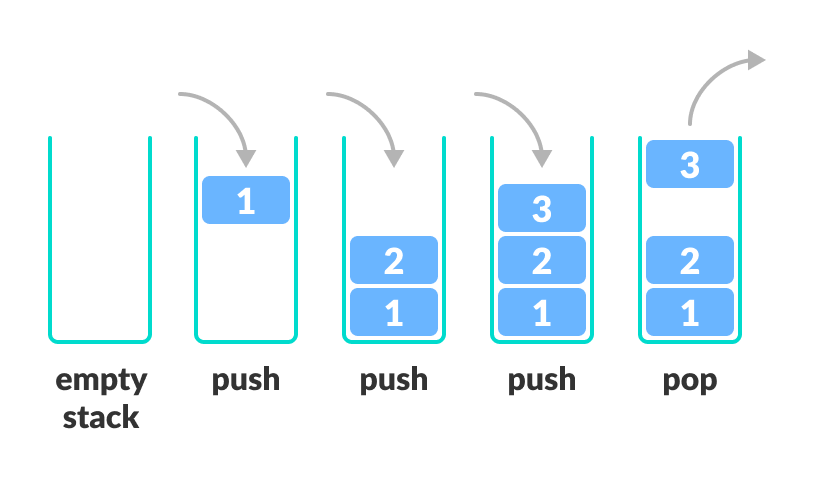
The basic two operations are called:
push(): Insert an item at the top of the stack.pop(): Remove the item from the top of the stack.
In this project you'll develop more advanced moves such as Rotate or Swap a stack.
Usually, a stack is implemented using a kind of linked list to facilitate the straightforward addition and removal of items. Here's a tip: when I learned Algorithms and Basic Data Structures (linked list, queue, stack), I learned it with Object-Oriented Programming (OOP). So, the stack would be a class that has an attribute of the Node class, and this concept made it much easier for me to understand Linked Lists and Nodes. I recommend doing it this way: have a separate struct for the Node, containing pointers for next/previous and the content, and another separate struct for the Stack, containing a pointer to the top of the stack and some other useful attributes you may want (such as the size of the stack, which will be useful for the algorithm I chose to use for push_swap). This will make your code way clearer to read, so instead of using **stack for accessing the top node, you'll be doing stack.top (It may seem trivial, but especially for beginners, this helps a lot in not getting lost in the logic of lists).
For this specific project, the majority of 42 cadets choose to use a sorting algorithm called Radix. This algorithm sorts without comparisons, based on the decimal place (or bit). I didn't like this algorithm, but I was compelled to use it because it is sufficient to pass with 80 points and is not too complex. However, a friend of mine (Shoutout to Rafael) showed me an algorithm created by a Turkish cadet, which I affectionately nicknamed Turkish Sort. This algorithm is enough to achieve a 100% score (if done well, unlike me; I couldn't optimize it to get 5 points on tests with 500 numbers), and its logic is quite intuitive (unlike the code, which is considerably complex). I'll leave the link to A. Yigit Ogun's article: https://medium.com/@ayogun/push-swap-c1f5d2d41e97
