
Have you ever wondered how you can ride a bike without thinking about every movement? That’s a perfect example of implicit knowledge—the kind of understanding that’s often unspoken and hard to articulate. It shapes your skills, intuition, and everyday actions without you even realizing it.
What Is Implicit Knowledge
Implicit knowledge refers to the understanding and skills you acquire through experience but can’t easily articulate. This type of knowledge shapes your behavior and decision-making in subtle ways. Here are some concrete examples:
- Riding a bike: You learn to balance without consciously thinking about it.
- Language fluency: You communicate effectively without analyzing grammar rules.
- Sports performance: Athletes react instinctively during games, relying on practiced moves.
Implicit knowledge is often intuitive. For instance, when you cook without measuring ingredients, you’re drawing from past experiences rather than following a recipe.
Additionally, consider how implicit knowledge affects social interactions. You pick up cues like body language and tone of voice effortlessly. These non-verbal signals guide your responses even if you don’t think about them explicitly.
In professional settings, implicit knowledge enhances collaboration. Team members understand each other’s workflows and preferences without needing detailed discussions. This unspoken understanding promotes efficiency.
Ultimately, recognizing the significance of implicit knowledge can improve personal growth and skill acquisition. By valuing this type of learning, you enhance not only your capabilities but also your interactions with others.
Characteristics of Implicit Knowledge
Implicit knowledge possesses unique characteristics that set it apart from other forms of understanding. It shapes behavior and influences decision-making in subtle ways.
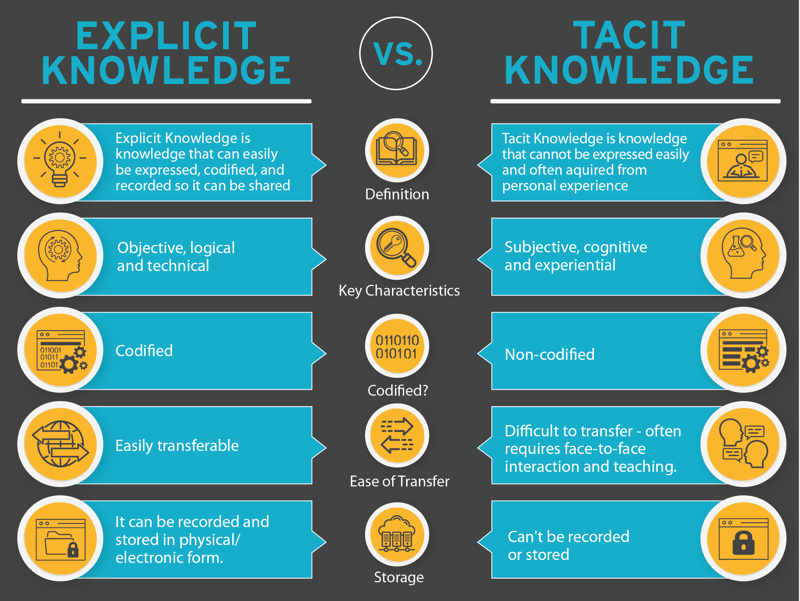
Tacit vs. Explicit Knowledge
Tacit knowledge refers to the unarticulated skills and insights gained through personal experience. You use this type of knowledge daily, often without conscious thought. In contrast, explicit knowledge is easily communicated and documented, such as facts found in books or manuals. While explicit knowledge can be shared verbally, tacit knowledge remains embedded within your practices and interactions.
Examples of Implicit Knowledge
Examples illustrate how implicit knowledge manifests in various aspects of life:
- Riding a Bicycle: You balance instinctively without analyzing your movements.
- Language Proficiency: Speaking fluently occurs without consciously recalling grammar rules.
- Sports Performance: Athletes react quickly during games based on muscle memory developed over time.
- Social Interactions: Picking up on non-verbal cues like body language happens effortlessly.
These examples highlight the vital role implicit knowledge plays in everyday activities and professional environments.
Importance of Implicit Knowledge
Implicit knowledge plays a crucial role in shaping your skills and actions. It influences how you learn, interact, and make decisions without you even realizing it.
Role in Learning and Skills Development
Implicit knowledge significantly contributes to learning processes. For instance, when you practice a skill repeatedly, like playing an instrument or cooking a dish, you develop an intuitive understanding that enhances performance. You might not be able to explain every detail about the technique you’re using, but your body knows what to do.
Examples include:
- Muscle memory: Athletes demonstrate this by executing complex movements effortlessly during competitions.
- Language acquisition: Children often speak fluently before they can articulate grammar rules thanks to their exposure.
- Social skills: You pick up on cues from others—like tone of voice—that guide your interactions naturally.
Impact on Decision Making
Implicit knowledge also impacts how you make decisions each day. It shapes your instincts and reactions in various situations. When faced with challenges, your past experiences inform choices without conscious thought.
Consider these scenarios:
- Quick judgments: A driver reacts instinctively to sudden obstacles based on prior experiences behind the wheel.
- Problem-solving: Professionals often leverage unspoken insights gained through experience when tackling complex issues.
- Interpersonal interactions: You’re likely to adjust your responses during conversations based on non-verbal signals you’ve internalized over time.
Recognizing these aspects highlights the importance of implicit knowledge in enhancing both personal effectiveness and collaborative efforts within teams.
Measuring Implicit Knowledge
Measuring implicit knowledge poses distinct challenges due to its unarticulated nature. Various methods and approaches exist to quantify this type of knowledge effectively.
Methods and Approaches
- Observational Studies: Observing individuals in action can reveal their implicit understanding. For example, a coach might analyze an athlete’s performance to gauge skill without requiring verbal explanations.
- Performance Assessments: Practical tasks often showcase implicit knowledge through execution rather than verbalization. Think of musicians playing pieces flawlessly without consciously recalling notes or techniques.
- Implicit Association Tests (IAT): These tests assess automatic associations between concepts, such as preferences for certain ideas or people, revealing underlying biases that may not be explicitly acknowledged.
- Simulations and Role-Playing: Engaging in simulated environments allows individuals to demonstrate skills in real-time scenarios, highlighting decision-making processes driven by implicit knowledge.
- Self-Report Surveys with Indirect Questions: Using indirect questioning can elicit insights about behaviors influenced by implicit knowledge without direct inquiries into the knowledge itself.
Challenges in Measurement
Measuring implicit knowledge faces significant obstacles:
- Lack of Articulation: Many individuals struggle to express their intuitive skills verbally, making it difficult to capture this information accurately.
- Variability Across Contexts: Implicit understanding often varies based on context; what works in one situation may not translate effectively into another.
- Influence of External Factors: Environmental conditions or emotional states can impact performance, complicating the measurement process.
- Subjectivity in Interpretation: Observers’ biases may affect how they interpret actions demonstrating implicit knowledge, leading to inconsistent evaluations.
Recognizing these complexities aids in developing more effective strategies for measuring implicit knowledge while acknowledging its intrinsic value in various fields like education, sports, and interpersonal communication.
Applications of Implicit Knowledge
Implicit knowledge plays a significant role across various fields, influencing decision-making and interactions. Understanding its applications clarifies how this type of knowledge enhances skills and efficiency.
In Education
In education, implicit knowledge manifests through learning processes that involve hands-on experiences. For instance, students often grasp mathematical concepts more effectively through practical application rather than rote memorization.
- Students learn to solve equations by working on problems instead of just reading instructions.
- Language acquisition occurs naturally when learners immerse themselves in conversation rather than focusing solely on grammar rules.
- Teachers foster implicit knowledge by encouraging collaborative projects where students pick up social cues and teamwork skills without explicit instruction.
In the Workplace
In the workplace, implicit knowledge significantly influences collaboration and productivity. Team members often rely on shared understanding developed through experience rather than formal communication.
- Employees develop problem-solving skills as they encounter challenges together, enhancing their collective ability to address issues quickly.
- Colleagues demonstrate implicit knowledge in project management by anticipating each other’s needs based on past interactions.
- New hires benefit from observing experienced staff members, absorbing unwritten norms and practices that guide behavior within the company culture.
By recognizing these applications, you can appreciate how implicit knowledge enriches both educational environments and professional settings.