

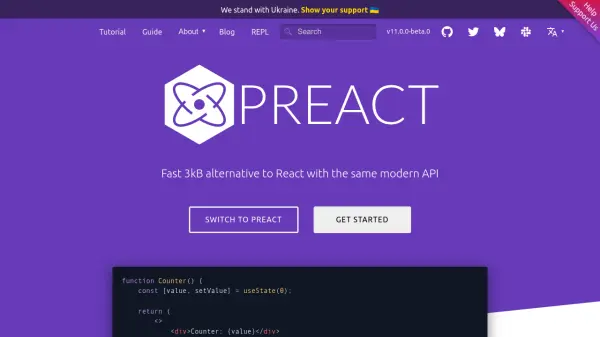
What is Preact?
Preact is a lightweight JavaScript library that provides a fast 3kB alternative to React with identical modern API capabilities. It delivers a thin Virtual DOM abstraction layer directly on top of the DOM, utilizing stable platform features and genuine event handlers for optimal compatibility with other libraries. The framework operates efficiently in browsers without requiring transpilation steps, making it immediately accessible for developers.
The library's minimal size ensures that application code remains the primary component of JavaScript payloads, reducing download, parsing, and execution times. Preact achieves exceptional performance through a straightforward and predictable diff implementation, with automatic update batching and extensive performance optimizations developed in collaboration with browser engineers. Its compact footprint enables embedding in various contexts, from partial application components to standalone widgets, while maintaining full productivity with features like standard HTML attribute support and seamless React ecosystem compatibility via the preact/compat alias.
Features
- Small Size: Only 3kB library size making application code the largest part of JavaScript payload
- High Performance: Fast Virtual DOM implementation with optimized diff algorithm and automatic update batching
- React Compatibility: Same modern API as React with preact/compat alias for using React ecosystem components
- No Transpilation Required: Can be used directly in browsers without build steps
- Embeddable Design: Compact footprint allows embedding in widgets and partial applications
- Productivity Features: Supports standard HTML attributes like class and for with props, state, and context passed to render()
Use Cases
- Building lightweight web applications with React-like syntax
- Creating embedded widgets and components within larger applications
- Developing performance-critical user interfaces where bundle size matters
- Migrating from React to a smaller alternative without API changes
- Building parts of applications without complex integration requirements
- Educational projects teaching Virtual DOM concepts with minimal overhead
FAQs
-
How does Preact compare to React in terms of API compatibility?
Preact offers the same modern API as React, allowing developers to use identical syntax and patterns, with additional compatibility through the preact/compat alias for using React ecosystem components. -
Can Preact be used without any build tools or transpilation?
Yes, Preact can be used directly in the browser without any transpilation steps, making it immediately accessible for development and prototyping. -
What makes Preact different from other UI frameworks in terms of size?
Preact's 3kB size is significantly smaller than most UI frameworks, ensuring that application code constitutes the majority of JavaScript payload rather than framework code. -
How does Preact achieve its performance advantages?
Preact uses a simple and predictable diff implementation for its Virtual DOM, automatically batches updates, and undergoes extensive performance tuning in collaboration with browser engineers. -
Can existing React components be used with Preact?
Yes, through the preact/compat compatibility layer, thousands of React ecosystem components can be seamlessly integrated into Preact applications.
Related Queries
Helpful for people in the following professions
Preact Uptime Monitor
Average Uptime
100%
Average Response Time
134.73 ms


