Polar Transformation of the Villa Rotonda

The Villa Rotonda (1550, completed 1591) is a representation of an anthropomorphic world.

“If we consider this beautiful machine of the world, with how many wonderful ornaments it is filled, and how the heavens, by their continual revolutions, change the seasons according as nature requires, and their motion preserves itself by the sweetest harmony of temperature; we cannot doubt but that the little temples we make, ought to resemble this very great one, which, by his immense goodness, was perfectly compleated with one word of his.” (Palladio, 1570, in Norberg-Schiulz, 1980: 127)

The circular space at the centre, which Palladio derived from the Pantheon, figures completeness and order. All the rooms of the house refer back to this stable centre. Another way to look at this is that the central space doubles the outer world in miniature. What happens if, rather than echoing the world in a rationalised way, we make the representation of the world and the world itself coincide, like they do in the legend of the 1:1 map.

By subjecting the plan of the Villa Rotonda to a polar transformation, we can effectively unroll it.  The static closure of the circle is replaced by open-ended linearity. The house becomes a demarcating line: the porches face one way, and all the passages lead through to an infinite interior. What happens to your fancy Renaissance humanism now, Andrea? Huh?

rotonda plan

rotonda plan polar

The result is different if the plan is rotated 45º : before / after

Biggering

Read this hilariously ignorant editorial from the Herald. The writer, who appears to have absolutely no grasp of the issues involved in contemporary city development, complains that ‘Green thinking’ has been too prominent at the Auckland Regional Council, and that the ARC’s transport plan is unrealistic.

The ARC’s plan aims to “support and contribute to a compact and contained urban form consisting of centres, corridors and rural settlements” – which the Herald’s writer calls a ‘fundamental mistake’. Auckland’s “environment and terrain invite sprawl” apparently.  The writer also laments the Council’s prioritising of rail projects over new roads. It is the writer’s hope that once the Super City is established, the council will be too busy to worry about this environmental nonsense, and let it fall through the cracks, so the city can get on with making more roads and biggering and biggering.

Sustainability and good environmental management are not just about climate change and peak oil, as the writer seems to think (having apparently mastered only a couple of keywords from decades of environmental science, planning, and design). They are about very concrete issues that directly affect the lives of people in the city: the quality of the water at the beach, noise and air pollution, access to community resources, the cost of getting around, the physical health of the city’s occupants, the time spent commuting… Environmental concerns don’t ‘compete’ with economic and social equity concerns, as the writer says; environmental concerns are economic and social concerns. The economics of externalities is outdated.

The writer claims that “Auckland’s roads are of national interest in a way that its public transport is not”, unaware that proper public transport is an essential part of allowing the roads to function properly. All the world’s major cities invest substantially in public transport. It is an embarrassment that someone arriving at the Auckland International Airport can’t catch a train into town.

The Herald’s editor also plays the seedy trick of implying that policies you don’t like must reflect a problem of governance: that only bumbling politicans acting out of bad faith could support policies like this, and that there must be a systemic problem.

The ARC is not being held hostage by garden gnomes. It is doing it’s job: thinking over the long term, and managing the city environment. What did the editor think the ARC was supposed to be doing?

[ crossposted to aaa.org.nz ]


Contingency

In lieu of spitting on the carpet in the doorway, Vek nodded politely and left the Risk Manager’s office. He waited until he was around the corner before muttering angrily at such a preposterous waste of his time. It was obscene to be managed like this. Vek resented the insinuation that the way he had been managing his department for seventeen years was suddenly risky. And what made him irate was that it didn’t seem like the Risk Manager actually thought this. He had been apologetic, the ridiculous little crab, as if it wasn’t really him asking for thirty-odd pages of forms and boilerplate. He had even rolled his eyes at one point, which Vek took to be implying that the two men were in the same boat really, driven by managerial whims. That it was the system, the institution, that somehow required Vek to stop working for the three days it would take him to fill in enough rectangles to quell its anxieties. As if he, the Risk Manager, wasn’t the institution! As if somehow writing things in a rectangle on a form made them comprehensible and controllable! Planes fell out of the sky some days!

Unwilling to go back to the workshop after his meeting, Vek slunk off home. Stopping on the corner close to his rented flat, he pushed through the grubby glass door of a questionable-looking eating establishment and searched his pockets to see what he could afford for dinner. Not finding much, he settled for a pie and a drink taken at random from the fridge. In the back corner, where it was warm, he settled on a bench: the pie was ok, but the drink tasted terrible. He squinted at the label trying to find a description in English of its contents, but when this proved futile he drank the rest anyway. Reaching into his bag, he took out a piece of paper and a pencil. Exhausted by consistency, he leaned over the page and began to draw the plan of the apartment he would build one day.

Enric Miralles, <em>Apartment Calle Mercaders</em> (1995)

Enric Miralles, Apartment Calle Mercaders (1995)

Gunnar Asplund, Villa Snellman (1917-18)

I am in awe of this plan! Just look at it. In overview its not that complicated: a two-storey main block with a single-storey wing meeting it at a slight angle in the corner. Rectangular rooms off a couple of corridors. But look more closely: everything is tweaked. Look at the shape of the upstairs corridor! That circular room isn’t actually a circle or an ellipse—it’s amorphous—and look at the shape of the the entry to the room on the left of it! Good grief, is that another stair squeezed in to the sliver of space left over from the corridor? Notice the thickening of the walls where the two wings meet downstairs. Look at the three doors in the first room of the smaller wing—they’re all different sizes. And look how the window spacings slip out of alignment in the garden elevation! The walls enclosing the bath upstairs!

Villa Snellman, Djursholm (near Stockholm), Erik Gunnar Asplund, 1917-18.

Pictures of the house on flickr ]


snellman djursholm plan

snellman djursholm elevations

Rangitoto

Someone at some point decided that Auckland was the ‘City of Sails’ — a moniker that reflects a fairly privileged view of the city. We don’t all have the means to go messing about in boats, and the boats plebs like me do get to go on tend to be of the noisy seagoing lounge type. But even those are ok if you can get up on the roof. Clearly Gummer or Ford or someone involved with the Auckland War Memorial Museum was of a nautical bent, because the museum never makes more sense than when it is viewed from the harbour.

Auckland War Memorial Museum from the water [ photo M. Russell ]

Auckland War Memorial Museum from the water ( photo M. Russell )

According to Richard Toy’s vision of Auckland as a water-city (currently undergoing a revival of interest), the crucial space of the city is the water’s edge. One of the most interesting things about this is that with your feet in the water, the dominance of visual perception is weakened, giving way to a more haptic mode.

On Rangitoto Island, the youngest of Auckland’s fifty-whatever volcanoes, the water’s edge is a fascinating place: mangroves grow on lava, and alpine lichens are found at sea level (I like reading information signs). Fresh water runs off the island so precipitously that it forms a lens of less salinated water visible from the air. The little necklace of baches strung along the shoreline seem precarious. In some places the lava still appears viscous, as if it barely stopped flowing.

Rangitoto - 28

In this context, close to the wharf where the aforesaid seagoing lounge moors, is a small salt-water pool, built by convict labour between 1926 and 1933, along with a hall at Islington Bay and the coastal road (I can think of worse places to do your PD). The slightly cambered walls of the pool are made from the island’s black scoria. The angles of the pool in plan are particularly nice, I think. It isn’t deep, and usually when I go, the tide isn’t high enough to fill the pool, so it’s just a concrete and scoria hollow.

Rangitoto - 27Rangitoto - 32Rangitoto - 39

From in the pool, the view of the volcanic cone above you is lost, as is any view of the city across the water. Your horizon is limited, closed in. But you hear the birds in the overhanging trees, and the wash of the waves just outside. And you feel the coastal flux: the slight sediment in the water against your skin, the temperature of the sun, the water trickling in and out, something eating, someone on the gravel.

Ocean pools are great.

Literary Advice

If you were to write a novel on human vanity, and in this novel, you imagined the sheik of a wealthy desert kingdom who conceived of a plan to recreate in miniature the entire world, so that every country would become a private island, and every island hold a palace surrounded by pools and gardens, and every palace host one of the most extravagantly wealthy of the globe’s inhabitants; and if in your novel the sheik commanded all his slaves to pour sand into the ocean for nearly ten years; and if at last, abandoned by his fairweather friends, at the end of his resources and humiliated, he was forced to abandon his work, leaving it a clumsy image of the world, as if a child had drawn it; and a single house, the sheik’s own, was left amidst the sun-baked sandbanks; then I would be put in an uncomfortable position. Even if the writing was irreproachable, as I’m certain it would be, I would be forced to find a way of telling you that this kind of sublime romanticism was best left to Shelley or Borges; that the symbolism was crass and obvious and that you had best try again, exercising more subtlety.

[ Credit crunch signals the end of The World for Dubai’s multi-billion dollar property deal. ]

Black Maria: References

[ Part I ]

[ Part II ]

[ Part III ]

A non-exhaustive reference list for works by Hiroshi Nakao, including Black Maria:

(2004)10×10, Haig Beck & Jackie Cooper ed. (Black Maria, Bird Cage)

(2001) XS: Big Ideas, Small Buildings, Phyllis Richardson ed. (Black Maria, Gisant/Transi)

(2001) Lotus. n111, 2001 (Black Maria, Observation Tower, Dark Box Bird Cage)

(2001) Detail. v41, n8 (Dec), pp1496-98 (Black Maria)

(2000) quaderns. n226 (Jul), pp56-65 (‘Creating a Hollow’; ‘Not to be at Home’)

(1999) GA Houses. n59 (Feb), pp144-145 (House with Gallery)

(1997) ume. n5, pp16-23 (Dark Box Bird Cage)

(1997) AA Files. n33 (Summer), pp72-76 (Dark House Bird Cage, Studio for Flower Artist)

(1997) Domus. n794 (Jun), pp18-25 (Studio for Flower Artist)

(1996) Japan Architect. n24 (Winter), pp210-213 (House for Flower Artist)

(1995) GA Japan Environmental Design. n17 (Nov-Dec), pp94-96 (Summer House)

(1995) GA Houses. n47 (Oct), pp68-73 (Dark Box Bird Cage)

(1995) World Architecture. n32, pp88-93: (‘Second Trend in Japanes Architecture; Poetics of HN’)

(1995) GA Houses. n45 (Mar), pp150-151 (Penthouse, Black Maria)

(1993) Architecture d’aujourd’hui. n289 (Oct), pp74-79 (Dark Box Bird Cage)

(1993) Japan Architect. n9 (Spring), pp228-229 (Dark Box Bird Cage)

(1993) Japan Architect. n11 (Autumn), pp194-203 (‘Black Indoors White Yard’)

(1993) Space Design. n5(344) (May), pp88-89, (‘Report on Ando Exhibit’)

(1992) Japan Architect. n6 (Spring), pp38-53, (‘Creating hollows’, Chairs for a Photographer, Dark Box Bird Cage)

The Worker’s Dollhouse I

Although dollhouses and their close relatives model railroads appear to be objects of play, they are in fact about work. Dollhouses are expressions of bourgeois value. They are conservative and nostalgic; sites for the rehearsal of conventions of domesticity, gender roles, and social relations.

The dollhouse comes to prominence in Europe at the same time that the private dwelling becomes understood as opposed to the workplace. Benjamin writes that against the uncomfortable realities of the workplace, the individual ‘needs the domestic interior to sustain him in his illusions’. The house becomes a servant space for the capitalist system, a void compelling consumption. Work is a distasteful necessity. In nineteenth-century Europe, individual identity comes from consumption and leisure. This is the world that the dollhouse models and supports.

Edwin Lutyens, <em><a=href "http://en.wikipedia.org/wiki/Queen_Mary%27s_dollhouse">Queen Mary's Dollhouse</a></em>, 1924

Edwin Lutyens, Queen Mary's Dollhouse, 1924

The studio I am currently running seeks to reinvent the dollhouse as a critical device for thinking about work, particularly the work of making things. What does it mean to exist primarily as a maker, not a consumer? In this studio the dollhouse is to become an active implement not a narcotic, a trivial decoration, or the training wheels of bourgeouis housewifery.

The project is proceeding through a series of Prototypes and developed surface drawings. Below are a few images of Prototype 2. I’ll discuss some of these separately when I get a chance.

Bookbinder's Dollhouse, Anna Harder

Bookbinder's Dollhouse, Anna Harder

Collapsible Dollhouse, Nicole Taylor

Collapsible Dollhouse, Nicole Taylor

Wearable Landscape, Alison Taua

Wearable Landscape, Alison Taua

Dollhouse for Illicit Manufacture, Johanna Calis

Dollhouse for Illicit Manufacture, Johanna Calis

The Forefront, etc.

A follow-up on an earlier post asking why the NZIA doesn’t promote the services of architects in the popular media.

I corresponded briefly with Beverley McRae at the NZIA, who suggested that while it was the responsibility of individual practices to manage their own marketing, the Institute actually did “quite a lot” of advertising to the general public. I’d appreciate it if anyone who has seen some of this advertising could point it out to me. Ms McRae didn’t feel inclined to assist. She did, however, indicate that there was some new advertising in the pipeline to be launched “when we think the time is right” (I asked for a preview, but I think that might have been a rude question!).

I got the sense that the NZIA wasn’t particularly interested in dialogue (at least public dialogue) about this.

It still seems to me that there is a need to publicise the value that architects provide. For a person about to build a new house, who has never worked with an architect before, the question is not ‘which architect should I employ?’ but ‘should I employ an architect?’. For many, the question may not even occur—perhaps it would be a worthy goal to see that it does.

If you have a view, comment below or contact the NZIA directly.

[ crossposted to aaa.org.nz ]

The Diffused Fortress I

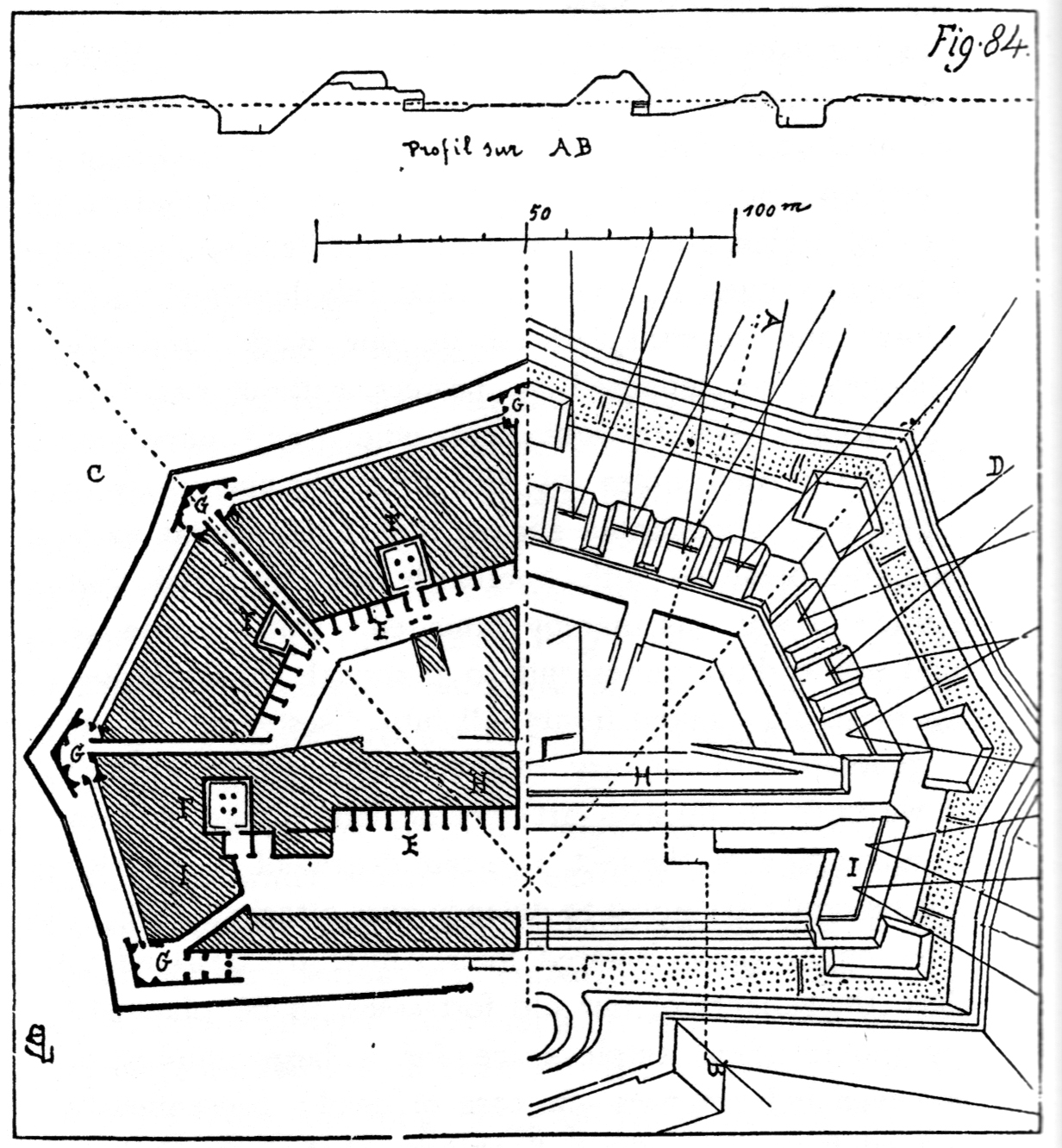
fig 4

In a postscript to his lesser-known work Histoire d’une Forteresse (1874), Eugène-Emmanuel Viollet-le-Duc (1814-1879) describes the diffusion of fortifications brought about by the introduction of ranged artillery. The morphology of fortified towns was redefined by the need to operate in increasingly large arenas of conflict.

Histoire d’une Forteresse recounts the history of a fictional town in a valley in eastern France. Positioned strategically, it undergoes a series of sieges and rebuildings illustrating the practice of fortification from Stone Age Gaulish tribes to the Napoleonic wars of the early nineteenth century. Some of the town’s seven sieges result in it’s capture, while in others the town is able to hold out against the invaders. Illustrated with the lucid metal engravings characteristic of Viollet-le-Duc’s books, the text describes military architecture as fundamentally a problem of tactically exploiting matter. Neither tactics nor constructed matter alone are able to keep the fortress secure or overrun it. Instead security consists in a strategic conjunction between matter (the physical matter of the fortress and the surrounding terrain) and military practices. The fortess is a practiced site.

The conclusion, which is the only part of the text we will be concerned with in this paper, purports to be extracted from the notes of one Captain Jean, dated 1871, a year in which French military confidence had been shaken by the Prussian seige of Paris. “Attack,” writes Jean,

“implies a shock or onset; defence is a resistence to this onset. Whether a piece of ordnance discharges a ball against a plate of iron, or a casing of masonry, or an earthwork; or an assaulting column climbs a breach, the problem is substantially the same; in either case we have to oppose to the impulsive force a resistance that will neutralise its effect.” (Viollet-le-Duc, 1876: 357)

Defensive strategy, tactics, and technology therefore, aim to oppose, resist, and neutralise the effect of shock, at whatever scale it comes. Jean’s brief essay uses a series of ten geometrical plan diagrams to describe a fundamental shift in the nature of fortification, brought about by the shock of artillery.

In the simplest case of attack, a series of blows are exchanged in one-to-one combat. Advantage can be taken by outnumbering the enemy, or alternatively, by surrounding oneself with an enclosure. Jean’s first drawing shows that a group protected in this fashion strictly limits the way attackers can engage them. No matter how the attackers configure themselves, or what numeric advantage they hold, they can only confront the defenders individually.

When ranged weapons, “projectile arms”, are taken into account, the attackers receive an advantage. They can set up a line of weapons which can converge their fire on a point on the circumference of the defenders. Because of the nature of a circular fortress, the defenders are extremely limited in their ability to converge fire on the attackers. They are constrainted to scatter their fire outwards, while the attackers can concentrate it inwards. To ameliorate this asymmetry, the fortress can be constructed with external appendages, salients, that allow the defenders to establish a broader base of fire, as well as offering better visibility of the foot of the main wall. In response, however, the attackers can reconfigure, beginning their assault by concentrating fire on the exposed, outflung salients. Defender and attacker compete for the ability to converge fire on the other while remaining protected. This is the central tension of fortification, which Jean writes,

“regulates and will always regulate attack and defense; distances alone modify its applications… The more eccentric the defence is, the more distant must be the attack, and the wider the perimeter it must occupy; but it should be observed, that the more widely the defence is extended, the more open its flanks are to attack.” (Viollet-le-Duc, 1876: 360).

The 17th century fortifications of Sebastien le Prestre de Vauban (1633-1707), based on the star-shaped forts of the Renaissance, work according to this principle [3]. By extending salients out from the main fort to form bastions, the defenders create a wider line of fire which can be concentrated at any point on a circumference around the fortress corresponding to the range of the artillery, while minimising the exposure of any individual salients to concentrated fire from attackers. In the fourth of his sequence of diagrams, the geometry of the star-shaped fort is seen to be partially material (in the form of the stone walls), and partially immaterial (in the form of sight-lines, firing ranges, and trajectories). These lines of force or agency form a coherent system with lines of solid material. The trajectories do not simply inform the walls, nor do the walls simply define the trajectories. These immaterial lines are as essentially architectural as rows of cut stone. Captain Jean notes that this worked very well for the ranges of the artillery in use in Vauban’s time, but as the range of artillery increases (he notes that late nineteenth-century artillery was effective at ranges of eight or nine kilometres), the balance swings again. In operations at these greater distances, the fortress is proportionally reduced to a point. The attacker, “taking advantage of an indefinite amount of space” is hidden and free to move, while the defender, “soon encumbered with débris of all kinds” is slowed and confused. Under these asymmetrical conditions of mobility, Jean says, the end result is never in doubt. The solution? “In proportion to the length of the trajectory, therefore, the defence must remove its defensive arrangement from the centre of the place.” (VIollet-le-Duc, 1876: 363).

In the sixth diagram in this section, Viollet-le-Duc re-plots Vauban’s geometry for these larger dimensions. Vauban’s star-forts presented fronts of about 360m, but the new situation called for fronts twelve or thirteen kilometres long. To achieve this, the salients are detached from the main fortress; instead of bastions, they are distributed as separate forts forming a defensive ring. They are positioned at the limit of their own firing range from the central fortress, so they themselves cannot be used to bombard it. The arrangement is then refined into a dual ring of forts, so that no one fort is exposed without other forts being able to provide supporting fire from the flanks. In the drawing, the solid material of the fortress appears as a small hatched mass embedded in an increasingly complex field of radii and circumferences demarcating the domains of projected firepower. Railways are necessary to connect the distant forts, and communication lines must be kept open. The territory surrounding the fortress proper becomes a zone of mobility.

In the eighth drawing, the solid material of the fortress walls is given no presence at all; the entire fortress has dissolved into arcs and radii, with certain key points marked algebraically. However, the fortress has not become obsolete, but ubiquitous. The ninth drawing reveals that each individual fort retains the articulation of salients and angles appropriate to smaller arms and closer quarters. The efficacy of the new system was no longer in the solidity of a fixed centrepoint but in the furnishing of a territory. In the tenth drawing, we are shown how this abstract geometry is deformed by the terrain itself. We see the fortress with its wall, but the arced lines of the wall no longer indicate the presence of solid material, as they did in the first drawings. The wall is the extent of the artillery’s range; it is a horizon of effect surrounding a zone of mobility rather than an enclosure.

[ This older post from David Gissen’s HTC Experiments makes an interesting connection between Viollet-le-Duc and conceptions of crowds in the nineteenth century. ]

[ Part II ]

Background Noise

Frances Richardson, <em>Paradise Lost</em>, 2002

Frances Richardson, Paradise Lost, 2002

I’ve been meaning to write something about Byzantine interiors, but I’m working to some deadlines right now. Instead, here are a couple of drawings by Frances Richardson. Her drawings are made up of thousands of tiny little markings, pluses and minuses, a kind of zero-point-energy field. The distinction between figure and ground can only be made through a kind of averaging: the figure is often no more than a slight disruption of the background. Foreground and background are not different orders of material, just different configurations of the same material. Figures arise out of a field of difference. Above, Paradise Lost, in which Richardson renders only the background of an Orthodox icon, revealing the spatiality of the halos and frame. Below, 020602, is how a hallucinating particle physicist sees a forest.

Frances Richardson, <em>020602</em>, 2002

Frances Richardson, 020602, 2002

Black Maria III: Failure

nakao black maria dwg

[ Part I ]

[ Part II ]

[ Refs. ]

Black Maria’s failure to hold a single likeness is paralleled by its failure to contain space in any regular way. When Black Maria is closed, it forms a deep narrowing hollow. Space is trapped in the dark angle. When it is slowly opened, a bright sliver bisects the space at it deepest, most concentrated point. The new angle, as it opens, forms a space at the opposite end, close to the hinge; but before it can form properly, the hinge, which is offset from the open face, causes that angle too to come apart and the space to escape. The deepest, most intense interiority that Black Maria is capable of producing is also the moment at which that interiority is closest to incisive failure. Nakao describes the space as turning in on itself “like a glove turned inside out”. As a container for cartesian space, Black Maria is entirely unsatisfactory. The movement produced by its articulation about the hinge causes space to slip in and out, to flicker irregularly. “A folding screen. Not the conventional folding screen that distributes spaces, but one that sucks space inward, or rather, inspires space and expires it.”  Black Maria doesn’t contain space; rather it ‘spaces’. It projects space, articulates it, inhales and exhales it. It makes spaces between itself, within its angles. The emphasis here is placed on how Black Maria spaces rather than what space it contains. In order to inquire of Black Maria (as if it were an oracle), we need to consider its operation rather than its identity.

These two parallel failures: the failure to hold a stable likeness and the failure to contain a stable space, are not incidental. Black Maria spaces as it signifies: by means of an angle which traps. It creates angles in which space pools or is wedged. This angle, which manifests in Black Maria as a cut which severs, or a mouth which opens introduces an interval into the object.

It is not enough to say that Black Maria is simply continuously variable, in an isotropic way; as if all degrees of movement, all adjustments, all positionings, are precisely equal in value. Black Maria works strongly against this idea of isotropic variability. At certain positions, locations, configurations, significance is trapped for a moment in the angle; a little further and this significance leaks away: Look, a shark! No, wait, where did it go? Likeness only appear when, for a brief instant, the configuration attains a likeness and signifies.

The uncertainty that this produces in the person who encounters Black Maria, and registers the momentary likenesses (as I am suggesting people cannot help but do) is part of the effect of Black Maria. Black Maria does not simply and solely operate in the domain of form (if it is ever possible for architecture to reserve itself in that way). Its primary register is in the domain of the affect on the encounterer.

What does Black Maria do? It fails. Or rather, it refuses to succeed. It fails to signify a wolf in a stable way. Such signification would be possible: a statue of what a wolf looks like would suffice. But Nakao refuses this stability. Similarly, it would be possible to make some modifications to Black Maria in order to make it space in a stable way. But Nakao refuses this stability, too. The locus of both the refusal-to-be-like and the likeness itself, as well as the refusal-to-space and the spacing itself in Black Maria is the hinge.

Contractual Obligations

This is the first section of a paper to be published in the forthcoming issue of Interstices. It argues for the existence of implicit theories of assemblage. I think overall I’m trying to make a connection between architectural assemblages and social or political ones – a stronger connection than just suggesting that the former represents the latter. Something like this is going to feed into my PhD research (whenever that finally gets going). I haven’t included the footnotes or anything, and it ends a bit abruptly. And its far too long for a blog post.

Laugier, Frontispiece to 2nd ed. of <em>Essai sur l'Architecture</em>, 1753

Laugier, Frontispiece to 2nd ed. of Essai sur l'Architecture, 1753


“Man was born free, and he is everywhere in chains.” The Social Contract begins with chains, and remains entangled in questions of binding. The chain is a figure of arbitrary constraint, and is represented as something to be thrown off. But in Rousseau’s text it is not a matter of aspiring to a state of absolute unconstraint. The very concept of society, of a social order, implies some kind or degree of attachment; and it is the proper form of this attachment which is the concern of The Social Contract.

Rousseau makes a primary distinction between the arbitrary bond of the chain and the natural bond of the family, “the oldest of all societies, and the only natural one” (1968: 50). The child is bound to the father by necessity (the maternal bond is never raised), and once the child becomes independent, this bond dissolves: the child and father are freed from this relation, and if it persists, it is by mutual consent: “If they continue to remain united, it is no longer nature, but their own choice, which unites them; and the family as such is kept in being only by agreement” (50). In this shift from dependence to agreement Rousseau locates the shift from the natural to the social. All legitimate authority, asserts Rousseau, must be based on agreement, and he sets himself the task of describing a society of this kind. Rousseau, who has occasionally been misunderstood as advocating a return to nature, actually describes the social as a second nature[1]. Natural order does not authorise social order. Social order must consist of covenants, freely entered into.

As Mark Wigley points out, Rousseau explicitly describes the constitution of social order as a building project, for which the ground must be cleared and tested, the structure carefully maintained, and collapse avoided, “as an architect who puts up a large building first surveys the ground to see if it can bear the weight”  (Rousseau, 1968: 88; see Wigley, 1993: 133). The state is a collective identity formed by very specific relationships between individual elements. By freely entering into the social contract, an aggregate is formed, a corporate body, a “public person… once called the city” (61). This agglomeration is given its internal cohesion by the social contract subscribed to by each individual. The contract is the fundamental joint, the bond or bind by which the entire social edifice takes shape and holds together. The social body acquires unity, life and will.

Although a social whole is formed, however,  the parts must remain autonomous, such that each individual has a private will distinct from the general will: “His private interest may speak with a very different voice from that of the public interest” (63). This freedom runs to the extent that the individual may at any time withdraw from the contract entirely. Society exists only so long as the social contract is freely maintained by its constituents. The freedom to renounce society is essential. The joints of Rousseau’s social structure must not be bound or fused. There cannot be forceful constraints in the social contract.

Rousseau’s social contract is in many respects a gloss on Hobbes’s Leviathan. Hobbes proposed that the state should be conceived as a collective body, of which the sovereign was the head. The famous frontispiece of Hobbes’ treatise show what he has in mind: a body comprised of individual humans as cells, all looking up towards the sovereign. Rousseau’s innovation is in shifting focus from the exterior relations to interior relations. Where Hobbes begins with the image of a human organism, and proceeds to show how society can be fitted into this authorising metaphor, Rousseau begins with individual connections, and attempts to discover what the whole body might look like. [fn useful critique of the organismal metaphor in delanda] Put simply, where Hobbes tendentially assumed the primacy of social form, Rousseau was concerned with social formation. [fn for a fuller discussion of Hobbes’ Leviathan, see McEwen]

Joseph Rykwert has suggested a correlation between Rousseau’s primitivism and that of his contemporary, Marc-Antoine Laugier. The famous frontispiece image of Laugier’s Essay on Architecture (1753) is one of the key coordinates for Rykwerts study of the idea of the primitive hut in architectural theory, On Adam’s House in Paradise. Laugier proposes that the basic elements of the classical tradition in architecture are already present in an imagined primitive scene: seeking environmental control over light, heat, dampness and air, a primitive man finds four trees arranged in a square, and constructs a raised roof; thus inventing column, entablature, and gable. Rykwert writes “Allowing for the inevitable differences between the two men, and the differing scale of their enterprises, this view of the authority of the primitive hut is not unlike that which Rousseau attributed to the family as the archetype of social organisation” (Rykwert, 1981: 44).

In his The Contribution of Art and Science to the Refinement of Manners, Rousseau describes in parallel the socialisation of human beings, and the degenerate elaboration of architecture: “Here is a calm riverbank, dressed by the hand of unaided nature, towards which the eye turns constantly, and which you leave with regret… then came the height of degradation, and vice was never carried so far as when it was seen, to speak figuratively, supported by marble columns and engraved on Corinthian capitals” (Rykwert, 1981: 46-47). How to properly house human beings is a question allied to that of proper social relations.

laugier2

In his drawing for the 1755 edition of the Essay on Architecture, Laugier’s hut is conspicuous for its structural self-sufficiency. The individual elements: the still-living columns, the cross-beams and the rafters, all rest together naturally, without pins or bonds. The four tree-columns have been pruned, and the stumps of the branches become brackets to support the beams. The trees retain their leafy growth, except possibly for the front left tree, which looks as if it has been trimmed back to the trunk. The rafter branches sit up at an improbably steep angle. They rest on the beams without any evident support: under close inspection, the expected bindings are found to be absent, and the rafters do not appear to be notched onto the beams. At the ridge, the rafters rest against one another. A ridge-beam is possibly hinted at, but looks as if it is suspended under the rafters rather than providing any substantive support. Again, there is no hint that the rafters are bound or pinned together at the top; and they cannot be interwoven, because the branches are conspicuously thick and blunt.

laugier3

Perhaps the gesture of Architecture personified in the foreground could be re-interpreted as a gesture of blame for the collapse of the Ionic edifice in the foreground that has attempted to follow the structural logic of the Laugier’s hut – in which case it is no wonder that the cherub appears shocked.

It is evident, of course, that Laugier did not intend his hut to be understood as an exemplar of construction practice, but as a moral “first model” (Laugier, 1756: 11). It is used to demonstrate the essential elements of architecture, and to exclude those elements which are superfluous additions, “essential defects” (12). If performs the same role (and has the same anthropological nonspecificity[3]) as Rousseau’s primitive family. But to point out the strange condition of the joints in Laugier’s image is not entirely perverse – this model does, after all, deliberately express principles of construction. And in fact, the disjointedness of Laugier’s hut is entirely consistent with his thinking about architectural attachment, and the relationship between part and whole. In the Essay on Architecture, there is little written directly concerning joints. Perhaps consideration of joints is included amongst those details with which Laugier felt disinclined “to load this little work” for fear they might “trouble and distaste the reader” (xvi). Connection and attachment are, however, important subthemes of Laugier’s text.

In the chapter of his essay which directly addresses construction, the strength of a building is said to depend on the choice of good material, disposed with consideration of loadpaths and bearing. Laugier writes, “There are three things which render a wall strong and immoveable. The foundation upon which it bears its thickness, the connection and right line of its parts” (138). It is obvious that in his text he has in mind one type of joint, stacked masonry; this is in spite of what he has asserted about the timber origins of architecture. Stones are to be laid accurately and tightly, “that there may be no void in the thickness of the wall” (141), and the use of mortar, a concession, is to be minimised. Laugier’s ideal structure would be held together by nothing other than gravity. Beams are “laid” on the columns. Columns are to “bear immediately upon the pavement, as the pillars of the rustic cabin bear immediately on the ground” (15).

For Laugier, working from the model of his primitive hut, the column was the only proper means of bearing vertical loads. Walls were to be treated as infill panels, concerned solely with sealing up a spatial envelope. Engaged columns are only permitted as a “licence authorised by necessity” (16), but they must not be lost into the mass of the wall – they should be engaged “a fourth part at most… so that even in their use they may always retain something of that air of freedom and disengagement,” (16). For Laugier, parts must remain distinct, even while they form an integrated architectural body. They must be seen to be distinct (as the columns must be seen to be distinct from the wall); and they should need a minimum of concern for attachment: there is an expected natural co-dependence of parts. The disconnection of parts which Laugier encourages could be seen as a foundational principle for later tectonic conceptions of the joint, the role and expression of which became one of the central preoccupations of modernist architecture.

Laugier and Rousseau share more than an authorising appeal to a fictional primitive scene. Both idealise connections in the same way, envisaging a kind of joint which is held together without binding. Their respective edifices, social and architectural are complete wholes comprised of individual elements, which must remain free and discrete, even as they constitute this wholeness. Both edifices are only conceivable on the basis of a very particular mereology. This joint is primitive, in the sense that it is taken to emerge from primitive social and technical conditions. Although these conditions place the joint close to nature, the joint itself is not understood as natural, except insofar as rationalism is natural. For Rousseau, there are three joints: the paternal bond, the agreement, the chain. The first is natural and primitive, the second rational and natural, the third unnatural and irrational. The social contract is of the second of these orders. Laugier fumbles the question of origin by treating it over-literally, but he too seeks to authorise architectural production by demonstrating it to be a rational and natural assembly.

See, I told you it ended abruptly. If you actually read all the way to the end, free virtual cookies for you.

Waste in Transit

piranesi


“ALL ARCHITECTURE IS BUT WASTE IN TRANSIT” – a note taken by Jeremy Till during a lecture by Peter Guthrie; underlined and punched home with a couple of spare exclamation points.

In Cradle to Cradle, McDonough and Braungart write that most of what we call recycling is actually downcycling: materials are recycled in a form less usable and valuable than they were. They point out that these materials are still bound for the landfill, they just make a few extra stops on the way. They argue that all material productions need to be carried out with a view to its re-use. Up-cycling should be possible, or failing that, at least true recycling, where all materials can be separated out and used as nutrients for future technological, biological, or technobiological processes.

Till is struck by the particularity of Guthrie’s phrasing: Architecture is not potential waste, or future waste, but waste in transit: already waste. The abject connotations of the term are important. Waste is stronger than patina or weathering. It is a shame for something to be wasted (remind me to call someone a ‘wastrel’ some time). What does it mean to say that architecture is already waste? McDonough and Braungart are unashamedly and necessarily techno-progressives (not in the sense of a faith in unfettered technological progress, but in the sense that progress is essentially understood to be connected to the correct implementation of technology). Their hope is to eliminate the concept of waste. Guthrie’s observation, however, is for me more directly confrontational for architecture, because it also unveils the systems of classification and socially-derived definitions according to which material becomes coded as waste, dirt, detritus, or wreckage.

Cathcart, Fantauzzi and van Elslander, <em>Slump</em>, 1994. Twenty thousand discarded shoes assembled into a 16' cylinder, raised until it collapsed under its own weight.

Cathcart, Fantauzzi and van Elslander, Slump, 1994. Twenty thousand discarded shoes assembled into a 16' cylinder, raised until it collapsed under its own weight.

Cathcart, Fantauzzi, and van Elslander, <em>Slump</em>, 1994

Cathcart, Fantauzzi, and van Elslander, Slump, 1994

UPDATE: In some cases, very literally waste.