Pricing

Secure, PCI DSS-compliant payment infrastructure

Corefy operates as a PCI DSS Level 1 environment with security and data protection controls embedded across every layer — from infrastructure and access governance to tokenization and transaction-level risk evaluation. Run a PCI-compliant payment gateway without rebuilding the controls yourself.

Securite levels

Built for regulated payment environments

Corefy meets the security standards expected of payment infrastructure operators — and gives PSPs, platforms, and merchants the controls to evidence that posture to their own customers, partners, and regulators.

Independent security audits

Regular external assessments and penetration tests verify that controls work as designed across the platform.

Account and access protection

Configurable controls including multi-factor authentication, password rotation, and session management.

Documented incident response

Defined detection, escalation, and notification procedures for security and operational events.

The security challenges payment platforms actually face

Running payment infrastructure means defending four surfaces at once: authentication, transaction risk, sensitive data, and platform access. Weakness in any one of them creates exposure for the entire flow.

Authentication failures graph
Authentication failures

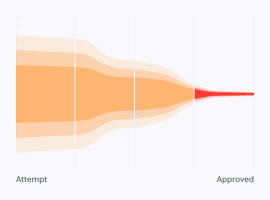
Misconfigured 3DS or SCA flows raise fraud exposure and quietly cost approval rate. Authentication needs to be enforced where required, not everywhere.

Fraud and abnormal transactions graph
Fraud and abnormal transactions

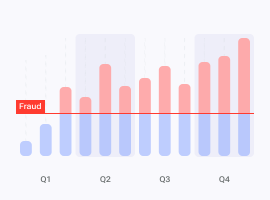
Card testing, bot traffic, and velocity-based attacks exploit gaps in transaction-level controls. Detection has to happen before the transaction reaches the provider.

Payment data exposure graph
Payment data exposure

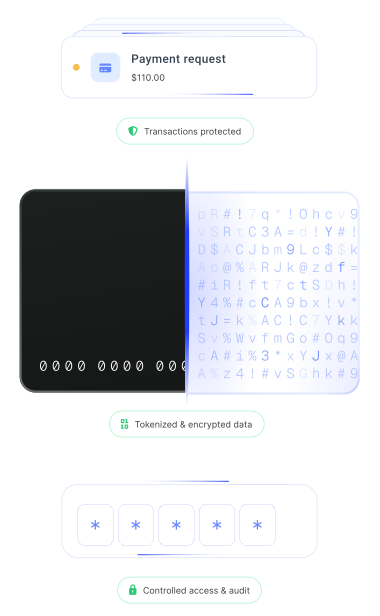
Touching card data widens PCI DSS scope and increases breach impact. The fix is to handle as little of it as possible — and tokenize the rest.risks.

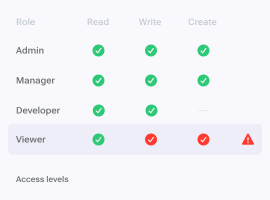
Roles and access UI
Unauthorized platform access

Over-privileged users, weak audit trails, and shared credentials are how internal incidents start. Access governance has to be granular and traceable.

Security and compliance standards

Corefy holds the certifications that payment platforms, PSPs, and enterprise merchants are required to evidence — and applies the technical controls that sit underneath them.

PCI DSS logo

PCI DSS Level 1 environment

Corefy operates as a PCI DSS Level 1 payment infrastructure: the highest tier of certification under the Payment Card Industry Data Security Standard. Card data handling, encryption, tokenization, and access control are designed to PCI DSS requirements at the platform level.

  • Card data tokenization and isolation

  • Encryption in transit and at rest

  • Secure cryptographic key management

  • Network segmentation (PCI zone isolation)

  • Continuous security monitoring and vulnerability management

GDPR logo

GDPR aligned data protection

Corefy applies the technical and organizational measures expected under GDPR, so customers operating in the EU and UK can build their own compliance posture on a platform that's already aligned.

  • Encryption of personal and payment data

  • Defined data retention and deletion policies

  • Access control and activity logging

  • Secure data storage and backups

  • Audit trails for personal data access

Here's what Corefy handles for you

Payment security is layered. Corefy carries the platform-level controls: infrastructure, data protection, encryption, and access governance. The matrix below shows where PSPs and merchants make business-level decisions like risk rules and KYC.

Responsibility area

Infrastructure security

Payment data protection

Payment routing

Payment flow control

Business risk rules

Merchant onboarding

Corefy

PSP

Merchant

Secure infrastructure by design

Corefy's payment infrastructure is built on a cell-isolated architecture distributed across multiple availability zones — designed for high availability, fault containment, and continuous secure processing.

Cloud infrastructure

Cloud infrastructure

Built on AWS across multiple availability zones for reliability, scalability, and secure data processing under defined geographic constraints.

Monitoring and alerting

Real-time monitoring

Provider behaviour and payment flows are monitored continuously, with automated alerts on anomalies and degraded performance.

High availability

High availability

Each zone is built with redundancy, so payment processing continues through individual component failures without merchant-visible impact.

Cells isolation

Fault isolation by cell

Issues in one cell are contained inside that cell. They do not propagate to other merchants, providers, or payment flows.

Backup and recovery

Encrypted backups and data archiving meet long-term availability and retention requirements.

Data recovery

Payment data protection and tokenization

  • Encryption in transit

    All external traffic between merchants, PSPs, and the Corefy platform is protected with TLS encryption. Payment data stays confidential and tamper-evident across every hop.

    Encryption in transit
  • Tokenization

    Card data is replaced with secure tokens that can be used for subsequent transactions, recurring billing, and card-on-file flows. This narrows the PCI DSS scope of any system that integrates with Corefy.

    Card tokenization
  • Card vault

    Card data can be stored in a dedicated PCI DSS-compliant vault, so merchants can offer card-on-file payments without holding card data themselves.

    Card vault
  • Secure credential storage

    Provider integration credentials and API keys are encrypted and isolated per cell. A compromise in one tenant cannot reach another.

    Secure credential storage
  • Webhook signing

    Every webhook notification is cryptographically signed. Merchants and PSPs can verify origin and integrity before acting on it.

    Webhook signing

Payment security, built into the infrastructure

See how Corefy protects payment flows, sensitive data, and platform access across the full transaction lifecycle.

Access management and audit visibility

Administrative actions inside the platform are governed through structured access controls and recorded for full traceability — so you can evidence who did what, when.

Role-based access control (RBAC)

Users receive only the permissions their role requires.

Least-privilege access · Reduced operational risk

Granular permissions

Permissions are configurable across platform entities — by team, environment, and action.

Precise access control · Safer team collaboration

Audit logs

Every operational action is recorded in tamper-evident audit logs.

Full activity traceability · Compliance readiness

Activity monitoring

Administrative actions and system events stream to monitoring tools for ongoing operational visibility.

Operational visibility · Faster incident investigation

Security across every stage of the payment flow

Security checkpoints are embedded throughout the payment lifecycle. Every transaction is evaluated at five distinct stages — before, during, and after it reaches a provider.

  • Secure payment request

    Incoming payment requests are validated before entering the processing pipeline.

    • TLS-protected API communication
    • API key validation
    • Request integrity checks
    Secure payment request
  • Risk evaluation

    Rule-based transaction controls catch abnormal payment activity at the earliest possible point.

    • Velocity limits
    • BIN / issuer filters
    • IP filtering
    • Transaction amount limits
    Risk evaluation
  • Customer authentication

    Dynamic authentication rules enforce 3DS and Strong Customer Authentication where regulation or risk profile requires it.

    • 3DS configuration
    • SCA-ready authentication flow
    Customer authentication
  • Routing decision

    Risk signals feed into routing logic, so transactions can be steered, retried, or blocked based on real exposure.

    • Risk-based routing
    • Failover control
    • Provider-level filtering
    Routing decision
  • Payment processing

    External risk signals and provider responses are incorporated into transaction evaluation.

    • Third-party fraud signals
    • Merchant risk inputs
    • Issuer responses
    Payment processing

Operational security practices

Platform security is supported by continuous monitoring, regular external testing, and defined response procedures.

Continuous monitoring

Continuous monitoring

Platform activity, infrastructure, and access logs are monitored without interruption. Suspicious behaviour triggers automated detection and a defined response path.

Responsible disclosure

Responsible disclosure

Security researchers can report findings to security@corefy.com. We acknowledge, investigate, and remediate under a defined process.

Vulnerability management

Internal security assessments, vulnerability scans, and external penetration tests run on a recurring schedule, with remediation tracked to closure.

Vulnerability management

Run your payments on infrastructure that's already secured

Connect providers, configure flows, and operate your payment business on a PCI DSS Level 1, GDPR-aligned platform without building the controls yourself.

Frequently asked questions

Prefer to speak with someone directly?

Talk to a payment expert