
For the past thirty years, I’ve had a rather strange vision in my head about what a true interactive theme park experience could really be like. At first, I really wasn’t sure how it could be done, from a technology point of view, but I knew how the experience should feel to the guests.
Ironically, this idea came to me while reading about a proposed theme park concept that has largely been forgotten today.
Back in the 1990s, there was once a proposal to build an actual Wizard of Oz theme park in Kansas. The idea was genius and made perfect sense… and it still boggles my mind today how it failed to find enough support to actually make it happen in the state that was synonymous with the Oz IP itself.

As memory serves, it was to be located just west of Kansas City, on the site of a former Army munitions plant that had been closed down, which would be transformed into the world of Oz, transport guests from our world to Oz via a Twister simulation and even feature a “Flying Monkey” themed inverted roller coaster.
While I remember reading many news updates about the project at the time, there was one particular concept that just blew my mind.
One of the developers had suggested filling this fictional “Oz” with animatronic figures that could somehow recognize guests and store memories, so they could recall previous interactions they might have had with the guest.
At that point, my brain just exploded with ideas about just what this experience could be like.
A real personalised experience
Now, if you recall the 90s, the internet was still fairly new. The general public had not even thought their way through the concepts of privacy laws, let alone the complications about companies potentially storing personal data about minors and such. So really, this was kind of the wild, wild west of outrageous concepts.
The question was just how you could turn a theme park into a living and breathing world, full of sensors, animatronic characters and stations, all linked to a giant database that would somehow be able to recognize each individual guest.
From there, you could create a memory profile of the things they did, perhaps noting the things they liked, the things they didn’t, the kind of foods they ate, and the characters they seemed to prefer to interact with, and so on.

My mind just raced with ideas about what you could accomplish with something like this. In 1993, the film Jurassic Park had just hit theaters with the idea of what nearly unlimited funds could accomplish within the realm of a theme park concept.
While the Steven Spielberg film was based on the incredible novel by Michael Crichton, this was not the first imaginary theme park concept Crichton had come up with.
Twenty years prior, a much younger Michael Crichton wrote and directed a film about another even more incredible theme park concept called Westworld. If that sounds familiar, you may have seen the HBO reboot series of the same name, which received critical acclaim in 2016.
While the 2016 version added many modern ideas about the world and technology, the concept behind it all was essentially the same… a theme park world inhabited by life-like robots that each played a role in the world and were tied into various interactive storylines that guests could live out.
In essence, it was like living in a video game world, where guests could do whatever they wanted, no matter how crazy, and the world would simply adapt around them as they navigated various storylines.
Behind the scenes, in both versions, there was a hidden master-control ops center that attempted to oversee everything that went on, and an army of technicians that would come up from hidden underground doors at night to fix and reset the world for the next day’s adventures and the arrival of new guests.
The rise of AI
Much like what we saw happen in Jurassic Park, in both versions of Westworld (the original 1973 film and 2016 series), things sort of got complicated, and the theme park world began to spiral out of control as the make-believe dangers suddenly became very real…and deadly.
While the 1970s version seemed to place more blame on bad programming and malfunctioning machines, the interesting aspect of the 2016 series is that it really played hard into the concept of artificial intelligence.
This modern take embraced the idea of AI, not only as the driving force behind the robotic characters, but seemed to show that these artificial beings were beginning to evolve, starting to remember past events they were supposed to have forgotten, and even got smarter by learning about the reality of their world.
In the climaxes of these kinds of Hollywood stories, things tend not to go so well for the humans, as the very system begins to run completely off the rails.
Personally, I would like to believe that the time may be right to merge many of these concepts with today’s technology and the rapidly growing use of AI to create a theme park concept that feels like a never-ending story.

From time to time, I’ve heard a phrase tossed around to describe such a concept as being a “Living Story” environment. The raw concept would be to design a theme park where the guests are no longer just spectators, but instead have the ability to become active and even recognized characters within the world’s persistent storyline.
While standing near the wreckage of a crashed TIE fighter in Star Wars: Galaxy’s Edge today, the conversation with the characters usually follows a predictable arc. A First Order Stormtrooper will approach, offer a canned but authoritative phrase like "Move along, citizen," and perhaps strike an intimidating pose, blaster at the ready.
It is a scripted moment, carefully rehearsed and perfectly executed and a staple of the modern "immersive" theme park land. It is also, perhaps, something that could grow increasingly obsolete as the industry is on the cusp of its most profound narrative shift since Walt Disney first envisioned audio-animatronics that could pretend to whistle a tune.
We are witnessing the death of the script.
The death of the script
The future of theme park storytelling is not dictated by pre-recorded loops or fixed interaction matrices. It should be fluid, responsive, and deeply personalized.
To bring about the era of the "Living Story", the experience would be powered by generative artificial intelligence and feature the rise of more intelligent non-player characters (NPCs) within the environment. The goal of the combination is to transform the guest from a passive observer of a narrative into an active, remembered participant.
For decades, immersion was defined by the quality of the detail. If the fake rockwork looked real and the attraction queue was decorated with enough theming and lore, the illusion held. The limitation, however, was the people or the animatronics that were pretending to be people.
Within themed lands such as Universal’s Wizarding World of Harry Potter or Disney’s Avengers Campus, these background characters (or NPCs) serve as the connective tissue to the story being told. And yet, the various human NPCs or expensive robotic characters still have to operate within very strict parameters.

The trained actors still follow their show script, and the animatronics, no matter how expensive or fluid their movements are, are still triggered to say the same lines hundreds of times each day.
This creates a narrative loop in which guests are simply ghost-like characters passing through the world. While those First Order Stormtroopers may have addressed you while you passed, the interaction was only momentary. If you return to them 15 minutes later, they won’t remember you, what was said, or what had taken place.
This is the first major crack in the immersion illusion because at this moment, the guests know the script and are aware that the performance they are watching is a fixed event that will be repeated throughout the day, no matter who is standing there.
The goal of the “Living Story” would be to shatter that fixed narrative loop. This would be a dramatic shift away from a traditional theme park attraction experience where everyone sees the same show and experiences the same general story.
In this living world, the story could change and adapt based on the guest’s choices, actions, and even conversations with characters within the park, or even while on an attraction.
How can tech solve this issue?
For example, through the use of a piece of wearable tech, such as an RFID-enabled wristband (not unlike a Disney MagicBand), guests riding an attraction like Pirates of the Caribbean could have the experience shift from being an invisible observer to the story unfolding, to actually having a presence that the pirates or ghosts could react to as you pass by.
In fact, through the use of this kind of technology, aspects of the attraction could technically change because of things you might have done earlier on, for example, interacting with something in the pre-show or queue could potentially unlock a different scene or entirely new dialog within an attraction.
It is worth noting that today, the technology to recognize a guest as they move through a park isn’t limited to just wearable technology any longer, as the use of facial recognition technology becomes more widespread.

Through a persistent database, a park could remember each guest and any particular actions they took involving storylines, then create a history of their interactions within the world that can be remembered across several different visits.
For example, if within the storyline of an attraction, you just happened to be involved in the theft of the plans to the Death Star on one visit, the Stormtroopers may still be on the lookout for you the next time you visit and enter Star Wars: Galaxy’s Edge.
If you were asked to deliver said plans to a particular member of the resistance on that first day, but were unable to accomplish that task before the end of your visit, what if you could instead pick up the same storyline and actually deliver those plans on another visit, even if it was months later?
While on the subject of Star Wars Stormtrooper characters, one of the most fun aspects of a visit to Galaxy’s Edge right now is how these live-action characters are able to trigger various pieces of pre-recorded dialog in order to interact with guests.
While this is limited to just the dialog scripts that have been pre-loaded and the creativity of the user within, what if the experience was not so limited?
Next-gen NPCs
What if, instead of accessing a dropdown menu of pre-recorded responses, the next generation of NPCs were plugged directly into a customized large language model (LLMs) for better interaction?
Think of this as ChatGPT with a deep, authoritative database of IP lore and character backstories, and a distinct linguistic profile that creates a more distinct persona for the individual NPCs.
So the Stormtrooper by the TIE fighter is no longer relying on a sound chip with five phrases. If you ask them, "How is the local food here?" the AI wouldn’t break character, it would understand the context of the question, access the lore and generate a proper response in real-time that is both lore-accurate and unique to the moment.
Now, what if these NPC characters (live or robotic) also had access to a database about any given guest? This could allow selected bits of data to be presented as response options to the characters, giving them knowledge of previous interactions with the guest.
For example, without being prompted by anyone, what if the character you were posing for pictures with knew it was your birthday that day, or that a couple was celebrating their anniversary? Or what if it was something simpler, such as knowing what you may have had for lunch earlier in the day?
A key selling point of a Living Story-style world would be the ability for the various characters to remember you and your past actions or interactions.

So if that Stormtrooper passed by you again, they might be able to make a side comment about the food you may have just eaten based on the AI-generated review of the local food in Galaxy’s Edge it had just given you an hour ago. “I see you tried that Bantha Burger I told you about…”
Another great example could be applied to the Megatron character at Universal Studios Hollywood.
Voiced by a talented live actor, footage of the massive Megatron character can be found all over the internet, slinging hilarious insults at the guests as they pose for pictures with him, which has created many a viral moment for the Universal parks over the years.
These are simply just live, spur-of-the-moment interactions, based only on what the Megatron actor can see or hear. But it does make me wonder what the experience could be like if Megatron was perhaps fed a little extra “personal” information ahead of time, as guests stand in line?
How would a guest react if Megatron had knowledge of something potentially embarrassing that they might have posted on social media that week?
Using guest data
Various tech-savvy characters in parks would certainly be in-character if they were to have access to a guest’s social media feeds. Megatron, for one, a Tron universe character from Disney, or even someone from Disney’s Wreck-It-Ralph universe.
Of course, the reality of today’s world would involve the creation of various permissions for parks to access these data feeds by asking guests to voluntarily submit their accounts for greater "interactivity" within the park, and thus allow guests who have privacy concerns to completely opt out and still have a more traditional observer-style experience.
In fact, some parks are already dealing with digital permission issues as they deploy concepts like facial recognition at entrance turnstiles and in line-cutting queues, while still allowing guests to “opt out” if they so wish.
Universal has already begun processes with this kind of early technology at its Orlando and Beijing properties, including opt-out procedures.
With 2026-era high-speed processing power and data transmission speeds, we can not only track a guest through a park in real time, but, via AI-backed systems, transmit relevant data at a speed that can actually be used in real time.
This kind of speed and computing power can allow for a computer-generated option to unfold in real-time for a guest in a way that would almost seem magical, or at the very least, feel like a seamless part of the overall experience.
Free-roaming Olaf and the future of interactive characters
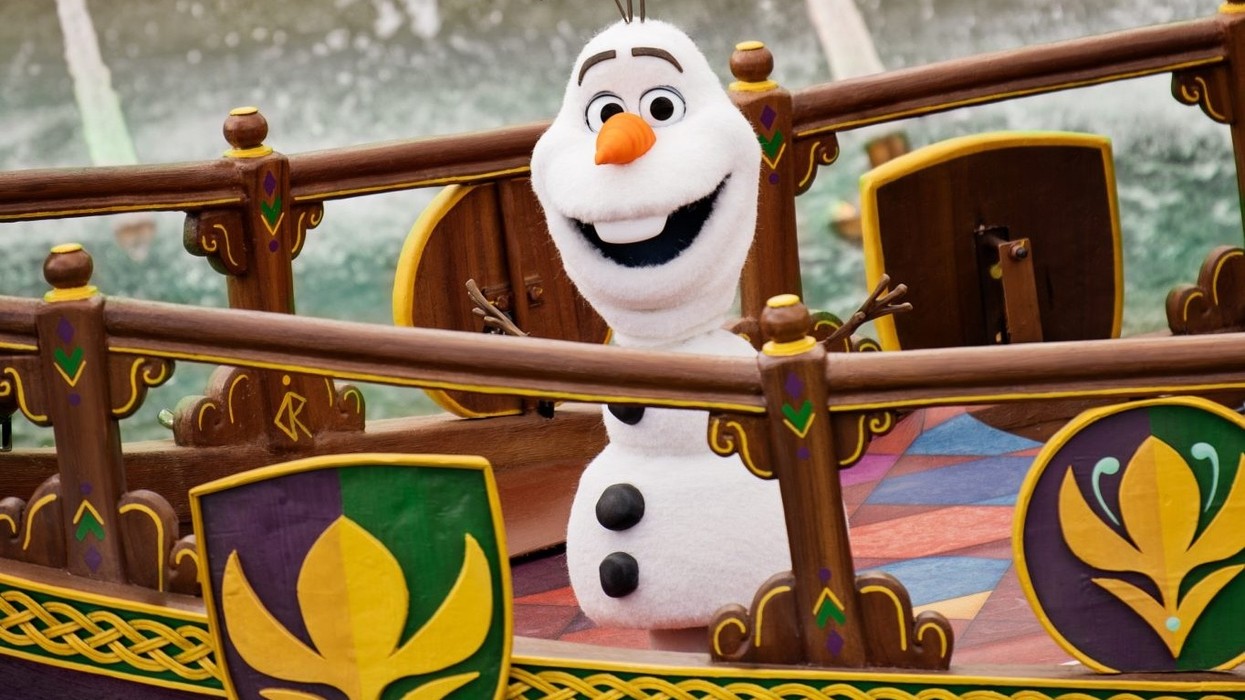
Just this week, Disney launched a great new example of this: the free-roaming robotic Olaf snowman character in the World of Frozen at the Disneyland Paris resort.
Not only can Olaf wander and move about a section of the park, but he can also interact with guests in unscripted moments and even react to their movements in real time.
If I had to guess, the new Olaf character may be an evolution of the BD-X Droids that were previously launched by Disney to inhabit the Star Wars-themed areas of the parks.
While the BD-X Droids were not capable of speech like Olaf, they did seem to have the ability to react to the actions of guests they would encounter on their adventures through the park, making the land feel more populated by sentient creatures able to travel about rather than stationary props and stations.
The BD-X Droids did have a handler with them at all times, and for his own protection, I can only assume Olaf does as well, if for nothing else than to keep guests from picking him up and running away with him.

Meanwhile, Universal is also launching its own robotic characters as well in the form of the Night Light baby dragon characters in Epic Universe’s Isle of Berk. While they don’t talk, they do appear to be capable of performing tasks under the command of a handler character while appearing to be somewhat autonomous creations.
It does make me wonder what kind of surprises Universal may have in store for the world when it opens the new Universal Kids Resort in Texas later this year.
Technology is advancing so far, I really do think we are on the cusp of achieving something we’ve never quite seen before in the world of themed entertainment.
The creation of the “Living Story” addresses the fundamental flaw of the current immersive park concept: the illusion decays through repetition.
By transforming the guest into a persistent and remembered character, parks would create an environment where magic is not just witnessed but experienced uniquely by every individual.
The script may be dead, but the story is more alive than ever before.


