1. Why is 4D Imaging Radar considered a “Game Changer” for autonomy?
Traditional radar forced a compromise: you could have a wide field of view with poor detail, or high detail in a very narrow slice. Arbe’s technology breaks this trade-off by providing ultra-high resolution (1° Azimuth) across a wide 100° field of view, delivering the “optical-like” sensitivity of a camera with the “all-weather” reliability of radar.
2. What are the “Three Forces” driving the autonomous market?
3. How does Arbe’s data rate compare to standard automotive sensors?
Arbe’s chipset generates a high-resolution 4D image with an internal data rate equivalent to more than 2,000 Gbps (and processing throughput up to 3 Tbps). This allows the system to process massive amounts of environmental data in real-time, far exceeding the “sparse” point clouds of legacy radar.
4. Can this radar actually compete with the range of optical sensors?
Yes, and it often exceeds them. While market-leading optical sensors (cameras) typically reach around 100 meters in challenging conditions, Arbe’s 4D Imaging Radar reaches up to 350 meters. This long-range capability is essential for safe braking and lane-changing at high highway speeds.
5. How does the radar solve the “False Alarm” problem?
Legacy radars often trigger “phantom braking” because they can’t distinguish between a metallic manhole cover and a stalled vehicle. Arbe uses a low detection threshold to catch everything, then employs advanced post-processing, tracking, and calibration to filter out noise. This ensures the car only reacts to genuine hazards.
6. What is the significance of the “10x Sensitivity” benchmark?
Arbe’s radar is roughly 10 times more sensitive than traditional automotive radars. This allows it to detect “weak” reflectors—like a pedestrian in dark clothing or a bicycle—even when they are standing next to “strong” reflectors like a metal fence or a large truck.
7. How does high-resolution radar reduce the overall cost of a vehicle?
Because 4D Imaging Radar is so detailed and reliable, it can perform tasks that previously required multiple overlapping sensors. By serving as the “backbone,” it allows OEMs to simplify the sensor suite, reducing the total number of cameras or expensive LiDAR units needed.
8. What is the difference between “Safety Decisions” and “Path Planning”?
9. What major milestone did Arbe reach in early 2026?
In January 2026, Arbe announced a major integration with NVIDIA DRIVE. This combined Arbe’s ultra-HD radar data with NVIDIA’s AI computing to create a platform for “eyes-off” driving. For the first time, this allowed vehicles to handle complex highway scenarios at speeds up to 130 km/h with human-like predictability.
10. What is the “China L4 Win” and why is it important?
As of December 2025, a major China-based state-owned automaker selected Arbe’s chipset (via Tier-1 partner HiRain) for its Level 4 autonomous vehicle program. With a Start of Production (SOP) in December 2026, this marks one of the world’s first large-scale deployments of ultra-HD radar in a fully autonomous fleet.
As the autonomous vehicle industry advances toward anticipated exponential market growth, major players already have begun announcing deals that will make autonomy inevitable. At Arbe, we believe three forces are currently driving both technology and market development:

Radar is the only reliable technology to support these trends
We believe that level 3, 4, and 5 vehicle autonomies are not achievable without the robustness of radar. Optic sensors have a higher risk of failure in various weather and lighting conditions. Radar is indispensable due to its functional advantage of being able to penetrate dust, rain, fog, and snow. It is the only sensor able to work around the clock – all day and night.
In addition, as radar technology is more affordable, making it highly valuable for adding level 1 and 2 active safety features to more entry and mid-level vehicle platforms.
Is radar advanced enough for autonomous driving?
Today’s radar already plays a vital role in various safety systems. However, the radar options available in the market today are not the best solution for achieving a fully autonomous vehicle – yet. With the current radar technology, a functional choice must be made between medium resolution at a limited field of view or low resolution at a wide field of view. Current radar systems often show false alarms, which can cause vehicles to needlessly brake under normal driving conditions. They also have challenges with recognizing obstacles that suddenly appear ahead of the vehicle.
At Arbe, our goal is to change all of this by bridging the gap between radar and optical sensors. Our proprietary solution provides the sensitivity of optic sensors with the reliability and maturity of radar technology.
Disrupting radar technology will forever change the industry
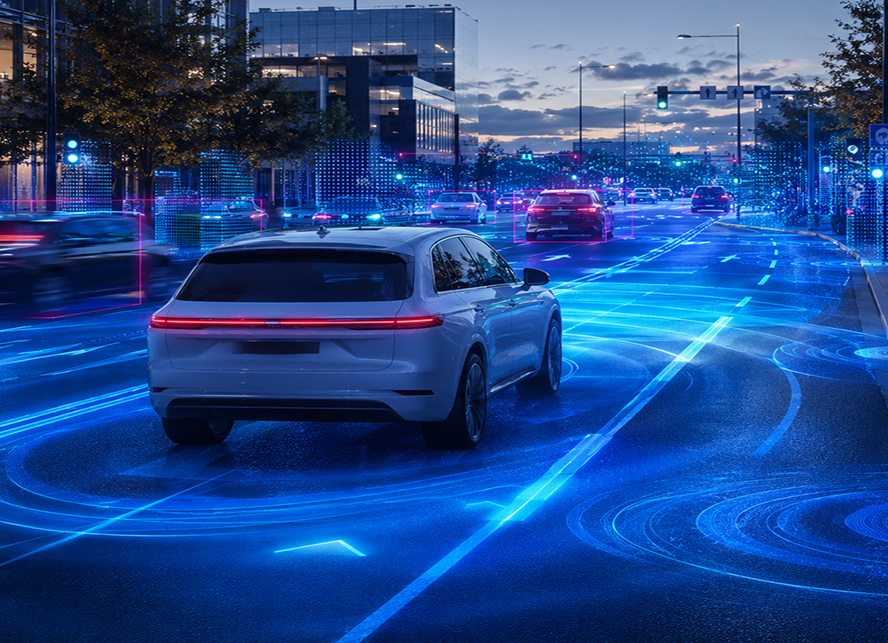
Arbe is developing the world’s first ultra-high resolution radar to address the autonomous vehicle sensor challenges of today and of tomorrow. The breakthrough in radar technology lies in our ability to generate a high-resolution, 4D image with the equivalent data rates of more than 2,000 Gbps and process it in real time.
Our radar can deliver a 4D image of the environment: the azimuth and elevation positions, the object ranges, and doppler velocities. It has 10 times higher sensitivity than any other radar currently on the market, sensing the environment at 100-degree field of view with one-degree angular resolution of azimuth and 30-degree field of view with two degrees angular resolution of elevation. In parallel, our radar reaches a range of up to 350 meters, compared to the 100 meters associated with today’s market-leading optic sensors.
Another important differentiating factor is our radar’s ability to filter out false alarms. To provide optimal sensitivity, the radar uses the lowest detection threshold. Post processing and tracking are used to filter out random noise, while calibration schemes allow reaching extremely low side lobe levels.
With the introduction of our high-resolution radar, fewer sensors are required in the entire sensor suite, reducing the overall autonomous vehicle cost and streamlining its operational management.
Addressing safety and autonomy
The capabilities of an advanced radar can be leveraged to provide:
Arbe 4D imaging radar is a true enabler of autonomous driving.
Looking beyond autonomous driving
As the radar technology reaches innovation maturity, it can benefit additional mobility and lifestyle markets, like autonomous robots, drones, home safety, and many others.
We are excited about the possibilities.
Connect to learn more