
The Paper Wasp (Polistinae)
Paper Wasp Characteristics
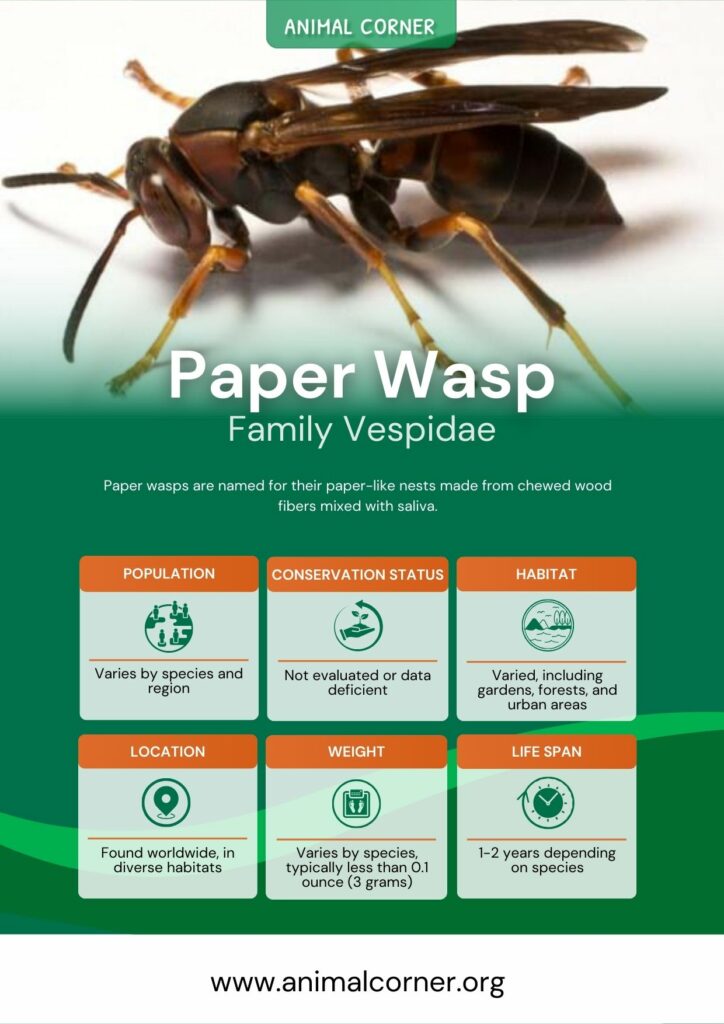
Paper wasps are 3/4 to 1 inch long, slender, narrow-waisted wasps with smoky black wings that are folded lengthwise when at rest. Paper wasps are usually brown with yellow markings on the head, thorax and bands on the abdomen. Paper wasps should not be confused with yellowjackets and baldfaced hornets. Paper wasp nests are open and cells are not covered with a cap (in an envelope).
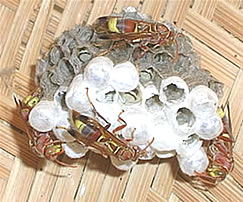
Paper wasp colonies contain three castes: workers, queens and males. Fertilized queens, which appear similar to workers, hide themselves through the winter in protected habitats such as cracks and crevices in structures or under tree bark. In the spring they select a nesting site and begin to build a nest (nests are built from wood fibre collected from posts and occasionally from live plant stems).
Paper Wasp Lifecycle
Eggs are laid individually in cells and hatch into legless grub-like larvae that develop through several stages (instars) before pupating. Cells remain open until developing larvae pupate. Sterile worker wasps assist in building the nest, feeding young and defending the nest. A mature paper wasp nest may have 20 to 30 adults.
In late summer, queens stop laying eggs and the colony soon begins to decline. In the fall, mated female offspring of the queen seek over-wintering sites. The remainder of the colony does not survive the winter and dies off.
Appearance and Identification
While Paper Wasps share some similarities with other wasp species, there are several features that make them relatively straightforward to identify with a little practice. The body is notably slender and elongated, with a distinctly narrow waist that gives the insect a pinched, almost fragile appearance compared to the chunkier build of a hornet or yellowjacket. The legs are long and dangle visibly beneath the body during flight, which is one of the easiest ways to spot a Paper Wasp in the air.
The colouring varies between species but is generally a combination of brown and yellow, with some species also showing reddish or orange tones. The wings have a warm amber tint and are folded flat along the length of the body when the wasp is at rest, giving it a narrow profile. The antennae are medium length and slightly curved.
One of the most reliable ways to tell a Paper Wasp nest apart from that of a yellowjacket or hornet is the open-celled structure. Paper Wasp nests have no outer covering or envelope, meaning the individual hexagonal cells are clearly visible from the outside. The nest resembles a small, upside-down umbrella hanging from a central stalk, which is why Paper Wasps are sometimes also referred to as umbrella wasps in some parts of the world.
Building the Nest
The nest-building process of the Paper Wasp is one of the most impressive feats of natural engineering found among insects. The queen begins construction entirely alone in spring, after emerging from her overwintering site. She locates a suitable sheltered spot, such as beneath a roof overhang, inside a garden shed, under a fence rail or within dense shrubby vegetation, and begins collecting raw material.
Wood fibre is scraped from weathered timber, fence posts and dry plant stems using the wasp’s strong mandibles. The fibres are chewed and mixed with saliva to produce a soft, grey papery pulp, which is then moulded into the distinctive hexagonal cells of the nest. As the pulp dries it hardens into a lightweight but surprisingly strong material, similar in texture to thin cardboard. This is the origin of the Paper Wasp’s common name, and the material produced is a genuine natural form of paper, created by the wasps millions of years before humans independently discovered the same process.
As the colony grows and more workers are available to help, the nest expands steadily through the summer, with new cells added around the outer edge as the queen continues to lay eggs.
Behaviour and Temperament
Paper Wasps are generally considered to be less aggressive than yellowjackets or hornets and will not typically sting unless they feel that the nest is being directly threatened. A single Paper Wasp encountered away from the nest is unlikely to cause any trouble and will usually fly away if left alone. However, if the nest is approached too closely or disturbed, the workers will defend it vigorously and are capable of stinging repeatedly, as wasps do not lose their sting in the way that honeybees do.
It is worth being aware of nest locations around the home and garden, particularly in late summer when colonies are at their largest and the wasps can be more defensive.
Paper Wasps and the Garden
Despite their reputation as a nuisance, Paper Wasps provide a genuinely valuable service in gardens and natural habitats. They are active predators of caterpillars, flies and other soft-bodied insects, which they catch, chew up and feed to their developing larvae. This predatory behaviour makes them effective natural pest controllers, reducing the populations of insects that might otherwise damage garden plants and crops. Adult Paper Wasps also visit flowers to feed on nectar and in doing so contribute to pollination, adding further ecological value to a species that is often unfairly dismissed as simply a stinging nuisance.
Sources & References
Cite This Page
APA
Joanne Spencer (2026, April 9). Paper Wasp. Animal Corner. Retrieved 2026, May 4, from https://animalcorner.org/animals/paper-wasp/
MLA
Joanne Spencer. "Paper Wasp." Animal Corner, 2026, April 9, https://animalcorner.org/animals/paper-wasp/.
Click to copy