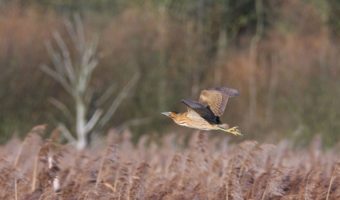
The Great Bittern bird (Botaurus stellaris) is a wading bird of the heron family Ardeidae. The Great Bittern bird is a large, chunky, brown bird, very similar to the American Bittern, (Botaurus lentiginosa). The Great Bittern bird is 69 – 81 centimetres (24 – 34 inches) in length, with a wingspan of 100 – 130 centimetres.
The Great Bittern bird is usually well-hidden in Phragmites reedbeds (a large grass native to wetland sites throughout temperate and tropical regions of the world).
The Great Bittern bird is a solitary bird and walks stealthily seeking amphibians and fish which are its main diet. If it senses that it has been seen, it becomes motionless, with its bill pointed upward, causing it to blend into the reeds. The Great Bittern is mostly active at dawn and dusk.
The Great Bitterns folk names include ‘barrel-maker’, ‘bog-bull’, ‘bog hen’, ‘bog-trotter’, and ‘butterbump’. These names mostly refer to the mating call of the male, which is a deep ‘fog-horn’ or ‘bull-like’ boom which is easily audible from a distance of 2 miles on a calm night. The Latin for bittern, ‘Botaurus’, also refers to the bull. The other part of its scientific name, ‘stellata’ is the Latin for ‘starry’, in reference to its plumage.
The Great Bittern bird is declining in much of its temperate European and Asian range. It is resident in the milder west and south, but migrates south from areas where the water freezes in winter.
The Great Bittern bird is one of the species to which the Agreement on the Conservation of African-Eurasian Migratory Waterbirds (AEWA) applies.
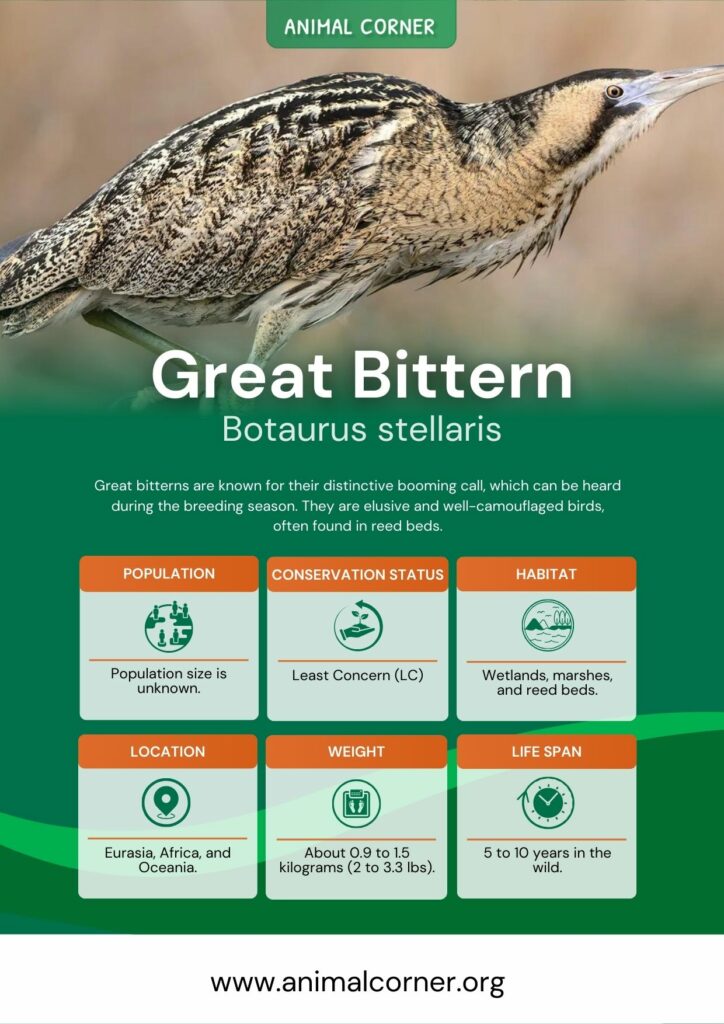
The Boom and Its Names
The Great Bittern’s folk names include barrel-maker, bog-bull, bog hen, bog-trotter and butterbump, a collection that reveals both the affection and the wariness with which country people have long regarded this elusive bird. Most of these names refer to the extraordinary mating call of the male: a deep, resonant boom, somewhere between a foghorn and a distant bull, that carries easily across two miles of open fenland on a still night.
It is one of the most primal sounds in the British countryside, rising from invisible reed beds in the half-dark of a spring evening with a quality that is difficult to describe to anyone who has not heard it. The genus name Botaurus refers directly to this bull-like quality, while the species name stellaris derives from the Latin for starry, a reference to the bird’s beautifully spotted and streaked plumage.
Feeding and Behaviour
The Great Bittern is a patient and methodical hunter, relying on stillness and stealth rather than speed. It moves through shallow water with a slow, deliberate gait, neck drawn in and eyes angled downward, before striking with sudden and precise speed when prey comes within range.
Fish, frogs, newts, small mammals and invertebrates all feature in its diet, and it is capable of taking surprisingly large prey. It hunts primarily at the water’s edge within the cover of reed beds, rarely venturing into open water where it would lose the concealment that is so central to both its hunting strategy and its survival. Outside the breeding season, Great Bitterns are almost entirely solitary, each bird maintaining its own stretch of reed bed with quiet but firm exclusivity.
Breeding and Nesting
The breeding season begins in earnest in spring, when the male’s booming call serves both to attract females and to advertise territorial boundaries to rival males. A single male may mate with several females within his territory, taking no part in incubation or the rearing of young. The female builds a substantial nest of reeds and aquatic vegetation close to the water’s surface, well concealed within the reed bed.
She lays between three and five eggs, incubating them alone for around 25 days. The chicks are covered in warm, tawny down at hatching and are fed by the female until they are capable of fending for themselves, typically after around 50 days. It is a solitary and self-sufficient approach to parenthood that suits a bird whose survival depends so heavily on avoiding attention.
Distribution and Migration
The Great Bittern is resident in the milder west and south of its European and Asian range, remaining year-round where conditions allow. In areas where water freezes during winter, birds migrate south to find open wetland habitat, making them partially migratory across much of central and eastern Europe. In Britain, the species is largely sedentary, with wintering numbers sometimes supplemented by birds arriving from the continent during cold spells.
The Great Bittern is one of the species covered by the Agreement on the Conservation of African-Eurasian Migratory Waterbirds, known as AEWA, reflecting the international importance of protecting the wetland habitats on which it depends across its entire range.
Conservation
The Great Bittern is declining across much of its temperate European and Asian range, and in Britain it came perilously close to extinction during the twentieth century as reedbeds were drained, degraded and fragmented. Concerted conservation efforts, particularly the creation and restoration of large-scale reed bed habitats, have allowed numbers to recover modestly, and the species has returned to breed in counties where it had been absent for decades.
It remains, however, a bird of genuine concern. Water management, reed bed succession and the long-term effects of climate change on wetland hydrology all pose ongoing challenges. To hear that extraordinary boom rolling across a spring marsh at dusk is to be reminded, quietly but powerfully, of what careful conservation can retrieve from the edge of loss.
Sources & References
Cite This Page
APA
Joanne Spencer (2026, April 15). Great Bittern. Animal Corner. Retrieved 2026, April 28, from https://animalcorner.org/animals/great-bittern/
MLA
Joanne Spencer. "Great Bittern." Animal Corner, 2026, April 15, https://animalcorner.org/animals/great-bittern/.
Click to copy