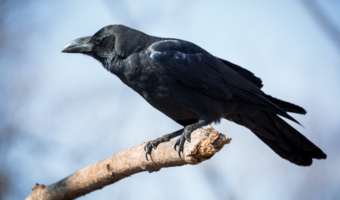
Crows, make up most of the species of bird belonging to the genus ‘Corvus‘. In many cultures and across history, they have been seen as symbols of intelligence and adaptability.
Within the Corvus genus, there are 47 extant species currently recognised, and 36 of these are known as crows. The remainder are known as Rooks, Jackdaws and Ravens, the latter of which generally make up the largest of the Corvus birds. This genus sits within the ‘Corvinae‘ subfamily, which in turn is a member of the ‘Corvidae‘ family. There are 135 species in this family, and while it includes many other species such as Nutcrackers, Jays and Magpies, it is still sometimes referred to as the ‘Crow Family’.
Each Crow species has its own unique characteristics, habitats, and behaviours. They have successfully inhabited various regions from dense urban areas to serene countryside, across the entire globe. Their presence in mythology and folklore further enhances their mysterious aura, often symbolizing change, intelligence, and adaptability.

Appearance & Characteristics of the Crow
Most Crows (but not all), have a very recognisable jet-black plumage, beak, and legs. Their size varies across the different species, but on average, they tend to weigh between 11 to 21 ounces, have a body length around 17 inches and a wingspan that averages 30 inches. This can vary widely by species however, with species such as the Large-Billed Crow and Brown-Headed Crow averaging closer to 22 inches in length. While some species of Crow can grow bigger than some species of Raven, the latter are generally the largest of the Corvus birds.
The crows eyes are a striking contrast to their coat, gleaming with intelligence and curiosity. They have not only survived but thrived across various environments, often succeeding close by to humans. They have a remarkable ability to find food and shelter in even the most challenging conditions, but some species do have more success than others.
Their stark black appearance, often associated with mystery and folklore, has made them a subject of numerous studies, particularly focusing on their remarkable cognitive abilities and complex social structures.
Five Notable Crow Species:

American Crow (Corvus brachyrhynchos):
The American Crow is found mostly in North America, but also across Central America too. It is known for its remarkable problem-solving abilities and adaptability to urban environments. This species does well in a group or on its own, though they are commonly seen in large, noisy groups.

Carrion Crow (Corvus corone):
The Carrion Crow is predominantly found in Europe and parts of Asia. It is often seen in a close pair but can also be quite a solitary species. They have an all-black, sleek plumage and are very resourceful. This species is known to utilize tools to access food and has a varied diet.

Hooded Crow (Corvus cornix):
Inhabits Northern and Eastern Europe and parts of the Middle East. The Hooded Crow is easily recognized by its grey body which contrasts against its black head and wings. This species is known to be quite opportunistic and brave, often seen foraging near humans and unphased by our presence.

House Crow (Corvus splendens):
The House Crow is native to the Indian subcontinent and surrounding countries in South East Asia, as well as some spots across coastal areas of East Africa and the Arabian Peninsula. It is identified by its light grey neck and underbody and is often seen around human habitats. Known for its resourcefulness. This crow thrives in urban settings.

Pied Crow (Corvus albus):
Predominantly found below the Sahara in Central to Southern Africa, it is notable for its white front and black body, often seen in both open habitats and near human settlements. This species often forms large communal roosts, and is known for its loud, harsh calls.
Distribution – Location and Habitat
Across the various species, crows can be found on every single continent except Antarctica. There are countries in South America where they are absent, and in some areas of Siberia too. On Greenland, they stick to the coastal areas which makes sense, as this is where they have availability of food and shelter.
From the dense forests of North America to the bustling streets of Asian cities, they are incredibly adaptable. Their habitats are as diverse as their species, ranging from deserts, forests, and grasslands to urban environments.
Their ability to utilize resources effectively, even in urban settings, is testament to their survival skills and adaptability, making them one of the most widespread bird species on the planet.
That being said, some are more adaptable, and have a much greater range than others. The Hooded Crow for example, is found widely across Central and Eastern Europe, as well as the North of Scotland and Isle of Mann. The Pied Crow is abundant too, found in most of Sub-Saharan Africa. Then you have the endangered Flores Crow, which is endemic to Indonesia, but only found in the Western half of East Nusa Tenggara, in the Lesser Sunda Islands.
As a whole, crows are abundant, but as individual species, some have a much smaller population and range than others.
The Lifestyle & Behaviour of Crows
Crows are renowned for their intelligence and complex social structures. They have lots of vocalizations that they use to communicate. Each signifying different meanings, from alerting others about potential threats to calling out to their mates.
In observations, crows have demonstrated advanced problem-solving abilities, utilizing tools and strategic thinking, which is often considered to indicate a high level of intelligence among avian species. Crows, and other that make up the corvid family, are the only animal other than primates that are known to make tools and have the comparative intelligence equal to that of a 7 year old human child.
Socially, they exhibit strong familial bonds, often staying with their parents for several years and participating in cooperative breeding. In tests they have shown a capacity for group reasoning and abstract reasoning, which can provide many advantages when living in a strong social group.
Crows can be territorial, especially during breeding seasons, and are primarily diurnal animals, though some may be seen in the air still long after sundown.
Diet & Nutrition of the Crow
Crows are omnivorous and exhibit a very wide diet consisting of fruits, small insects, seeds, and scavenging often on carrion. They will hunt and eat lots of insects like spiders and earthworms, or small amphibians like frogs. Depending on the species and location, they may also eat small lizards and snakes. Coastal birds will scavenge seafood from the shore, and they might also snatch fledgling and eggs from the nests of smaller birds.
Their hunting strategies involve both solitary and group efforts, sometimes utilizing tools and strategic approaches to access food. Crows have been observed using traffic to crack nuts and employing hooks crafted from twigs to extract insects from tree barks. They are incredibly intelligent animals and able to innovate to get their meal.

Predators & Threats to Crows
Crows face threats from various predators, including larger birds of prey like hawks and eagles. In the USA, fledglings may also fall victim to smaller competitors like the red-winged blackbird. Their eggs and fledglings are vulnerable to nest raiders like snakes, and mammals such as raccoons and squirrels.
Domestic cats may also be a threat to crows that nest in built up residential areas. Even in the safety of the tree tops, cats are up for the climb, or will stealthily wait for fledglings entering their garden or yard.
Human activities, such as deforestation and urbanization, also pose significant threats by disrupting their natural habitats. However, crows are very adaptable, particularly around human environments, finding new opportunities and resources within cities and towns.
Crow Reproduction
Crows are typically monogamous, forming lasting pair bonds. The male crow often initiates the courtship, engaging in song and aerial displays, sometimes even presenting gifts to the female. Once a pair is formed, the bond is usually monogamous and both partners take a role in raising their offspring and defending their territory.
The nest-building process is a collaborative effort, with both the male and female participating, although the female often plays a more dominant role in the construction. The nests are usually constructed high in the treetops to protect them from ground predators.
These birds are oviparous animals, and once mating has successfully occurred, the female lays a clutch of eggs, which can range from 3 to 9 depending on the species. The eggs are incubated primarily by the female while the male guards the nest and brings food. The incubation period generally spans 18 to 20 days.
Once the chicks hatch, they are altricial, meaning they are born blind and without feathers, completely dependent on their parents for survival. Both parents take a role in feeding the chicks with regurgitated food, and sometimes older siblings help out with raising the young chicks too.
The young chicks grow quickly, developing feathers and gaining strength, usually ready to fledge within 4 to 5 weeks after hatching. But unlike many other species, they don’t leave home as once they have fledged. They will stay with their parents learning vital survival skills like most do, but beyond that, they may stick around for a few years, helping out in the family unit. Across the species, young crows will reach sexual maturity between the ages of 2 and 4 years old.
Lifespan of Crows
The lifespan of crows can vary significantly across the different species, as well as same species in different ranges and habitats. Like many animals, they can live much longer in captivity. The American Crow for example, has an average lifespan of 7-8 years in the wild, but can live for up to 20 years in captivity. Carrion Crows in the UK, can reach around the same in the wild, though some can reach up toward 15 years. The Torresian crow in Australia can reach around 20 years in the wild and the average across all corvid species, is between 16-20 years.
Ravens live longer on average than all other corvids, and pull the average up. It would seem there is some alignment between the size of the species and their projected average lifespan.
Population and Conservation
The conservation status of crows varies among species. While some like the American Crow are abundant and classified as ‘Least Concern’ by the IUCN, others face threats and declining populations due to habitat loss, conflict, agricultural changes and other challenges. Some are listed as critically endangered, vulnerable or near threatened, whilst one, the Hawaiian crow is now considered to be ‘Extinct In The Wild’.
You can see the classification for each of the species in the table at the bottom of this post, including whether the population is in decline or stable.
The Differences Between a Crow and a Raven, a Jackdaw, and a Rook
Crows, ravens, jackdaws, and rooks all belong to the Corvus genus but can be told apart by differences in size, appearance, and habitat. Ravens are generally the larger species in the genus, with a more robust bill and a wedge-shaped tail.
Crows are usually smaller in stature than Ravens and have a fan-shaped tail. Jackdaws are smaller again, with a distinctive silver-grey sheen on the back of their heads, and rooks have a bare, white face with a peaked crown.

Crows In Myth And Lore
Crows have been entwined with myths, lore, and symbolism across various cultures and epochs, often portrayed as creatures of mystery, intelligence, and transformation. Here are some of the more interesting accounts:
Native American Mythology
In Native American tales, the crow often emerges as a trickster, a creature of metamorphosis, and a messenger of the spirit world. Some tribes believe that the crow has the ability to live in both the physical and the spiritual world simultaneously, acting as a messenger between the two realms. The crow is also seen as a symbol of transformation due to its adaptability.
Greek and Roman Mythology
In Roman and Greek mythology, crows are often portrayed as messengers and linked to the gods. With Apollo, the god of prophecy often involved. It was not uncommon for crows to be delivering messages that were not favourable to the gods. There are tales where the crow was once a white bird, and due to various stories of deceit or bringing bad news, it was turned black as a form of punishment or protection.
Japanese Mythology
In Japanese mythology, the crow, or ‘karasu,’ is often seen as a symbol of love and family. One popular tale of the grateful crow, tells of a crow that brings gifts to a kind man who helped it when in need. They are also believed by some, to guide the spirits to their resting places.
Chinese Mythology
In Chinese mythology and culture, crows are often associated with the sun. In one well told fable, ten crows flew towards the sun causing the world to burn, and they had to be shot down to save the earth.
In this culture they are also often seen as symbols of filial piety, and that when a person passes away, crows would be in mourning and avoid feeding on carrion.
Modern Symbolism
In modern times, crows are often symbolized as creatures of intelligence and adaptability. Many admire crows for their complex problem-solving skills and social structures. They are also considered by some, to be one of the many spirit animals.
5 Fun Common Crow Facts for Kids
- Crows are one of the few animal species that use tools, such as twigs, to extract insects from hard-to-reach places!
- They solve complex problems, like figuring out how to drop nuts on roads for cars to crack them open!
- It is believed through observation, that crows can remember human faces and hold grudges against those they perceive as threats!
- Some crows can mimic sounds, including human voices, similar to parrots (Psittaciformes)!
- Crows often stay with their parents for several years and help raise their younger siblings!
The Many Species Of Crow
| Species Name | Location | Description | Conservation Status | Population Trend |
| Corvus albus | Central African coasts to southern Africa | Pied crow, white front, black body | Least Concern | Stable |
| Corvus bennetti | Australia | Little crow, small, black | Least Concern | Decreasing |
| Corvus brachyrhynchos | USA, Canada, Mexico | American crow, all-black, adaptable. There are 5 subspecies | Least Concern | Increasing |
| Corvus capensis | East and southern Africa | Cape crow, all-black, large | Least Concern | Increasing |
| Corvus cornix | Northern and eastern Europe and northern Africa | Hooded crow, grey and black plumage | (IUCN do not yet distinguish this species from the Carrion Crow) | (IUCN do not yet distinguish this species from the Carrion Crow) |
| Corvus corone | Eurasia | Carrion crow, all-black, often solitary | Least Concern | Increasing |
| Corvus culminatus | India and Sri Lanka | Indian jungle crow, large, black | Not Listed | Not Listed |
| Corvus edithae | Eastern Africa | Somali crow, black, smaller than common raven | Least Concern | Stable |
| Corvus enca | Malaysia, the Philippines, Borneo, Indonesia | Slender-billed crow, black, slender bill | Least Concern | Stable |
| Corvus florensis | Flores, Indonesia | Flores crow, black, medium-sized | Endangered | Decreasing |
| Corvus fuscicapillus | New Guinea | Brown-headed crow, black, brown head | Near Threatened | Decreasing |
| Corvus hawaiiensis | Hawaii | Hawaiian crow, black, medium-sized | Extinct In The Wild | – |
| Corvus imparatus | Gulf of Mexico coast of Texas and northeastern Mexico | Tamaulipas crow, black, small | Least Concern | Decreasing |
| Corvus insularis | Bismark Archipelago, Papua New Guinea | Bismarck crow, black, medium-sized | Least Concern | Unknown |
| Corvus jamaicensis | Jamaica | Jamaican crow, black, medium-sized | Near Threatened | Increasing |
| Corvus kubaryi | Guam and Rota, Northern Mariana Islands | Mariana crow, black, small | Critically Endangered | Decreasing |
| Corvus leucognaphalus | Hispaniola | White-necked crow, black, white throat | Vulnerable | Decreasing |
| Corvus levaillantii | Indian subcontinent to the northern Malay Peninsula | Eastern jungle crow, large, black | Not Listed | Not Listed |
| Corvus macrorhynchos | Himalayas, East Asia, the Malay Peninsula, Sunda Islands, and the Philippines | Large-billed crow, black, large bill | Least Concern | Stable |
| Corvus meeki | Bougainville Island and Shortland Islands, Solomon Islands | Bougainville crow, black, medium-sized | Least Concern | Stable |
| Corvus moneduloides | New Caledonia | New Caledonian crow, black, medium-sized | Least Concern | Stable |
| Corvus nasicus | Cuba, Isla de la Juventud, Turks and Caicos Islands | Cuban crow, black, medium-sized | Least Concern | Stable |
| Corvus orru | Australia, New Guinea, Lesser Sunda Islands | Torresian crow, black, medium-sized | Least Concern | Increasing |
| Corvus ossifragus | Eastern United States coast | Fish crow, black, small | Least Concern | Increasing |
| Corvus palmarum | Cuba, Hispaniola | Palm crow, black, medium-sized | Least Concern | Decreasing |
| Corvus pusillus | Palawan, Philippines | Palawan crow, black, medium-sized | (IUCN do not yet distinguish this species from the Slender Crow) | (IUCN do not yet distinguish this species from the Slender Crow) |
| Corvus samarensis | Samar and Mindanao, Philippines | Small crow, black, small | (IUCN do not yet distinguish this species from the Slender Crow) | (IUCN do not yet distinguish this species from the Slender Crow) |
| Corvus sinaloae | Pacific Coast of Mexico | Sinaloa crow, black, medium-sized | Least Concern | Stable |
| Corvus splendens | Indian subcontinent, Southeast Asia, Middle East, eastern Africa | House crow, black, grey neck | Least Concern | Stable |
| Corvus torquatus | Eastern China south into Vietnam | Collared crow, black, white collar | Vulnerable (listed under alternative taxonomy – Corvus pectoralis) | Decreasing |
| Corvus tristis | New Guinea and nearby islands | Grey crow, black, large | Least Concern | Stable |
| Corvus typicus | Sulawesi and Muna, Indonesia | Piping crow, black, medium-sized | Least Concern | Decreasing |
| Corvus unicolor | Banggai Island, Indonesia | Banggai crow, black, medium-sized | Critically Endangered | Decreasing |
| Corvus validus | Northern Moluccas, Indonesia | Long-billed crow, black, long bill | Near Threatened | Decreasing |
| Corvus violaceus | Seram, Indonesia | Violet crow, black, medium-sized | Least Concern | Stable |
| Corvus woodfordi | Southern Solomon Islands | White-billed crow, black, white bill | Least Concern | Stable |
You might also be interested in the Common Blackbird.
Sources & References
How many crow species exist?
There are 47 extant species currently recognised in the Corvus genus, with 36 of these known as crows. The remaining species include rooks, jackdaws, and ravens.
What is the average size and weight of a crow?
Crows typically weigh between 11 to 21 ounces, have a body length around 17 inches, and a wingspan averaging 30 inches, though this varies significantly by species.
How long do crows live?
American Crows have an average lifespan of 7-8 years in the wild, but can live up to 20 years in captivity.
How intelligent are crows?
Crows have demonstrated advanced problem-solving abilities, utilising tools and strategic thinking. They are the only non-primate animals known to make tools and have cognitive abilities comparable to a 7-year-old human child.
What is the Hawaiian crow conservation status?
The Hawaiian crow is classified as Extinct In The Wild, making it one of the most critically endangered crow species and the only one with this designation.
Cite This Page
APA
Joanne Spencer (2026, April 15). Crows – Life and Lore of these Intelligent Birds. Animal Corner. Retrieved 2026, April 22, from https://animalcorner.org/animals/crows/
MLA
Joanne Spencer. "Crows – Life and Lore of these Intelligent Birds." Animal Corner, 2026, April 15, https://animalcorner.org/animals/crows/.
Click to copy