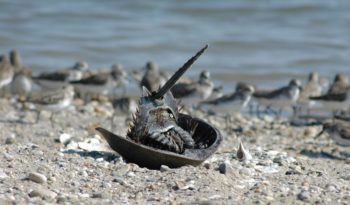
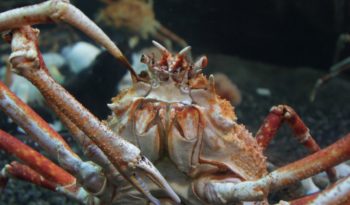
Crabs are crustaceans and related to lobsters and shrimps. There are almost 5,000 different species of crabs, about 4,500 are true crabs, plus around 500 are hermit crabs (hermit crabs do not have a very hard shell and use other animals old shells for protection). However, crabs have evolved so that they can walk or run sideways, as well as burrow and swim. The body of a crab is covered by a chitinous shell called a carapace.
A crabs abdomen has become fairly reduced and is tucked under the body. This reduction is greatest among the ‘true crabs’, which lack the flaplike tail of the hermit crabs and their allies; instead, the abdomen serves as a brood pouch for the eggs. A crabs segmented body has several pairs of appendages, of which usually five pairs serve as walking legs and two as sensory antennae.
The pincers of a crab, called chelae, are located on the front legs and are used for fighting, display and feeding. Crabs can possess fairly complicated nervous systems and are considered to be more advanced. Crabs can live in more extreme areas because of their ability to adapt well to the changing environment.
Crabs can see fairly well with their compound eyes. Their sense of smell and taste are also more advanced which helps them to find food and mates easier. Reproductive and social behaviour sometimes include complex mating rituals and communication techniques such as drumming or waving the pincers.
Crabs tend to be aggressive towards one another and the males often fight to gain access to the females.
Below is a list of different species of crabs from different parts of the world. Click on an individual species to find out more about it:
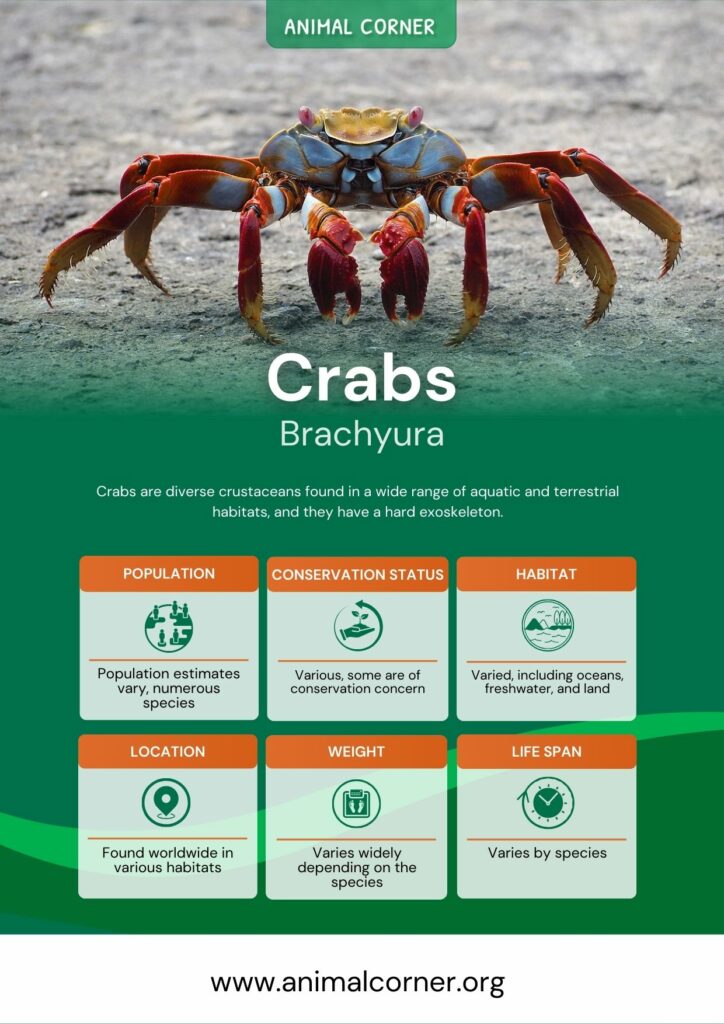
Crab Anatomy and the Carapace
The hard shell, or carapace, that covers a crab’s body is one of its most important features. It is made from a tough material called chitin, which is the same substance found in the shells of other crustaceans and in the exoskeletons of insects. The carapace provides protection from predators and also helps to prevent the crab from drying out when it ventures onto land or into shallow, exposed areas.
Because the shell cannot grow, crabs must shed it periodically in a process called moulting. During a moult, the crab splits open its old shell and backs out of it, leaving behind a perfect hollow replica of itself. For a short period after moulting the new shell is soft, leaving the crab extremely vulnerable. During this time it typically hides in crevices or burrows and avoids any contact that could cause injury. Once the new shell has hardened, which can take several days, the crab resumes its normal activity. Soft-shell crabs, which are considered a delicacy in some parts of the world, are simply crabs that have been harvested immediately after moulting before the new shell has had a chance to firm up.
Habitat and Distribution
Crabs are found in virtually every marine environment on the planet, from tropical coral reefs and mangrove swamps to the freezing depths of the polar oceans. Some species are also well adapted to life in fresh water, and a number have made the transition to a largely terrestrial existence, venturing onto land for much of their lives and returning to the sea only to breed. The Christmas Island Red Crab is one of the most famous examples of this, undertaking mass migrations to the coast each year in numbers that can reach tens of millions of individuals.
The range of habitats occupied by different crab species reflects the enormous diversity within the group. Rock crabs cling to wave-battered shorelines, mud crabs burrow into estuarine sediment, and deep-sea species have been recorded at depths of several thousand metres where pressure, cold and darkness would be fatal to most other animals. This adaptability is one of the key reasons crabs have been so successful as a group over the course of their long evolutionary history.
Diet and Feeding
Most crabs are omnivores, meaning they will eat both plant and animal material depending on what is available. Algae, detritus, worms, molluscs, small fish and the remains of dead animals all feature in the diet of various species. The chelae, or claws, play a central role in feeding, being used to break open the shells of prey such as mussels and clams, tear apart softer food items and pass food toward the mouth.
Some species are specialist feeders with very particular diets, while others are highly opportunistic and will consume almost anything edible they come across. This flexibility in feeding habits is another reason crabs are able to thrive in such a wide range of environments, as they are rarely dependent on a single food source that could disappear or become unavailable.
Crabs and Their Importance to Ecosystems
Crabs play a valuable role in the ecosystems they inhabit. As scavengers, they help to break down dead organic matter and recycle nutrients back into the environment, keeping the seabed and shoreline clean and productive. As prey animals, they are an important food source for a wide variety of species including fish, seabirds, otters, octopus and humans. Many commercial fisheries around the world are built around crab species, and they represent a significant and economically important part of the global seafood industry. Their health and abundance is therefore an important indicator of the wider health of coastal and marine ecosystems.
Check out more animals that begin with the letter C
Crab Species Scientific Name
 Green Crab Carcinus maenas
  Hermit Crab Pagarus longicarpus
  Horseshoe Crab Limulus polyphemus
  Japanese Spider Crab Macrocheira kaempferi
  Red Rock Crab Grapsus grapsus
What is a Crabs?
Crabs are crustaceans and related to lobsters and shrimps. There are almost 5,000 different species of crabs, about 4,500 are true crabs, plus around 500 are hermit crabs (hermit crabs do not have a very hard shell and use other animals old shells for protection).
Where do Crabss live?
Crabs can live in more extreme areas because of their ability to adapt well to the changing environment.
How long do Crabss live?
Crabs can live in more extreme areas because of their ability to adapt well to the changing environment.
Sources & References
Cite This Page
APA
Joanne Spencer (2026, April 15). Crabs. Animal Corner. Retrieved 2026, April 25, from https://animalcorner.org/animals/crabs/
MLA
Joanne Spencer. "Crabs." Animal Corner, 2026, April 15, https://animalcorner.org/animals/crabs/.
Click to copy