Cows are members of the sub-family ‘Bovinae’ of the family ‘Bovidae‘. This family also includes Gazelles, Buffalo, Bison, Antelopes, Sheep and Goats.
Cows are raised for many reasons including: milk, cheese, other dairy products, also for meat such as beef and veal and materials such as leather hide. In older times they were used as work animals to pull carts and to plow fields.
In some countries such as India, cows were classed as sacred animals and were used in religious ceremonies and treated with much respect.
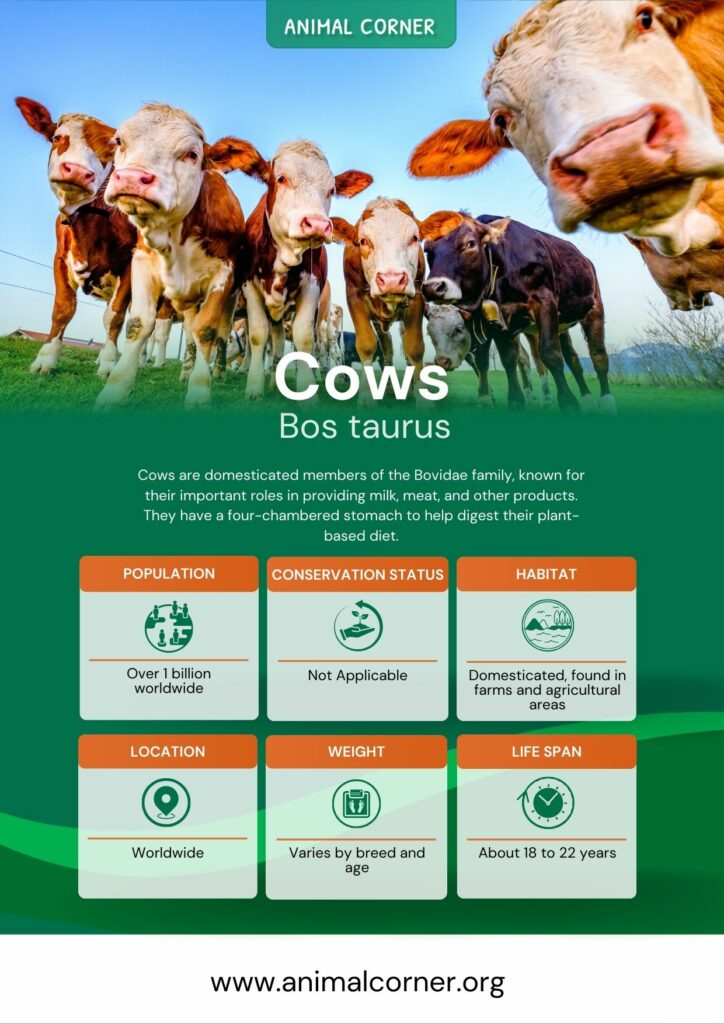
Today, cows are domesticated ungulates (hoofed animals with two toes on each hoof) that we see very often chewing the grass in farmers fields as we walk or drive through the countryside.
There is an estimated 1.3 billion head of cattle and 920 breeds of cow in the world today. Cows are referred to as the ‘fosters mothers to the human race’ because they produce most of the milk that people drink.
The mature female of the species is called a ‘cow’.
The mature male of the species is called a ‘bull’.
A group of cows is called a ‘herd’.
A young female cow is called a ‘heifer’.
A baby cow is called a ‘calf’.
A cow spends up to 6 hours a day eating. Cows spend over 8 hours a day chewing their cud which is regurgitated, partially digested food. Cows each drink equivalent to a bath tub full of water a day.
Cows occupy a unique role in human history. Cows have been considered one of the oldest forms of wealth. Cows have always been of interest to man because of their amazing ability to be able to provide meat and dairy products, have been strong animals to work with and also reproduce themselves while eating nothing but grass. Amazing!
Cow Reproduction

The average cow is 2 years old when she has her first calf. Calves are fed from the cow until they are between 8 and 9 weeks old. It is essential for a calf to be fed their mothers milk from the start as it contains antibodies that protect the new calf from diseases. Two months before giving birth, a dairy cow takes a rest from giving milk in order to grow her calf.
During this period the cow is known as a Dry Cow. When a dairy cow gives birth, this process is called a freshening. All calves are born with horn nubs. It is common for a vet to remove these nowadays.
A young female calf is called a heifer, she is called this until she has her first calf. A young male is called a bull calf.
Did you know that cows never forget their calves. It is quite common to see them licking their grown calves just as they did when they were young.
How to determine the age of a cow

The age of a cow is determined by examination of the teeth and less perfectly by the horns. The temporary teeth are in part erupted at birth and all the incisors are erupted within twenty days. The first, second and third pairs of temporary molars are erupted in thirty days. The teeth have grown large enough to touch each other by the sixth month. They gradually wear and fall in eighteen months. The fourth permanent molars are through at around the fourth month.
The fifth at the fifteenth month and the sixth at two years. The temporary teeth begin to fall at twenty-one months and are entirely replaced by the thirty-ninth to the forty-fifth month.
Interesting Cow Facts
- The oldest cow ever recorded was a Dremon Cow named ‘Big Bertha’ who died 3 months just before her 49th birthday on New Years Eve, 1993.
- ‘Big Bertha’ also holds the record for lifetime breeding as she produced 39 calves.
- The heaviest live birth of a calf is 225 lbs for a British Friesian cow in 1961.
- Dairy cows can produce 125 pounds of saliva a day.
- Dairy cows can produce up to 200 pounds of flatus (trumps and burps) a day!
- Cows often have their ears pierced-with I.D. tags.
- People first domesticated cows about 5000 years ago.
- The Holstein cow produces the most milk of all breeds.
- Cows can live to the age of 25 years old if people would let them.
- A cow stands up and sits down about 14 times a day.
- In an average herd, there is 1 bull to every 30 cows.
- Cows can detect odours up to five miles away.
- The age of a cow can be determined by counting the rings on its horns.
- Cows can see color.
- There are approximately 350 ‘squirts’ in a gallon of milk.
- Cows can pick and lick their noses with their tongues.
- Cows drink 25 – 50 gallons of water each day. That is nearly a bathtub full.
- When the Pilgrims went to America, they took cows with them.
Check out more animals that begin with the letter C
Learn more about cow anatomy and the cow’s stomach.
What is a Cows?
Cows are members of the sub-family ‘Bovinae’ of the family ‘Bovidae’. This family also includes Gazelles, Buffalo, Bison, Antelopes, Sheep and Goats.
How long do Cowss live?
Cow ReproductionnnnnnnnnThe average cow is 2 years old when she has her first calf.
How big do Cowss get?
Dairy cows can produce 125 pounds of saliva a day.
Sources & References
Cite This Page
APA
Joanne Spencer (2026, April 8). Cows. Animal Corner. Retrieved 2026, April 24, from https://animalcorner.org/animals/cows/
MLA
Joanne Spencer. "Cows." Animal Corner, 2026, April 8, https://animalcorner.org/animals/cows/.
Click to copy