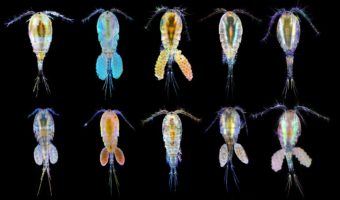
Although copepods can be found almost everywhere where water is available most of the more than 12.000 known species live in the sea. As they are the biggest biomass in the oceans some call them the insects of the sea. They roam the free water, burrow through the sediment at the bottom of the seas, are found on tidal flats and in the deep sea trenches.
At least one third of all species live as associates, commensals or parasites on invertebrates and fishes. One of the hotspots of species diversity are the tropical coral reefs in the Indopacific. Some coral species are hosts to up to 8 copepod species. Like the tidal flats the mangroves teem with copepod life.

Freshwater Habitats
Species of the Calanoida, Cyclopoida and Harpacticoida have successfully colonised all kinds of freshwater habitats from little creeks to glacier lakes high up in the Himalaya. Although the species diversity in freshwater is not as high as in the sea copepod abundance may sometimes be great enough to stain the water. Even in the groundwater a specialised copepod fauna has evolved.
Some copepod species can be found in the leaf fall of wet forests or in a wet compost heap, sometimes in rather high densities. Others live in peat moss or even in the phytotelmata (little pools formed in the leaf axils of plants) of bromeliads and other plants.
Locomotion
In the free water : The realm of the calanoid copepods. Their long and feathered antennae are ideal for drifting in the free water. Some species show daily migrations, ascending to the surface water during the night and descending to several hundred meters depth at daytime.
These tiny creatures (1-2 mm length) reach a speed of up to 90 meters per hour (this is about 45.000 times the body length per hour and would equal a speed of 81 km/h for a human of 1,80 m height!!).
The propulsion is provided by the movement of the mouth appendages, for faster movements and flight the swimming legs are used.
On the sea-bottom : The locomotion of species that live on the sea-bottom or on water plants is different. The four first swimming legs are primarily used for a kind of swimming-crawling. Their cylindrical body wriggles around between obstacles or over the substrate.
Reproduction
Mating : As there is no special copulatory organ for an internal fertilization the term copulation is used for the attachment of a spermatophore to the genital field of the female. A spermatophore is a container filled with sperm and various secretions. It is produced internally by the male and expelled during copulation. The reproductive behaviour of copepods is very diverse. In some species adult males clasp juvenile females already to be able to copulate straight after the final moult of the female (precopula, see picture at right, pairs and detail ).
This behaviour may be interpreted as a consequence of competition between many males for few females. In other species the males guard their females at least for the time necessary for the spermatophore to discharge its contents into the female. This guarding has the effect of securing paternity (postcopula). Sometimes a complex mating behaviour precedes copulation. Females in such cases may be endowed with effective mechanisms to keep off males from copulatory attempts.
Eggs : A few hours or days after copulation egg sacs are formed by the female. Most species produce paired egg sacs. These sacks are carried outside the body under the abdomen and consist of eggs embedded into a mass of secretions. Depending on size and life style a few to several dozen eggs develop inside their protective cover. Some parasites produce several thousand eggs. The eggs are probably still nourished by the females. After a few days the larvae hatch and the egg sack is cast off.
Larvae : The first larvae of copepods are called nauplii (picture). They are very small (sometimes 20 µm) and like the adults are found in very different habitats. Usually they pass six naupliar stages, which are separated by a moult. The first stages have only three pairs of appendages that are responsible for locomotion and feeding. The older nauplii already show buds of further mouth appendages and swimming legs.
The 6th naupliar stage moults into the first copepodid. This moult is accompanied by important morphological changes. The emerging copepodid stage resembles the adult already more or less. With the increasing number of body segments more appendages become functional. After the fifth moult adulthood is reached and reproduction can take place.
What is a Copepods?
Although copepods can be found almost everywhere where water is available most of the more than 12.000 known species live in the sea. As they are the biggest biomass in the oceans some call them the insects of the sea.
Where do Copepodss live?
Although copepods can be found almost everywhere where water is available most of the more than 12.000 known species live in the sea.
How big do Copepodss get?
Some species show daily migrations, ascending to the surface water during the night and descending to several hundred meters depth at daytime.
Sources & References
Cite This Page
APA
Joanne Spencer (2026, April 8). Copepods. Animal Corner. Retrieved 2026, April 28, from https://animalcorner.org/animals/copepods/
MLA
Joanne Spencer. "Copepods." Animal Corner, 2026, April 8, https://animalcorner.org/animals/copepods/.
Click to copy