Chameleons (part of the acrodonta group) are truly one of the finer examples of the wonder of nature. All chameleons belong within the lineage of the family Chamaeleonidae, and they come in a variety of shapes, sizes and colours.
Within this family there is one subfamily Brookesiinae and between them both there are around 12 different genera. The taxonomy of these genera has been the subject of debate, but as of 2015 it has been steadily defined that there are two genera within the subfamily, and 10 within the main Chamaeleonidae family itself.
Within these genera, there are around 200 known species of Chameleon, all originating from around the African continent, Some from southern Europe around the Mediterranean, the Arabian Peninsula and South-East Asia. They have also more recently been introduced as a non-native species to some warm, sub-tropical areas of the USA.
With their unique abilities and features, they stand out in the animal kingdom. Each with its own set of characteristics and charm. They are masters of adaption and have developed skills and behaviours to deter or avoid predators, particularly around crypsis and the ability to change colour.
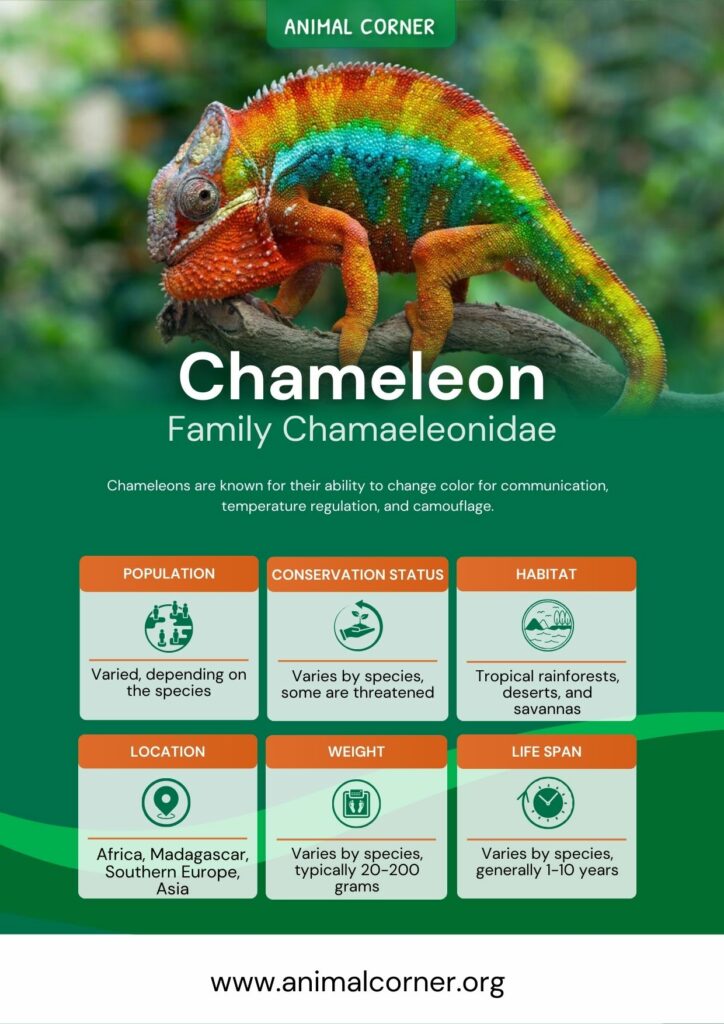
Appearance & Characteristics of the Chameleon
Chameleons are renowned for their color-changing abilities, but there really is more to them than that. Their long, sticky tongues can shoot out in a flash to catch prey, and with some they can reach out as much as twice the length of their bodeis!
Their eyes, which can move independently, give them a wide field of vision, allowing them to look in two directions at once! The eyes sit on either side of their head and each has near 180 degree range. With this adaption, they can see any threat coming from all angles.
Size-wise, chameleons can vary a lot. Some are tiny, fitting comfortably on a human finger, while others can grow to be over a foot long. Their feet are specially designed for gripping onto branches, with toes grouped together to form a pincer-like grip.
Some species have prehensile tails, meaning they can wrap around branches, aiding in balancing and climbing. These tails can also be used for grasping items. Species with these tails can even use them to communicate their emotions.
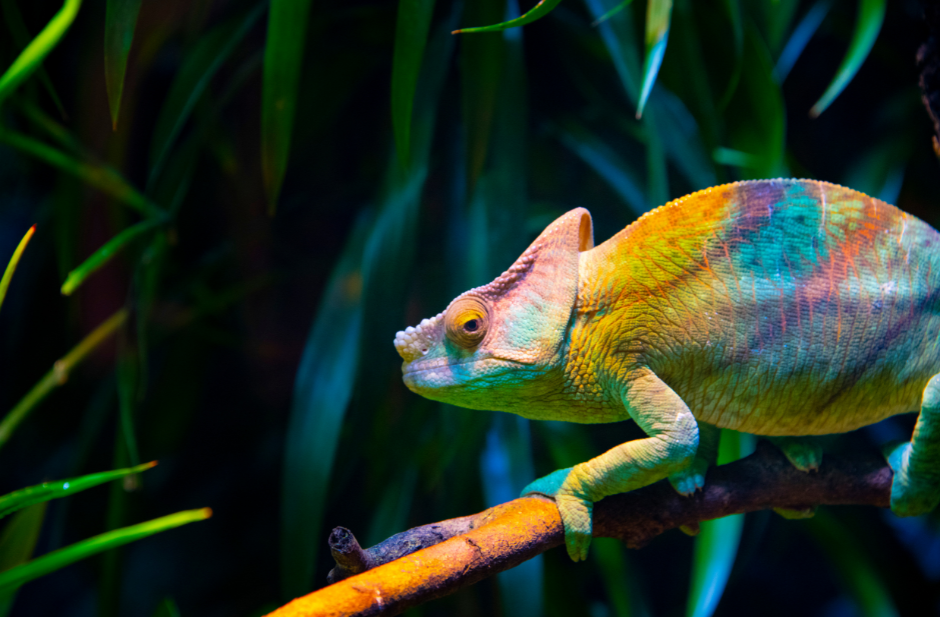
Can All Chameleons Change Colour?
The big question though, is do all chameleons change colour? The answer is more complex than a simple yes or no. While they can change colour, it’s not always to blend in, and it’s not always as dramatic as their legend would suggest. Each chameleon species has its own range of colours and patterns it can display, often influenced by its mood, temperature, and other factors.
The reason they can change colour, is due to a specific adaption that gives them special skin cells called chromatophores. These can come in various types, which all provide different pigmentation colour and vibrancy. Some are vivid, and some quite subtle.
Distribution – Location and Habitat
Chameleons are primarily found in warm habitats. From the rainforests of Madagascar to the deserts of Africa, temperate southern Europe, and the mountainous regions of Yemen and Saudi Arabia, they’ve adapted to a variety of environments. They can even be found as far east as Sri Lanka and Southern India. The vast majority however, reside either on Madagascar or African soil.
In recent years they have been introduced to some areas in the USA with a suitable climate, notably Hawaii, Florida and Southern California.
They are arboreal, meaning they spend most of their lives in trees and bushes, making the canopy their home. They don’t start off life in the trees though. Most are born in nests buried into the ground that are then abandoned by the mother. Once they hatch, they dig themselves out to the surface and scurry into the canopy.
Depending on where they live, they can adapt to, and prefer a variety of different habitats. Some prefer humid, shady areas such as jungles or forests; while others may opt for dry and hot plains or deserts.
The Lifestyle & Behaviour of the Chameleon
Life for a chameleon is all about adaptation. Their unique feet allow them to grip branches securely, and their swiveling eyes give them an almost 360-degree view of their surroundings. This is especially useful for spotting predators and prey.
Their color-changing ability isn’t just for show. It’s a complex process involving multiple layers of skin, each with its own role in the color change. From displaying their emotions to reacting to temperature changes, their skin is a window into their well-being.
Diet & Nutrition of the Chameleon
Chameleons are primarily insectivores. Their diet consists of insects, but larger species might occasionally consume birds or smaller reptiles.
In the wild they will eat a range of locusts, grasshoppers, crickets, and spiders. Small mantids, mealworms and a range of flies are also common foods. Some, such as the veiled chameleon might also resort to eating leaves for water if needs be.
Others, such as the Jackson’s chameleon have a taste for other small lizards, geckos, butterflies and ants. Their diet can be quite adaptable to the habitat they are in.
Predators & Threats to The Chameleon
Life isn’t all easy for chameleons. They face threats from birds, snakes, and some mammals. Their unique features, like color-changing skin, help them evade these threats, but they need to be constantly on the lookout.
Baby chameleons and juveniles are more at risk, particularly from the sky. Two notable predators include the Serpent-Eagle and the Banded Kestrel. These birds of prey feed on chameleons more than any other animal.
Other predators include monkeys, boomslang snakes and vine snakes. However, the specific bird of prey or snake predator changes depending on the species and the habitat.
Chameleon Reproduction
Most Chameleons are oviparous, and after mating, will lay eggs in a timespan of three to six weeks. Depending on the species, these eggs can take anywhere from four to twelve months before they hatch.
The number of eggs can vary greatly. For instance, the veiled chameleon can lay between 20 to 70 eggs in a clutch, and sometimes up to 200 which can take 6 to 9 months to hatch. Small Brookesia species may only lay two to four eggs and panther chameleons between 10-40 egg clutches.
Most eggs however, are typically born in clutches of anywhere between 8-40 eggs.
Some species are ovoviviparous, and with these, gestation usually takes 4-6 months before babies are born live. Examples of this are all three subspecies of the Jacksons Chameleon, and the Side Striped Chameleon.
Across the range of species, chameleons usually grow to full size within 8 months, and full adult weight within 2 years. Smaller species with shorter lifespans mature much quicker than larger species that live longer.
Lifespan of the Chameleon
Chameleons in the wild have mixed fortunes and lifespan does differ between the different species, depending on their different genetics, dietary and environmental conditions.
Some species of Madagascan chameleon live only for a few months, while others can live up to 12 years in the wild. In extreme cases, some larger species can live as long as 25 years.
Despite their skilful methods of predator avoidance, in the wild they average a shorter life than in captivity.
Population and Conservation
Many chameleon species have stable populations, while many also face threats from habitat loss and other – often human influenced – challenges. Some species such as the Namaqua Chameleon (Chamaeleo namaquensis) and the Western Pygmy Chameleon (Rhampholeon spectrum) are listed on the IUCN red list as ‘Least Concern’. While others, such as the Tiger Chameleon (Archaius tigris) are listed as ‘Endangered’.
You can check the status of individual species on the IUCN red list. However, it is important to note that it can take a long time for species to receive a status update on their population. Some have not been assessed for over a decade, it really does depend on the availability of researchers and resources.
It is believed that around a third of all species are endangered, and the number is increasing. It is likely that populations are declining for most due to habitat loss and encroachment, and as climate change impacts many of the areas where these lizards live.
Do Chameleons Make Good Pets?
Chameleons are indeed captivating, and they are often kept as pets, but they require dedicated care. Their habitat needs to mimic their natural environment, particularly around temperature and foliage, and their diet can be specific. With proper knowledge and commitment, they can make magnificently charming and attractive pets.
5 fun Chameleon facts for kids
- Chameleons can look in two directions at once!
- Their tongue can be twice as long as their entire body.
- Some chameleons have a ‘casque’ on their head that collects water.
- The world’s tiniest chameleons are from Madagascar.
- Chameleons don’t change colour just to blend in; it’s also about how they feel, particularly with temperature!
Chameleons Commonly Kept As Pets
Veiled Chameleon (Chamaeleo calyptratus)
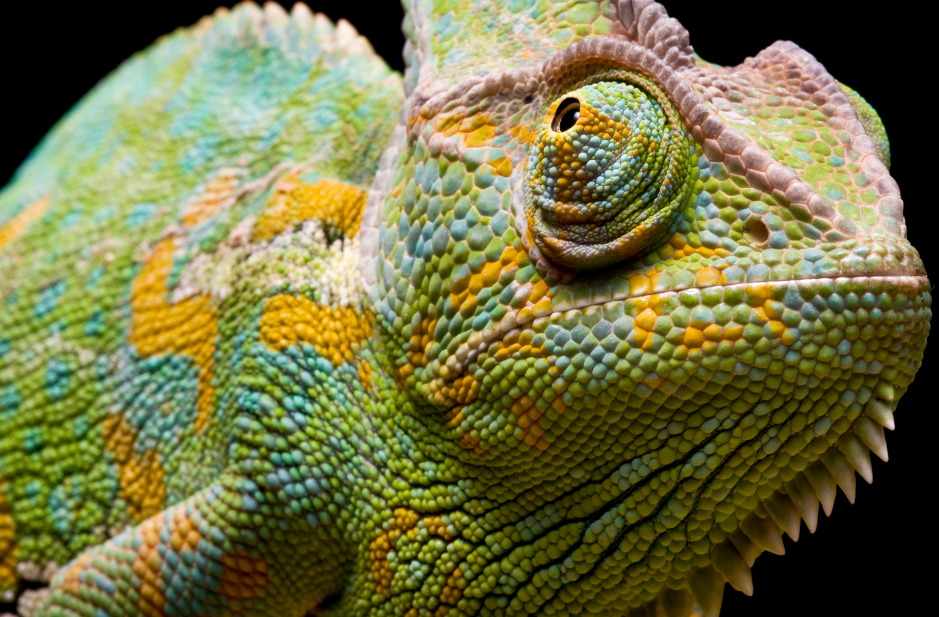
- Origin: Yemen and Saudi Arabia.
- Size: Male – 18-24 inches, Female – 10-14 inches
- Lifespan: 6 – 8 Years
- Colour: Green, with patterns of yellow, brown
- Description: Recognized by their large casque (helmet-like structure) on their head. They are primarily green, but can display patterns of yellow and brown. Males are larger than females.
- Features: They are known for their aggressive nature and should be housed individually. They have a varied diet and require a spacious cage.
Panther Chameleon (Furcifer pardalis)
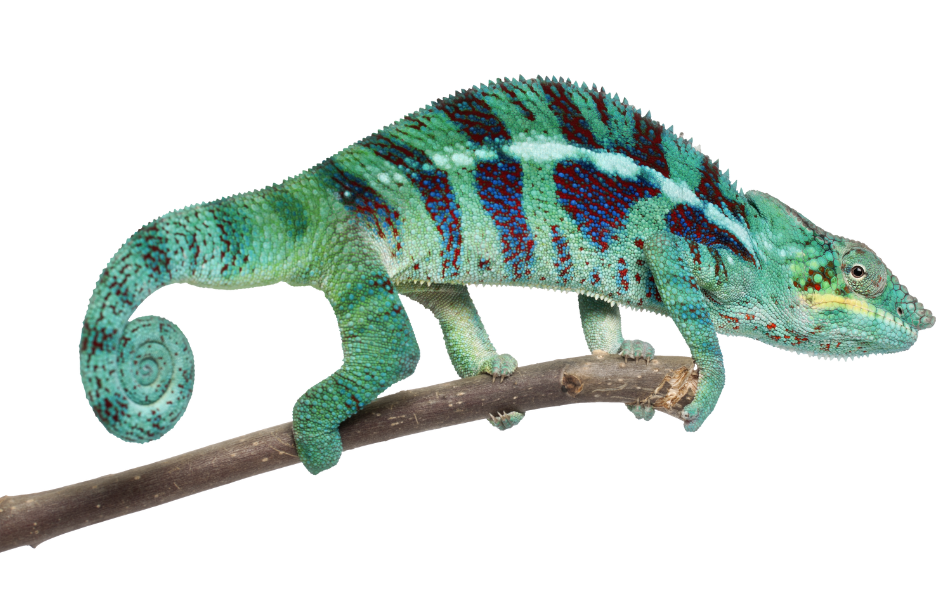
- Origin: Madagascar.
- Size: Male – 17-20 inches, Female – 10-14 inches
- Lifespan: 5 – 7 Years
- Colour: Varies (blue, red, green, yellow)
- Description: One of the most colorful chameleon species, with males exhibiting vibrant colors ranging from blue, red, green to yellow. Females are generally less colorful.
- Features: They are popular in the pet trade due to their striking appearance. Their color can vary based on their specific locale in Madagascar.
Jackson’s Chameleon (Trioceros jacksonii)
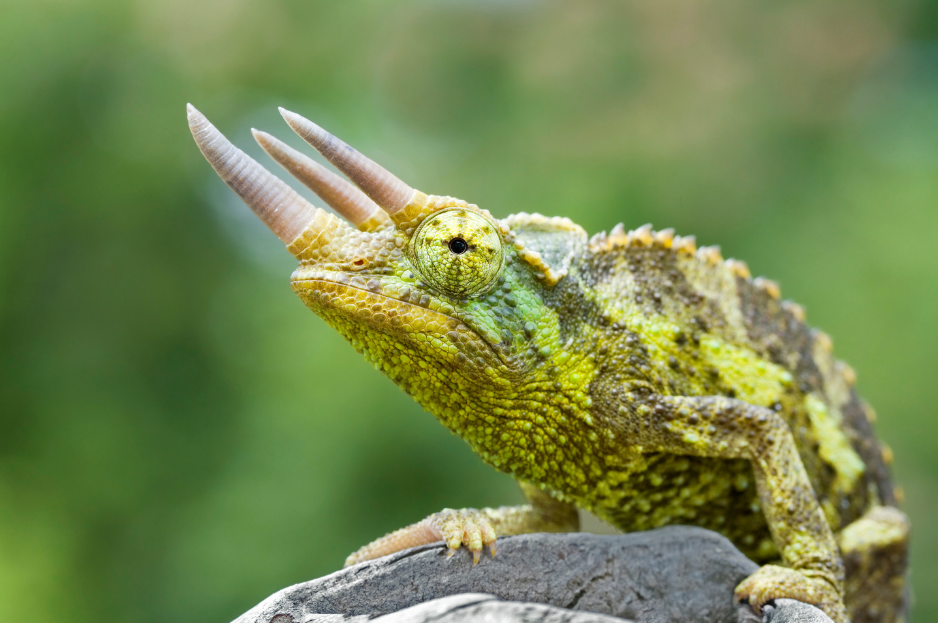
- Origin: East Africa, primarily Kenya and Tanzania.
- Size: Male – 8-10 inches, Female – 8-10 inches
- Lifespan: 5 to 10 Years
- Colour: Green
- Description: Recognized by their three horns, resembling a triceratops. They are primarily green.
- Features: They give live birth, which is unusual for chameleons. They are relatively peaceful and can be housed in pairs or small groups.
Senegal Chameleon (Chamaeleo senegalensis)
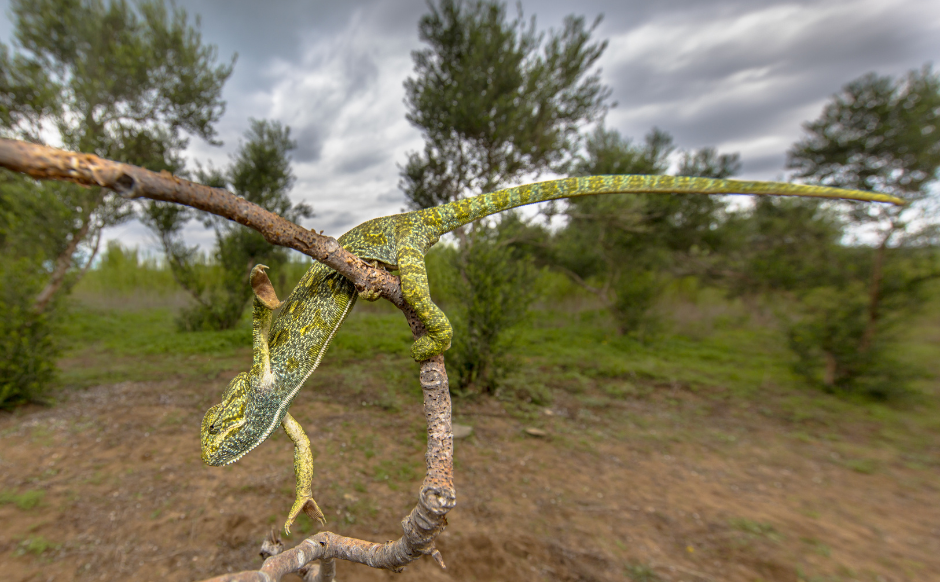
- Origin: West Africa.
- Size: Male – 10 inches, Female – 7 inches
- Lifespan: 5 – 8 Years
- Colour: Green or Brown
- Description: Typically green or brown, they have a slender body and a short casque.
- Features: They are one of the smaller chameleon species and are known for their calm demeanor.
Fischer’s Chameleon (Kinyongia fischeri)
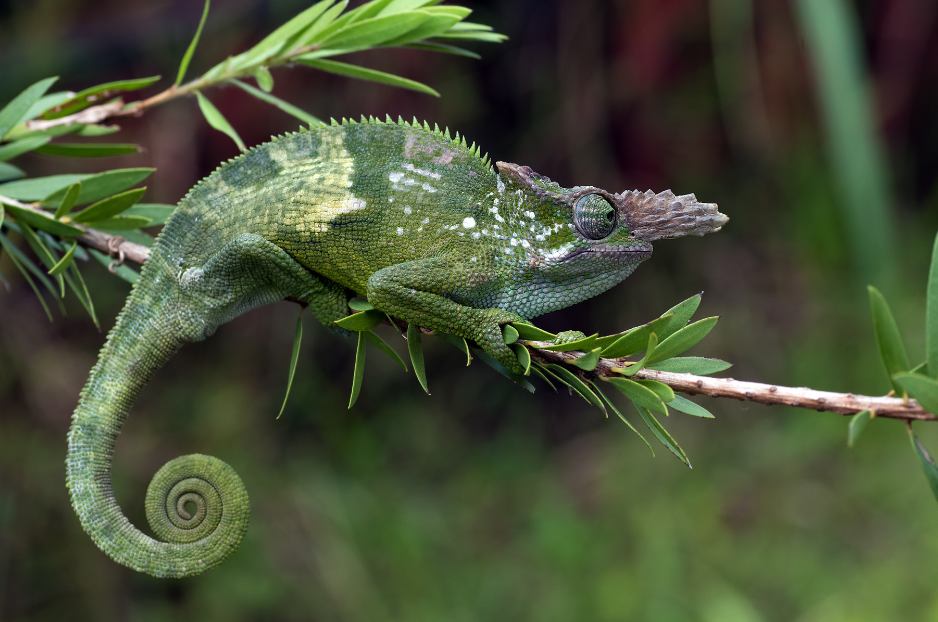
- Origin: Tanzania.
- Size: Male – 15 inches, Female – 8 inches
- Lifespan: 3 to 5 Years
- Colour: Green or brown with white stripes
- Description: Green or brown with white lateral stripes. They have a unique nose-like projection.
- Features: They are arboreal and prefer a vertically oriented enclosure. They are relatively shy and prefer a well-planted environment.
Oustalet’s Chameleon (Furcifer oustaleti)
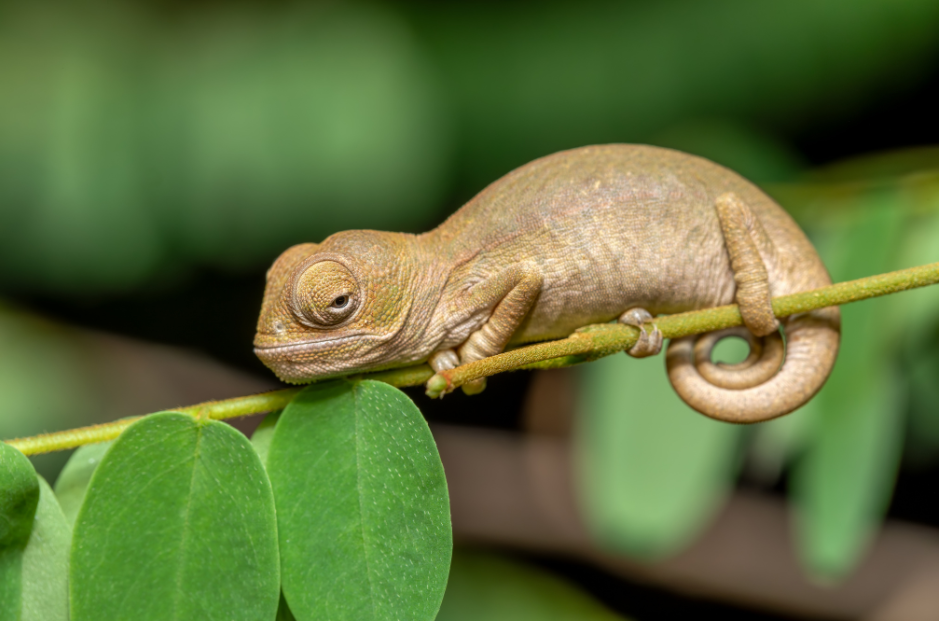
- Origin: Madagascar.
- Size: Male – 23-30 inches, Female – 20-27 inches
- Lifespan: 5 to 7 Years
- Colour: Brown or grayish-green
- Description: One of the largest chameleon species. They are brown or grayish-green.
- Features: Due to their size, they require a large enclosure. They are known to be more aggressive than some other species.
Carpet Chameleon (Furcifer lateralis)
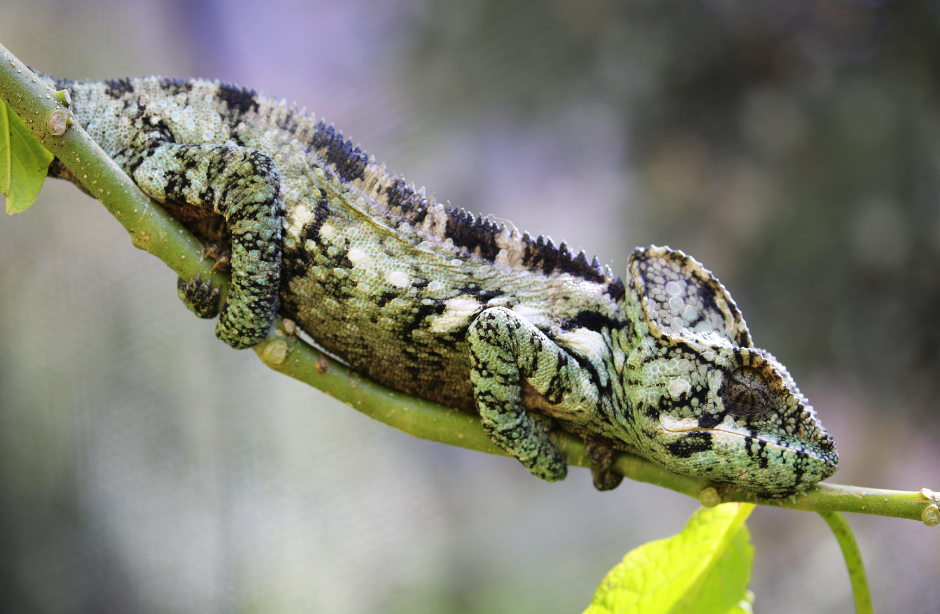
- Origin: Madagascar.
- Size: Male – 8-10 inches, Female – 6-8 inches
- Lifespan: 3 to 5 Years
- Colour: Varies (green, blue, yellow, red)
- Description: They can display a variety of colors, including green, blue, yellow, and red. They have a slender body.
- Features: They are one of the more adaptable chameleon species and can tolerate a range of conditions.
Four-horned Chameleon (Trioceros quadricornis)
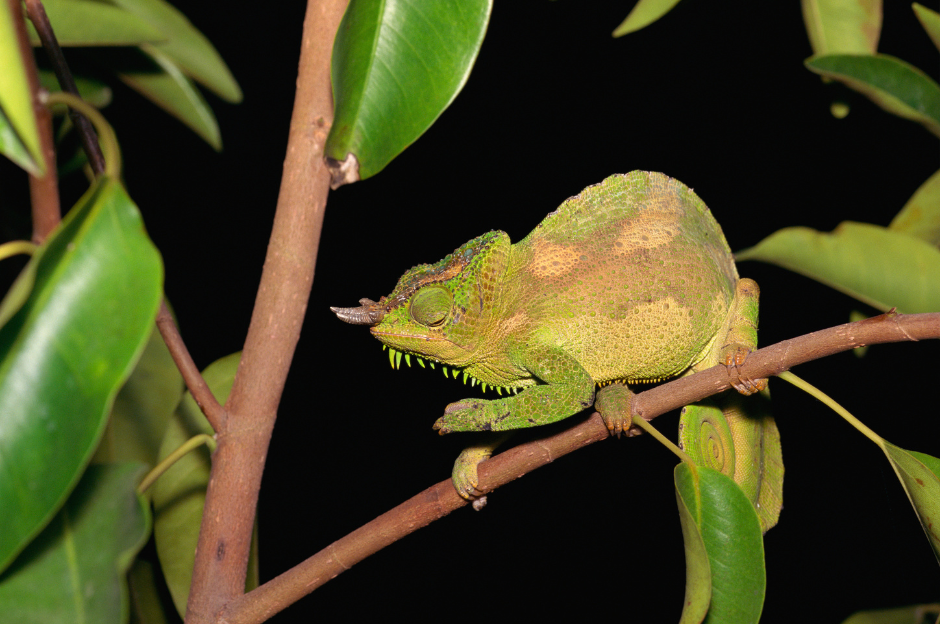
- Origin: Cameroon.
- Size: 14 inches/12 inches
- Lifespan: 3 to 5 Years
- Colour: Green with brown or yellow stripes
- Description: As the name suggests, they have four horns on their head. They are green with brown or yellow stripes.
- Features: They are arboreal and prefer a well-planted environment. They are known for their calm nature.
122 Different Species Of Chameleon
There are over 200 species of chameleon across the world, that we know of, but not all of these have been well described and detailed yet. Here is a list of most of the species that have so far been well described and observed. The species are listed alphabetically by common name.
| Common Name | Scientific Name |
| African Chameleon | Chamaeleo africanus Laurenti |
| Amber Chameleon | Calumma amber |
| Antsingy Leaf Chameleon | Brookesia perarmata |
| Arabian Chameleon | Chamaeleo arabicus Matschie |
| Bearded Pygmy Chameleon | Rieppeleon brevicaudatus |
| Beraducci’s Pygmy Chameleon | Rhampholeon beraduccii |
| Bizarre-Nosed Chameleon | Calumma hafahafa |
| Black-headed Dwarf Chameleon | Bradypodion melanocephalum |
| Blunt-Nosed Chameleon | Calumma tsycorne |
| Bocage’s Chameleon | Chamaeleo dilepis quilensis |
| Boulenger’s Pygmy Chameleon | Rhampholeon boulengeri |
| Brown Leaf Chameleon | Brookesia superciliaris |
| Cameroon Sailfin Chameleon | Trioceros montium |
| Cameroon Stumptail Chameleon | Rhampholeon spectrum |
| Cape Dwarf Chameleon | Bradypodion pumilum |
| Carpenter’s Chameleon | Kinyongia carpenteri |
| Carpet Chameleon | Furcifer lateralis |
| Chameleon Dragon | Chelosania brunnea |
| Chameleon Forest Dragon | Gonocephalus chamaeleontinus |
| Chapmans’ Pygmy Chameleon | Rhampholeon chapmanorum |
| Circular-scaled Chameleon | Kinyongia gyrolepis |
| Coarse Chameleon | Trioceros rudis |
| Cone-headed Chameleon | Chamaeleo calyptratus |
| Crested Chameleon | Trioceros cristatus |
| Cryptic Chameleon | Calumma crypticum |
| Dhlinza Dwarf Chameleon | Bradypodion caeruleogula |
| Domergue’s Leaf Chameleon | Brookesia thieli |
| Double-scaled Chameleon | Chamaeleo anchietae |
| Drakensberg Dwarf Chameleon | Bradypodion dracomontanum |
| Eiongate Leaf Chameleon | Palleon nasus |
| Eisentraut’s Chameleon | Trioceros quadricornis eisentrauti |
| Eshowe Dwarf Chameleon | Bradypodion caeruleogula |
| Fischer’s Chameleon | Kinyongia fischeri |
| Fito Leaf Chameleon | Brookesia lambertoni |
| Flapneck Chameleon | Chamaeleo dilepis |
| Four-horned Chameleon | Trioceros quadricornis |
| Graceful Chameleon | Chamaeleo gracilis |
| Gray Chameleon | Trioceros chapini |
| Green Pygmy Chameleon | Rhampholeon viridis |
| High-casqued Chameleon | Trioceros hoehnelii |
| Iaraka River Leaf Chameleon | Brookesia vadoni |
| Ilolo Chameleon | Trioceros goetzei |
| Indian Chameleon | Chamaeleo zeylanicus |
| Ituri Chameleon | Kinyongia adolfifriderici |
| Jackson’s Chameleon | Trioceros jacksonii |
| Johnston’s Chameleon | Trioceros johnstoni |
| Karoo Dwarf Chameleon | Bradypodion karrooicum |
| Kentani Dwarf Chameleon | Bradypodion kentanicum |
| Kenya Stumptail Chameleon | Rieppeleon kerstenii |
| Knysna Dwarf Chameleon | Bradypodion damaranum |
| Labord’s Chameleon | Furcifer labordi |
| Lesser Chameleon | Furcifer minor |
| Magombera Chameleon | Kinyongia magomberae |
| Malawi Stumptail Chameleon | Rhampholeon platyceps |
| Marojejy Leaf Chameleon | Brookesia griveaudi |
| Marojejy Peak Chameleon | Calumma jejy |
| Marshall’s Stumptail Chameleon | Rhampholeon marshalli |
| Matschie’s Dwarf Chameleon | Kinyongia tenuis |
| Meller’s Chameleon | Trioceros melleri |
| Minute Leaf Chameleon | Brookesia minima |
| Montane Side-striped Chameleon | Trioceros ellioti |
| Mount Chiperone Pygmy Chameleon | Rhampholeon nebulauctor |
| Mount d’Ambre Leaf Chameleon | Brookesia tuberculata |
| Mount Inago Pygmy Chameleon | Rhampholeon bruessoworum |
| Mount Kulal Chameleon | Trioceros narraioca |
| Mount Lefo Chameleon | Trioceros wiedersheimi |
| Mount Mabu Pygmy Chameleon | Rhampholeon maspictus |
| Mount Mulanje Pygmy Chameleon | Rhampholeon platyceps |
| Mount Namuli Pygmy Chameleon | Rhampholeon tilburyi |
| Mount-Nyiro Bearded Chameleon | Kinyongia asheorum |
| Moyer’s Pygmy Chameleon | Rhampholeon moyeri |
| Mt Kenya Hornless Chameleon | Kinyongia excubitor |
| Mt Kenya Side-striped Chameleon | Trioceros schubotzi |
| Mt Nyiru Chameleon | Trioceros ntunte |
| Namaqua Chameleon | Chamaeleo namaquensis |
| Natal Midlands Dwarf Chameleon | Bradypodion thamnobates |
| Ngome Dwarf Chameleon | Bradypodion ngomeense |
| Ngosi Volcano Chameleon | Trioceros fuelleborni |
| Northem Leaf Chameleon | Brookesia ebenaui |
| Oustalet’s Chameleon | Furcifer oustaleti |
| Owen’s Chameleon | Trioceros oweni |
| Panther Chameleon | Furcifer pardalis |
| Parson’s Chameleon | Calumma parsonii |
| Peltiers’ Chameleon | Calumma peltierorum |
| Permet Leaf Chameleon | Brookesia therezieni |
| Perret’s Chameleon | Trioceros perreti |
| Pfeffer’s Chameleon | Trioceros pfefferi |
| Plated Leaf Chameleon | Brookesia stumpffi |
| Qudeni Dwarf Chameleon | Bradypodion nemorale |
| Rednose Dwarf Chameleon | Kinyongia oxyrhina |
| Robertson’s Dwarf Chameleon | Bradypodion gutturale |
| Rosette-nosed Pygmy Chameleon | Rhampholeon spinosus |
| Ruppell’s Desert Chameleon | Trioceros affinis |
| Ruwenzori Side-striped Chameleon | Trioceros rudis |
| Senegal Chameleon | Chamaeleo senegalensis |
| Setaro’s Dwarf Chameleon | Bradypodion setaroi |
| Smith’s Dwarf Chameleon | Bradypodion taeniabronchum |
| Smooth Chameleon | Chamaeleo laevigatus |
| Socotra Chameleon | Chamaeleo monachus |
| South African Stumptail Chameleon | Rhampholeon nchisiensis |
| Southern Carpet Chameleon | Furcifer major |
| Southern Dwarf Chameleon | Bradypodion ventrale |
| Spiny Leaf Chameleon | Brookesia decaryi |
| Spiny-flanked Chameleon | Trioceros laterispinis |
| Strange-horned Chameleon | Kinyongia xenorhina |
| Tanzania Mountain Chameleon | Trioceros tempeli |
| Tilbury’s Chameleon | Trioceros marsabitensis |
| Toothed Leaf Chameleon | Brookesia dentata |
| Transkei Dwarf Chameleon | Bradypodion caffer |
| Transvaal Dwarf Chameleon | Bradypodion transvaalense |
| Two-lined Chameleon | Trioceros bitaeniatus |
| Ukinga Hornless Chameleon | Trioceros incornutus |
| Uluguru Pygmy Chameleon | Rhampholeon uluguruensis |
| Usambara Soft-horned Chameleon | Kinyongia tenuis |
| Usambara Stumptail Chameleon | Rhampholeon temporalis |
| Uthmöller’s Chameleon | Kinyongia uthmoelleri |
| Veiled Chameleon | Chamaeleo calyptratus |
| Wavy Chameleon | Trioceros deremensis |
| Wemer’s Chameleon | Trioceros werneri |
| Yemen Chameleon | Chamaeleo calyptratus |
| Zululand Dwarf Chameleon | Bradypodion nemorale |
Sources & References
How many species of chameleons exist?
There are over 200 known species of chameleons distributed across approximately 12 different genera within two subfamilies.
What is the typical lifespan of a chameleon?
Lifespans vary by species. Some Madagascan chameleons live only months, while others reach 12 years in the wild. Larger species can live up to 25 years.
How do chameleons change colour?
Chameleons possess specialised skin cells called chromatophores that provide different pigmentation. Colour changes reflect mood, temperature, and environmental responses rather than solely camouflage.
What do chameleons eat?
Primarily insectivores, chameleons consume locusts, grasshoppers, crickets, spiders, and flies. Larger species occasionally eat birds or smaller reptiles, and some species consume leaves for hydration.
Where are chameleons naturally found?
Chameleons originate from Africa, southern Europe, the Mediterranean, Arabian Peninsula, and Southeast Asia. Madagascar and Africa host the vast majority of species.
Cite This Page
APA
Joanne Spencer (2026, April 15). Chameleon – Masters Of Adaption. Animal Corner. Retrieved 2026, April 28, from https://animalcorner.org/animals/chameleon/
MLA
Joanne Spencer. "Chameleon – Masters Of Adaption." Animal Corner, 2026, April 15, https://animalcorner.org/animals/chameleon/.
Click to copy