
Canada Goose is the largest of the “black” geese, almost swan sized. Adult Canada geese have dark brown body on the top half and paler body below. They have a white patch below their black tail.
The scientific name for a Canada Goose is “Branta canadensis.
Their head, beak and long neck are black, with white face-patch on cheeks and under chin.
Their legs are dark grey. Immature similar to adult, duller. In flight, black rump and white tail band conspicuous. Wingbeats powerful. Their call is a hoarse disyllabic “aah-honk”.
Vagrant North American birds winter with grey geese on coastal marshes. Most European birds are descendants of introduced stock; resident on large freshwater bodies, including park lakes, and nearby grassland.
Abundant and extensive over the United States and Canada; uncommon in Mexico. extensively accepted after being introduced in Europe. Keep an eye out for loud honking cries, especially as flocks go above in the traditional V shape.
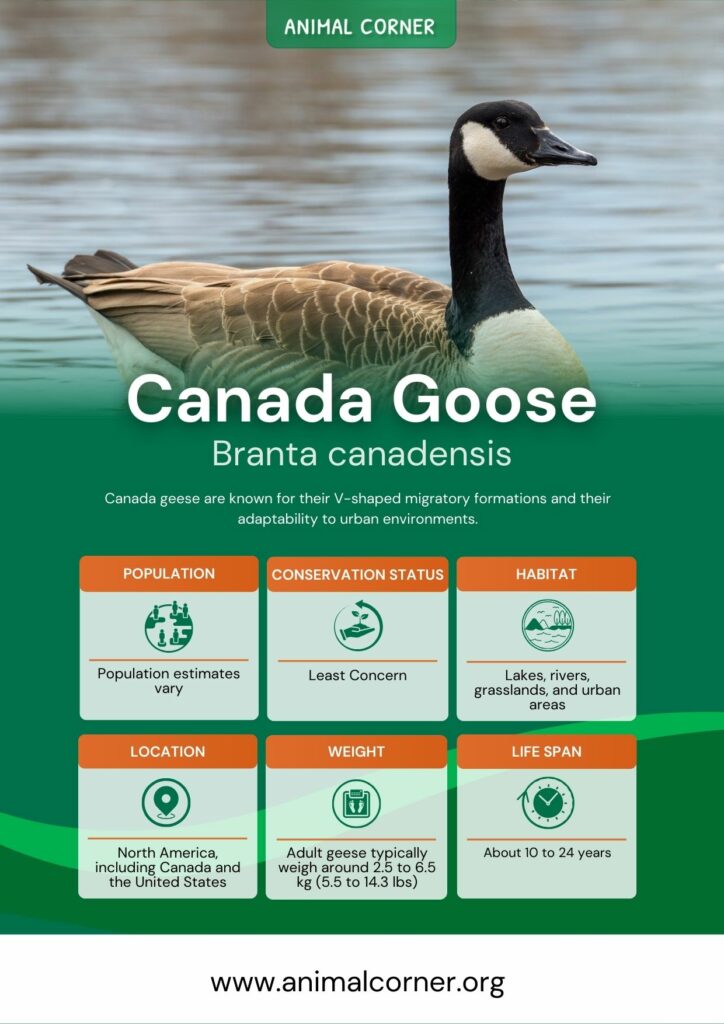
Size and Physical Variation
The Canada Goose is a notably large bird, with adults typically measuring between 75 and 110 centimetres in length and weighing anywhere from 3 to 9 kilograms. There is considerable size variation across the species, as Canada Geese are divided into several subspecies that differ quite markedly from one another. The larger subspecies found in northern Canada and parts of the United States are among the heaviest waterfowl on the continent, while smaller subspecies, sometimes referred to as Cackling Geese, are considerably more compact and were only reclassified as a separate species relatively recently.
The wingspan is broad and powerful, ranging from around 127 to 185 centimetres, which gives the bird its strong, sustained flight. Despite their size, Canada Geese are capable of covering enormous distances during migration, and their endurance in the air is impressive for a bird of their bulk.
Habitat and Distribution
The Canada Goose is one of the most widely distributed waterfowl species in North America. It breeds across a vast range stretching from the Arctic tundra of northern Canada and Alaska down through the temperate regions of the United States. Outside of the breeding season, large numbers move southward, wintering along the Atlantic and Pacific coasts, across the interior lowlands and into the northern reaches of Mexico.
In recent decades, a significant proportion of Canada Goose populations in the United States have become year-round residents rather than migratory birds. The availability of manicured grassland, parkland, golf courses and urban water bodies has created ideal conditions for the species to remain in one location throughout the year. This has contributed to a substantial increase in population numbers in many areas.
In Europe, Canada Geese were introduced from North America as ornamental birds on private estates during the 17th century. Their descendants have since established self-sustaining wild populations across the United Kingdom, Scandinavia, the Netherlands and parts of Germany. They are now a familiar sight on rivers, reservoirs, gravel pits and lowland lakes throughout much of northwestern Europe.
Behaviour and Social Structure
Canada Geese are highly social birds and are rarely found alone outside of nesting season. They gather in flocks that can range from a handful of individuals to several thousand, particularly during winter and migration. The iconic V-shaped formation seen during flight is not merely a visual spectacle but serves a practical purpose. Birds flying behind the leader benefit from the upwash of air created by the wingtip of the bird ahead, reducing the energy needed to maintain flight. The lead position rotates among flock members, distributing the effort more evenly across the group.
On the ground, Canada Geese can be assertive and territorial, particularly during the breeding season. Both males and females will defend their nesting area vigorously against perceived threats, and confrontations with other birds, animals and occasionally humans are not uncommon near popular nesting sites. Their loud honking call serves as both a warning signal and a means of communication within the flock.
Breeding and Nesting
Canada Geese typically pair for life, forming bonds that may last many years. Breeding usually begins in spring, with pairs returning to the same nesting area year after year. The female selects the nest site and constructs a shallow bowl of plant material lined with down feathers, usually positioned close to water on a raised bank, island or artificial platform.
Clutch size is typically between two and eight eggs, which the female incubates for around 25 to 28 days while the male stands guard nearby. Once hatched, the goslings are covered in yellow and grey down and are able to walk and swim within hours of leaving the egg. Both parents remain attentive and protective throughout the early weeks, and family groups stay together through the first autumn migration. Young birds from the same year often remain loosely associated with their parents into the following breeding season, gradually becoming independent as they reach maturity at around two to three years of age.
How Long Do Canada Geese Live For?
In the wild, Canada Geese have a lifespan of between 10 to 24 years.
Sources & References
- IUCN Red List — Branta canadensis
- Animal Diversity Web — Branta canadensis
- Wikipedia — Branta canadensis
Cite This Page
APA
Joanne Spencer (2026, April 15). Canada Goose. Animal Corner. Retrieved 2026, May 4, from https://animalcorner.org/animals/canada-goose/
MLA
Joanne Spencer. "Canada Goose." Animal Corner, 2026, April 15, https://animalcorner.org/animals/canada-goose/.
Click to copy